Singapore 3-Day Itinerary: The Complete First-Timer Route & Neighborhood Guide
A realistic 3-day Singapore itinerary covering Marina Bay, Chinatown hawker stalls, colonial landmarks, and tailored options for Sentosa or heritage districts.


Three days in Singapore hits the sweet spot for a first-time trip. With seventy-two hours on the ground, you have sufficient time to take in the dramatic architecture of Marina Bay, wander the shophouse-lined streets of Chinatown, eat your way through world-renowned hawker centres, and dedicate a full third day to either cultural enclaves or island entertainment. Because Singapore is geographically compact and anchored by an efficient transit network, you can experience a rich variety of urban landscapes without spending your holiday stuck in transit.
If your schedule is tighter, our 2-day Singapore itinerary condenses the core architectural and culinary highlights into a weekend sprint. Travelers with extra time can expand into the 5-day Singapore itinerary to include wildlife reserves and world-class museums, or settle into the 7-day Singapore itinerary for a relaxed pace with dedicated neighborhood exploration.
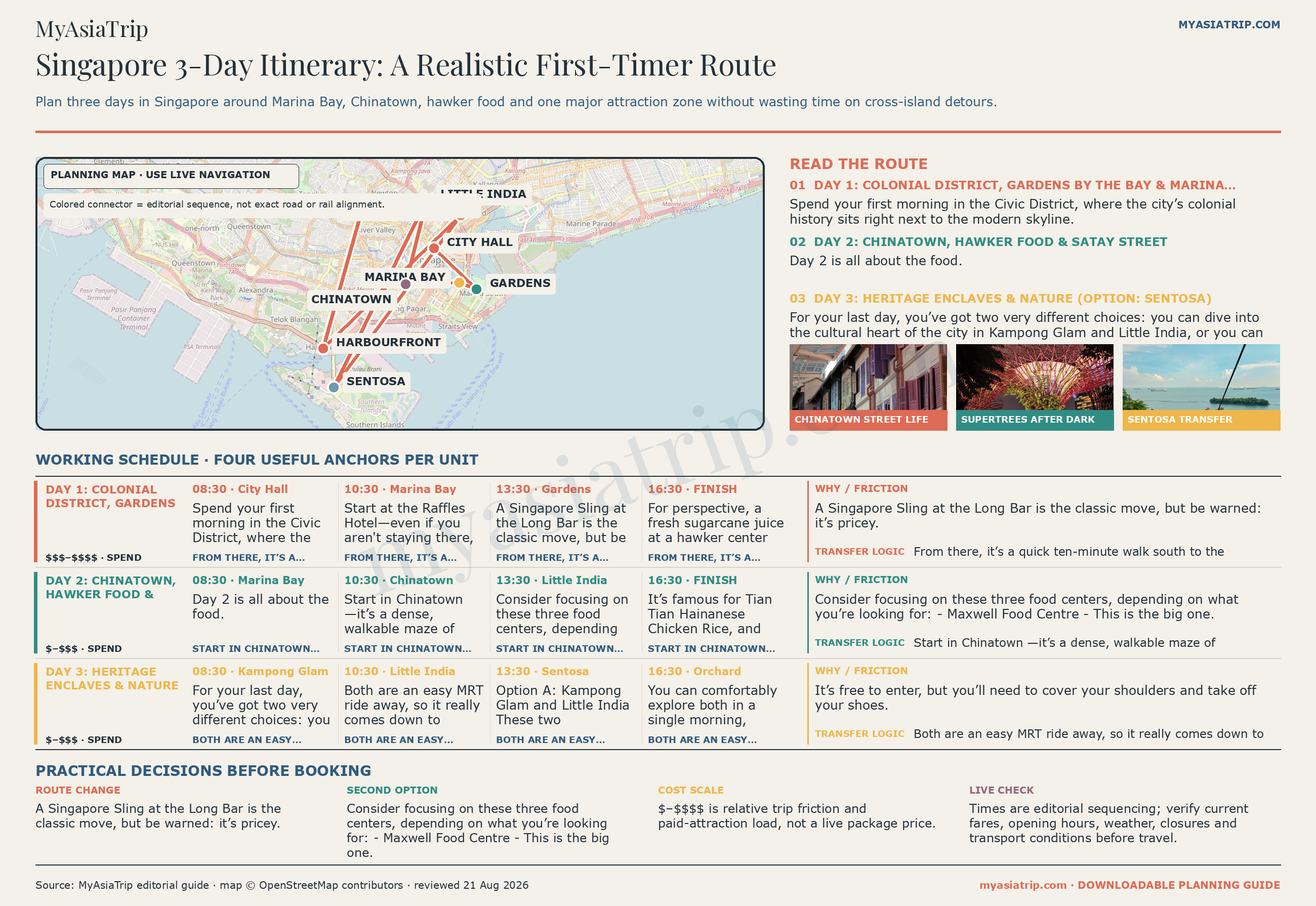
Three-Day Route at a Glance
The schedule assumes a full first day and a late flight on the final day. An afternoon arrival replaces that day’s morning block; an earlier departure replaces the final afternoon or evening. Hotel check-in, luggage collection and airport transfers sit outside the sightseeing blocks. An airline’s required airport-arrival time takes priority over optional Jewel or city stops.
This itinerary groups sights by geographic proximity and daily rhythm, matching outdoor walking to the cooler morning and evening hours while reserving the hottest midday stretch for air-conditioned galleries, conservatories, and dining halls.
| Day | Primary Focus Area | Core Highlights | Midday Food / Indoor Break | Evening Finale |
|---|---|---|---|---|
| Day 1 | Civic District & Marina Bay | Raffles Hotel, Singapore River, Merlion Park, Gardens by the Bay | Flower Dome & Cloud Forest Conservatories | Garden Rhapsody Supertree Light Show & Bayfront Promenade |
| Day 2 | Chinatown & Downtown CBD | Buddha Tooth Relic Temple, Sri Mariamman Temple, Telok Ayer Shophouses | Chinatown Complex & Maxwell Hawker Centres | Lau Pa Sat Satay Street & Clarke Quay Nightlife |
| Day 3 | Tailored Branch (Heritage, Island, or Nature) | Option A: Kampong Glam & Little India Option B: Sentosa Island & Beaches Option C: Botanic Gardens & Orchard Road | Air-conditioned shopping galleries, museums, or beach pavilions | Marina Bay Sands SkyPark or evening dining by the Singapore River |
Before starting your journey, secure a centrally located base using our Singapore neighborhood & hotel guide, review our overview on getting around Singapore via public transit, and browse the comprehensive Singapore food guide to familiarize yourself with staple local dishes.
Day 1: Civic District Heritage, Merlion Park & Gardens by the Bay

Your opening day traces the architectural evolution of Singapore, starting from the 19th-century colonial landmarks along the Singapore River and finishing among the futuristic vertical gardens and glass biomes of Marina Bay.
[Morning: City Hall MRT]
       │
       ▼
[Raffles Hotel Courtyards & Civic District Walk]
       │
       ▼
[Singapore River Promenade & Merlion Park]
       │ (10-min walk across Jubilee Bridge to Esplanade)
       ▼
[Afternoon: Gardens by the Bay (Cloud Forest & Flower Dome)]
       │
       ▼
[Supertree Grove & Free 7:45 PM Garden Rhapsody Light Show]
       │
       ▼
[Evening: Waterfront Promenade Walk & Marina Bay Sands]
Morning: Colonial Landmarks and the Singapore River Walk
Begin around 9:00 AM at City Hall MRT station, stepping directly into the heart of the historic Civic District. This quarter preserves Singapore’s earliest municipal architecture against a backdrop of towering financial skyscrapers.
- Raffles Hotel Courtyards: Walk through the open-air colonial arcades, lush cast-iron fountains, and manicured courtyards of this legendary 1887 heritage hotel. While ordering a Singapore Sling at the historic Long Bar is a famous ritual, expect premium cocktail pricing (check the current menu for pricing and applicable charges); the public palm-fringed courtyards and heritage shopfronts are free to explore.
- National Gallery Singapore & The Padang: Head south across the open green expanse of the Padang toward the National Gallery Singapore, housed inside the beautifully restored former Supreme Court and City Hall buildings. Even if you do not purchase a general admission ticket for the Southeast Asian art exhibitions, entering the public atrium allows you to admire the glass-and-steel roof bridging the two historic structures.
The UOB Southeast Asia Gallery is temporarily closed until late 2027; other exhibitions remain open. The gallery’s visitor information lists the available collections and opening hours.
- Singapore River to Merlion Park: Follow the river promenade past the historic Asian Civilisations Museum and the bronze statues depicting early river traders and coolies near Cavenagh Bridge. Continue around the river mouth to Merlion Park. The iconic 8.6-meter water-spouting statue stands directly across the bay from the Marina Bay Sands resort, offering one of the most recognizable panoramic skyline photo opportunities in Southeast Asia.
┌──────────────────────────────────────────────────────────┐
│             Marina Bay Walking Geography                 │
│                                                          │
│  [Merlion Park] ──(Jubilee Bridge)──> [Esplanade Theatres]
│                                              │           │
│                                      (Helix Bridge)      │
│                                              │           │
│  [Marina Bay Sands] <────────────────────────┘           │
│         │                                                │
│  (Lions Bridge Walkway)                                  │
│         │                                                │
│         ▼                                                │
│  [Gardens by the Bay Conservatories & Supertree Grove]   │
└──────────────────────────────────────────────────────────┘
Geography Note: Merlion Park and Gardens by the Bay sit on opposite sides of the Marina Bay water basin. Walking between them can take 40–60 minutes to the conservatories once the Jubilee Bridge, Helix Bridge and the walk inside the gardens are included. When traveling with children or during peak midday heat, taking a taxi or a Downtown Line ride of two stops from Telok Ayer or one stop from Downtown to Bayfront Station conserves energy.
Afternoon: Cloud Forest and Flower Dome at Gardens by the Bay

Cross the pedestrian Helix Bridge—inspired by the structure of DNA—or ride the MRT to Bayfront Station to reach Gardens by the Bay. Spanning 101 hectares of reclaimed waterfront land, this horticultural park is divided into free outdoor public gardens and ticketed indoor conservatories.
       ┌─────────────────────────────────────────┐
       │   Gardens by the Bay: Area Structure    │
       └────────────────────┬────────────────────┘
                            │
            ┌───────────────┴───────────────┐
            ▼                               ▼
   [Free Public Grounds]           [Ticketed Attractions]
   • Supertree Grove               • Cloud Forest (35m Waterfall)
   • Dragonfly & Kingfisher Lakes  • Flower Dome (Subtropical flora)
   • Heritage & Sun Gardens        • OCBC Skyway (Outdoor walkway)
- Cloud Forest: Enter this misty, temperature-controlled glass conservatory housing a 35-meter-tall man-made mountain cloaked in orchids, pitcher plants, and ferns. A walkway ascends inside the mountain and loops down through aerial walkways suspended beneath the structural glass ribs, wrapped around the 35-meter indoor waterfall.
- Flower Dome: The companion conservatory holds the Guinness World Record as the largest glass greenhouse in the world. It replicates the cool, dry climate of Mediterranean and semi-arid subtropical regions, featuring ancient olive trees, baobabs, and rotating seasonal floral displays.
- Timing & Visiting Logistics: Plan to spend roughly 2.5 hours total across both conservatories. The domes are kept at cool temperatures that vary by conservatory and zone, making them an ideal refuge during the afternoon heat. Check the official Gardens by the Bay website prior to arrival for monthly maintenance closure dates, as the closure dates vary by dome and month.
Evening: Supertree Grove Light Show and Waterfront Promenade
As twilight settles around 7:00 PM, head into the central Supertree Grove. These twelve towering vertical garden structures stand between 25 and 50 meters tall, wrapped in over 160,000 plants representing more than 200 species.
- Garden Rhapsody Light and Sound Show: Every evening at 7:45 PM and 8:45 PM, the Supertrees come alive in a choreographed musical light display lasting approximately 15 minutes. The show is completely free; arrive 15 minutes early to grab a spot on the lawns or benches beneath the central towers.
Special ticketed events may change access to Supertree Grove; the official show calendar lists exceptions.
- Marina Bay Sands Boardwalk: After the show, walk through the Lions Bridge connection into The Shoppes at Marina Bay Sands and out onto the waterfront event plaza. Stroll along the timber boardwalk to catch the reflections of the financial district skyscrapers shimmering across the water, rounding out your first evening with a casual meal at the indoor food halls or nearby waterfront bistros.
Day 2: Chinatown Shophouses, Hawker Food & Historic Waterfront
Day 2 shifts focus to Singapore’s rich culinary traditions and ethnic heritage, centered around the historic enclave of Chinatown and the bustling food halls of the central business district.
[Morning: Chinatown MRT] ──> [Buddha Tooth Relic & Sri Mariamman Temples]
                                       │
                                       ▼
[Lunchtime: Hawker Crawl at Maxwell / Chinatown Complex / Hong Lim]
                                       │
                                       ▼
[Afternoon: National Gallery Singapore / Fort Canning Park Walk]
                                       │
                                       ▼
[Evening: Satay Street at Lau Pa Sat & Clarke Quay Riverfront]
Morning: Temples and Heritage Streets of Chinatown
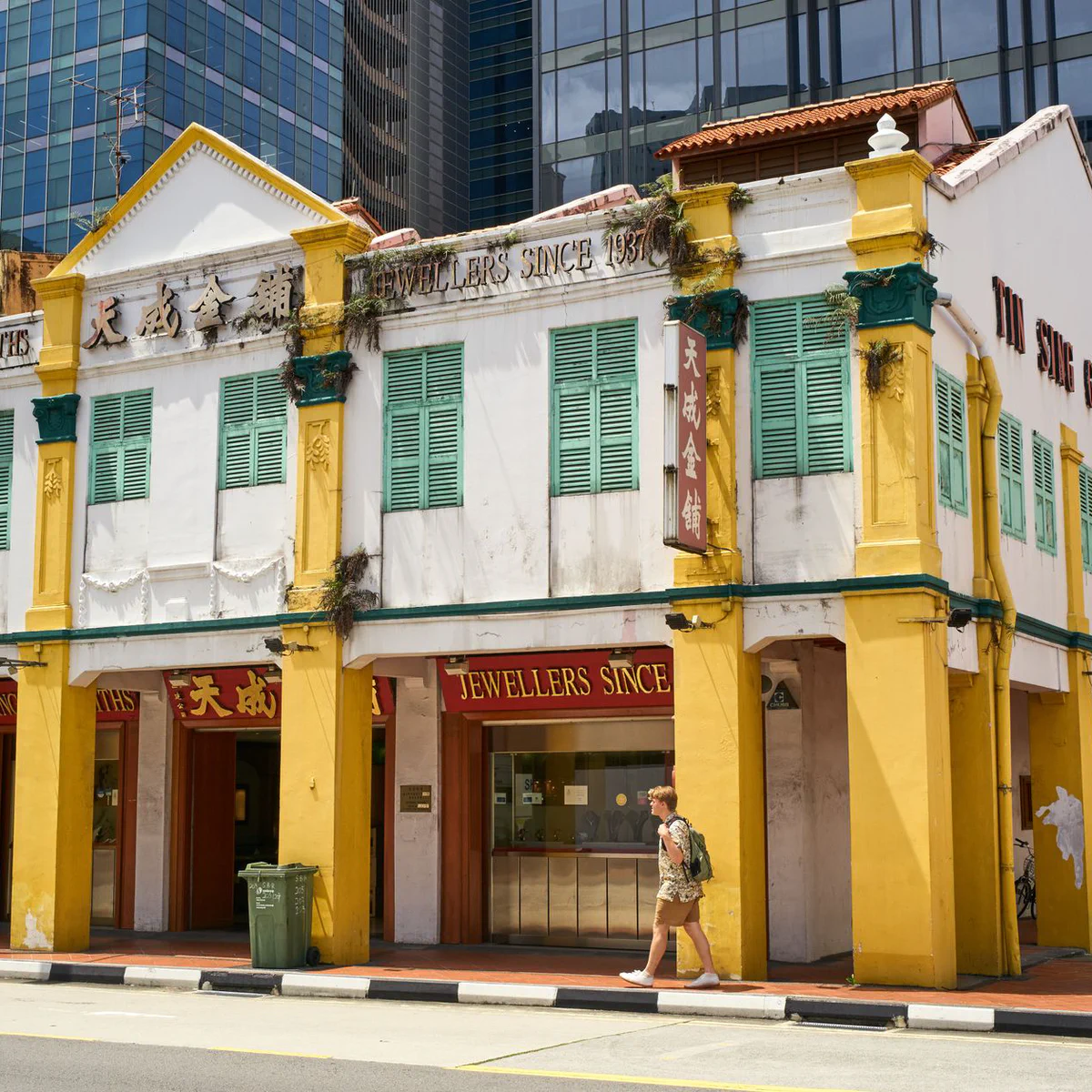
Exit at Chinatown MRT (North East or Downtown Line) onto Pagoda Street, where restored two- and three-story 19th-century shophouses feature distinctive timber louvred shutters and pastel facades.
- Sri Mariamman Temple: Located on South Bridge Road, this is Singapore’s oldest Hindu temple, founded in 1827. The exterior gopuram (entrance tower) is intricately sculpted with multi-tiered figures of deities, mythological beasts, and warriors. Visitors are welcome to enter free of charge (shoes must be removed at the entrance, and modest attire covering shoulders and knees is required).
- Buddha Tooth Relic Temple and Museum: Just two blocks south stands this striking four-story Buddhist temple built in the Tang dynasty architectural style. The ground floor prayer hall features rich red lacquer woodwork and thousands of golden miniature Buddha statues, while the upper floors house a quiet rooftop orchid garden with a Tibetan prayer wheel and a museum displaying sacred Buddhist relics.
- Telok Ayer & Ann Siang Hill: Wander through the quieter backstreets of Ann Siang Hill and Club Street, where historic clan association buildings have transformed into independent cafes, design studios, and boutique bakeries. Continue down to Telok Ayer Street to view the Thian Hock Keng Temple, one of Singapore’s oldest Hokkien temples, completed in 1842 without a single iron nail.
Lunch: Choosing Your Chinatown Hawker Centre
Singapore’s UNESCO-inscribed hawker culture is best experienced across the varied food centres clustered around Chinatown. Each centre offers a distinctive atmosphere and specialty stalls:
┌────────────────────────────────────────────────────────────────────────┐
│                      Chinatown Hawker Comparison                       │
├──────────────────────┬─────────────────────────┬───────────────────────┤
│ Hawker Centre        │ Atmosphere & Character  │ Signature Dishes      │
├──────────────────────┼─────────────────────────┼───────────────────────┤
│ Maxwell Food Centre  │ High ceiling, popular   │ Hainanese Chicken     │
│                      │ with first-time visitors│ Rice, Fuzhou Oyster   │
│                      │ and clear signage       │ Cakes, Tapioca Cake   │
├──────────────────────┼─────────────────────────┼───────────────────────┤
│ Chinatown Complex    │ Large food-stall      │ Claypot Rice, Liao    │
│ Food Centre          │ market; authentic wet   │ Fan Soya Sauce        │
│                      │ market feel downstairs  │ Chicken, Chee Cheong  │
├──────────────────────┼─────────────────────────┼───────────────────────┤
│ Hong Lim Complex     │ Bustling weekday haunt  │ Outram Park Char Kway │
│ Food Centre          │ for local office crowds │ Teow, Ji Ji Wanton    │
│                      │ and noodle specialists  │ Noodles, Curry Mee    │
└──────────────────────┴─────────────────────────┴───────────────────────┘
- Maxwell Food Centre: The most approachable starting point for beginners. Tian Tian Hainanese Chicken Rice draws long queues for its fragrant poached chicken and gelatinous, seasoned rice, though neighboring stalls like Ah Tai Chicken Rice serve comparable quality with shorter wait times. Budget S$5–8 per meal.
- Chinatown Complex Food Centre: Situated on the second floor above an active traditional wet market, this labyrinthine complex is the largest hawker centre on the island. It is ideal for adventurous eaters looking to sample charcoal-cooked claypot chicken rice, traditional Cantonese desserts, and fresh sugar cane juice.
- Hong Lim Market & Food Centre: Located closer to Chinatown Point, Hong Lim is celebrated for specialty noodles. Stalls here routinely earn Michelin Bib Gourmand nods, catering heavily to local workers during the midday rush.
For deeper insights into navigating stall etiquette and payment methods, review our dedicated guide to Singapore hawker centres.
Afternoon: Civic Greenery at Fort Canning or Museum Galleries
During the peak afternoon heat (1:30 PM to 4:30 PM), choose between shaded historic parkland or high-ceilinged museum galleries:
- Fort Canning Park: Ascend the escalators from Fort Canning MRT station to explore this historic hilltop that once served as the seat of 14th-century Malay royalty and later as the British military command headquarters during World War II. Walk the shaded Spice Garden and visit the Battlebox bunker. Wheelchair access is via the drop-off at Cox Terrace roundabout, according to NParks; other paths include slopes and steps.*
- National Gallery Singapore or Peranakan Museum: If heavy rain sets in or you prefer indoor cultural exhibits, head to the nearby Peranakan Museum on Armenian Street, dedicated to the unique hybrid cultural heritage, porcelain, and beadwork of the Straits Chinese communities.
Evening: Satay Street at Lau Pa Sat and Clarke Quay
As evening approaches, walk east into the heart of the financial district toward Lau Pa Sat, a Victorian cast-iron market pavilion built in the 1890s.
[Satay Street: weekdays 19:00 / weekends 15:00]
                     │
                     ▼
[Smoky Open-Air Charcoal Satay Stalls Set Up on Asphalt]
                     │
                     ▼
[Platters of Chicken, Mutton & Prawn Skewers with Peanut Sauce]
                     │
                     ▼
[Post-Dinner walk north to the river, then upstream to Clarke Quay]
- Satay Street (Boon Tat Street): On weekdays from 7:00 PM (weekends from 3:00 PM), Boon Tat Street immediately adjacent to Lau Pa Sat is closed to vehicular traffic. Stallholders wheel out charcoal grills and unfold plastic tables directly onto the street. Order a mixed set of chicken, beef, and tiger prawn satay skewers served with spiced peanut gravy, cucumber chunks, and pressed rice cakes (ketupat). Expect to pay S$15–30 for a generous sharing platter.
- Clarke Quay Riverside Walk: After dinner, walk north to the Singapore River and then upstream to Clarke Quay, allowing roughly 25–35 minutes from Lau Pa Sat. The restored 19th-century riverside godowns (warehouses) are lit with colorful canopies and house lively bars, live music venues, and river cruise jetties. For adrenaline seekers, the Slingshot ride catapults passengers 70 meters into the air over the riverfront (check operator height and safety guidelines on-site).
Day 3: Tailored Final Day — Heritage Enclaves, Sentosa Island, or Nature

For your final day, select one of three dedicated routes depending on your group’s travel style. Avoid attempting to combine Sentosa with the heritage enclaves on the same day, as both demand meaningful travel time and energy.
                         ┌─────────────────────────────┐
                         │   Choose Your Day 3 Route   │
                         └──────────────┬──────────────┘
                                        │
     ┌──────────────────────────┼──────────────────────────┐
     ▼                          ▼                          ▼
[Option A: Heritage]       [Option B: Island]         [Option C: Nature/Retail]
• Kampong Glam             • Sentosa Cable Car        • Botanic Gardens
• Sultan Mosque            • Universal Studios        • National Orchid Garden
• Little India             • Singapore Oceanarium          • Orchard Road Shopping
• Tekka Centre             • Siloso/Palawan Beach     • Dempsey Hill Dining
Option A: Cultural Heritage Enclaves of Kampong Glam & Little India
This route connects Singapore’s historic Malay-Arab trading district with the vibrant streets of Little India, easily linked via the Downtown and North East MRT lines.
[Morning: Bugis MRT] ──> [Kampong Glam & Sultan Mosque] ──> [Haji Lane]
                                                                │
                                   (20–30-min walk or 2-stop MRT)  ▼
[Afternoon: Little India MRT] ──> [Tekka Centre] ──> [Sri Veeramakaliamman]
- Kampong Glam & Sultan Mosque: Start at Bugis MRT and stroll down Arab Street to the gold-domed Sultan Mosque on Muscat Street. Completed in 1928, the base of the dome is framed by glass bottle ends donated by poor Muslim residents during construction so that all community members contributed.
- Haji Lane Shophouses: Explore this narrow pedestrian alleyway lined with vibrant street murals, independent fashion boutiques, coffee roasters, and lifestyle stores.
- Lunch in Kampong Glam: Dine at a traditional Nasi Padang establishment along Kandahar Street, selecting from steamed rice accompanied by beef rendang, sambal squid, and braised jackfruit (sayur lodeh).
- Little India & Tekka Centre: Walk west, allowing roughly 20–30 minutes, or take the MRT to Little India Station. Step inside Tekka Centre, an energetic multi-ethnic market where ground-floor stalls serve fragrant mutton biryani, crisp roti prata with fish curry, and teh tarik (pulled milk tea).
- Temples & Streets: Walk up Serangoon Road to admire the intricate towers of the Sri Veeramakaliamman Temple, explore traditional flower garland stalls, and visit the colorful landmark Former House of Tan Teng Niah. Browse the multi-story Mustafa Centre, a legendary retail emporium stocking everything from spices and electronics to cosmetics.
Option B: Sentosa Island Entertainment & Coastal Escape
Universal Studios fills the daytime block. Singapore Oceanarium is an alternative anchor, leaving time for lunch and one beach or outdoor attraction; the lists below are choices, not a sequence of every stop.
If your priority is family theme parks, world-class marine life, or tropical beachfront relaxation, allocate the entire day to Sentosa Island.
- Getting to Sentosa: Take the MRT North East or Circle Line to HarbourFront Station. From VivoCity Mall, either walk across the shaded Sentosa Boardwalk (free pedestrian admission), ride the Sentosa Express monorail, or board the Mount Faber Cable Car for sweeping aerial views across the container port and southern straits.
- Universal Studios Singapore: Southeast Asia’s only Universal Studios park features themed zones including Sci-Fi City (Battlestar Galactica), Ancient Egypt (Revenge of the Mummy), and Far Far Away. Plan a full 5 to 6-hour visit, ideally booking admission passes in advance to bypass ticket booth lines.
- Singapore Oceanarium: Located within Resorts World Sentosa, this colossal marine park houses marine life across immersive habitats, anchored by the massive Open Ocean viewing tank filled with manta rays and zebra sharks.
- Sentosa Beaches: Free electric beach shuttles connect the island’s three primary sandy stretches:
- Siloso Beach: Active sports, beachfront bars, and coastal water activities.
- Palawan Beach: Family-oriented, featuring a suspension bridge leading to the southernmost point of continental Asia.
- Tanjong Beach: Relaxed, quieter atmosphere with upscale day clubs and serene swimming lagoons.
Option C: Singapore Botanic Gardens & Orchard Road Retail
For a relaxed blend of lush tropical botany and modern retail architecture, spend the morning at Singapore’s oldest garden before heading into the city’s premier shopping district.
- Singapore Botanic Gardens (UNESCO World Heritage Site): Take the Circle or Downtown Line directly to Botanic Gardens MRT station (North Gate) or the Thomson-East Coast Line to Napier Station (South/Tanglin Gate). Established in 1859, the gardens features ancient tropical rainforest remnants, swan lakes, and the acclaimed National Orchid Garden, which showcases an extensive collection of orchid species and hybrids (nominal entry fee required for the orchid pavilion).
- Orchard Road Shopping Mile: From Napier, take the Thomson-East Coast Line two stops to Orchard. From Botanic Gardens station, take the Downtown Line to Newton and change to the North South Line for Orchard. Walk through air-conditioned subterranean shopping complexes and flagship multi-story malls such as ION Orchard, Takashimaya at Ngee Ann City, and Design Orchard, showcasing home-grown Singaporean designers.
- Dempsey Hill Dining: In the evening, take a taxi ride to Dempsey Hill, a former British military barracks complex tucked into lush forest that now hosts acclaimed farm-to-table restaurants, microbreweries, and seafood restaurants serving black pepper crab.
Where to Stay for a 3-Day Visit
Because three days requires swift transit connections, choose a hotel within a 5-minute walk of an MRT interchange station. For comprehensive hotel evaluations and neighborhood breakdowns, read our full Singapore accommodation guide.
┌────────────────────────────────────────────────────────────────────────┐
│                   Neighborhood Selection for 3 Days                    │
├─────────────────┬──────────────────────────────────────────────────────┤
│ Neighborhood    │ Best Suited For & Strategic Advantages               │
├─────────────────┼──────────────────────────────────────────────────────┤
│ Bugis /         │ • Strategic central location on Downtown & East-West │
│ Bras Basah      │ • Walking access to Kampong Glam and Civic District   │
│                 │ • Broad range of mid-scale and boutique hotels       │
├─────────────────┼──────────────────────────────────────────────────────┤
│ Chinatown /     │ • Unbeatable access to premier hawker centres        │
│ Telok Ayer      │ • Excellent nightlife and dining options             │
│                 │ • Characterful heritage shophouse boutique hotels    │
├─────────────────┼──────────────────────────────────────────────────────┤
│ Marina Bay /    │ • Luxury waterfront hotels with iconic skyline views  │
│ Downtown        │ • Gardens access depends on hotel location        │
│                 │ • Higher nightly room rates                          │
├─────────────────┼──────────────────────────────────────────────────────┤
│ Orchard Road /  │ • Immediate proximity to retail malls and shopping   │
│ Tanglin         │ • Convenient access to Singapore Botanic Gardens     │
│                 │ • Traditional upscale international hotel chains     │
└─────────────────┴──────────────────────────────────────────────────────┘
Hotel rates fluctuate sharply with dates, events and room type. The Singapore travel cost guide provides budget context; live availability determines the actual nightly price.
Essential Travel Logistics & Transport Tips
Airport Arrival and Downtown Transfers
Arriving at Changi Airport puts you roughly 20 kilometers east of the city center.
- MRT (Subway): The airport station serves Terminals 2 and 3. Change at Tanah Merah for the East West Line or at Expo for the Downtown Line; Expo requires walking between platforms. Allow roughly 60–75 minutes to a central hotel including station access, waiting and the final walk, rather than treating the train ride as the complete transfer.
- Taxis & Ride-Hailing: Changi Airport quotes about 30 minutes and S$25–45 for a taxi to the city. Metered fares, airport and time-based surcharges, traffic, and ride-hail quotations can vary. App pickups use designated bays; see the airport’s transport information.
- For step-by-step route comparisons, consult our Changi Airport to city transit guide and our overview of Changi Airport terminals & Jewel.
Transit & Flight Layovers: If you are visiting Singapore during a flight layover, remember that Jewel Changi Airport is located landside (outside immigration). You must clear Singapore border control, collect luggage if necessary, and ensure you meet all entry and visa requirements. A city excursion depends on usable hours after immigration, both transfers and the airline’s airport-arrival requirement; our one-day and layover guide includes a worked time budget.
Public Transit and Contactless Payment
Singapore operates one of the most efficient, spotlessly clean, and reliable public transportation networks in the world.
- SimplyGo Contactless Payment: SimplyGo accepts supported contactless Visa and Mastercard cards, including eligible cards in Apple Pay or Google Pay. A foreign-issued Visa or Mastercard incurs a S$0.60 administration fee per day of use, separate from any issuing-bank charges. Tap in and out with the same card or device for each journey; a phone and its physical card count separately.
- MRT Operating Hours: Trains operate daily from approximately 5:30 AM until midnight. Frequency during peak hours is every 2 to 3 minutes, and 5 to 7 minutes off-peak.
- For detailed network maps and fare calculators, consult our guide to getting around Singapore.
Weather Rhythms and Practical Packing
Singapore sits just 137 kilometers north of the equator, experiencing a consistent tropical rainforest climate year-round with temperatures hovering between 25°C and 32°C (77°F–90°F) and humidity levels regularly exceeding 80%.
- Tropical Downpours: Brief, intense rainstorms can occur at any time of year, most commonly in the mid-afternoon. Carry a compact umbrella or lightweight rain jacket in your daypack.
- Indoor Air-Conditioning: Malls, museums, and MRT carriages maintain cold air-conditioning; keeping a light layer or overshirt handy prevents discomfort when transitioning indoors from the tropical heat.
- Hydration & Footwear: Tap water across Singapore is thoroughly purified, safe to drink, and meets WHO standards. Carry a reusable water bottle to refill throughout the day, and wear comfortable, breathable walking shoes suitable for covering 10,000 to 15,000 steps daily.
- Review our monthly climatic breakdown in the best time to visit Singapore guide when preparing your packing list.
Advance Booking Summary for a 3-Day Trip
To prevent long ticketing lines and ensure preferred entry timeslots, organize your advance reservations according to your selected Day 3 itinerary branch:
| Sight or Activity | Advance Booking Requirement | Strategic Recommendation |
|---|---|---|
| Gardens by the Bay Conservatories | Recommended 3–7 days in advance | Secures direct digital barcode entry for Cloud Forest and Flower Dome, bypassing ticket queues. |
| Universal Studios Singapore (Day 3 Option B) | Highly recommended 1–2 weeks ahead | Peak dates and school holidays regularly sell out or incur elevated gate pricing. |
| Singapore Oceanarium (Day 3 Option B) | Recommended 3–5 days ahead | Entry arrangements depend on the selected ticket; queues may still occur. |
| National Orchid Garden (Day 3 Option C) | Walk-up or on-site digital purchase | Generally accessible on-site without significant queues at the ticketing kiosks. |
| Marina Bay Sands SkyPark Observation Deck | Recommended for sunset slots | Evening and sunset admission slots (6:30 PM–7:30 PM) have strictly capped capacity. |
Trip Planning Checklist for 3 Days in Singapore
- Foreign visitors entering Singapore generally need a passport valid for at least six months and an SG Arrival Card submitted within the three-day window including arrival day. Airside transit passengers who do not clear immigration are exempt from SGAC; ICA also lists exemptions for Singapore residents entering through land checkpoints. The card is free and is not a visa. ICA entry requirements explain eligibility and exemptions; our Singapore entry guide covers the wider process.
- Book a centrally situated hotel in Bugis, Chinatown, or the Civic District via our where-to-stay recommendations.
- Confirm that your mobile payment cards (Apple Pay / Google Pay) are enabled for contactless overseas transit transactions.
- Purchase entry tickets for Gardens by the Bay and your chosen Day 3 attraction.
- Pack lightweight, moisture-wicking clothing, a compact umbrella, and a refillable water bottle.
Quick answers
Frequently asked questions
Is 3 days enough to see Singapore?
How do you get from Changi Airport to downtown Singapore?
Are the Supertree light shows free to watch?
What are the must-try hawker dishes for a 3-day trip?
Should I stay in Marina Bay, Chinatown, or Bugis for a 3-day trip?
Research notes
Official planning references
We use these primary references for the time-sensitive details relevant to this guide. Rules, prices and operating hours can change, so confirm the live information before you travel.
- ICA — SG Arrival Card
Details to check: Three-day window including arrival day, exemptions, free submission; card is not a visa. Checked 2026-09-10.
- Changi — Airport transport
Details to check: Airport rail transfers and indicative taxi journey/cost. Door-to-door buffers in the itinerary are planning estimates. Checked 2026-09-10.
- SimplyGo — Contactless bank cards
Details to check: Supported payment methods and S$0.60 daily foreign Visa/Mastercard administration fee. Checked 2026-09-10.
- LTA — Rail network
Details to check: Station/line relationships. Walking and transfer allowances are planning estimates. Checked 2026-09-10.
- Gardens by the Bay — Opening hours
Details to check: Conservatory closures, outdoor hours and Children’s Garden opening days. Checked 2026-09-10.
- Gardens by the Bay — Garden Rhapsody
Details to check: Standard light-show times and ticketed-event exceptions. Checked 2026-09-10.
- National Gallery — Visitor information
Details to check: 10:00 opening; UOB Southeast Asia Gallery closure until late2027; other exhibitions remain open. Checked 2026-09-10.
- NParks — Fort Canning Park
Details to check: Wheelchair access from Cox Terrace roundabout. Checked 2026-09-10.
- Singapore Botanic Gardens — Visitor information
Details to check: Entrance/station geography; additional walking within the gardens. Checked 2026-09-10.
- RWS — Singapore Oceanarium
Details to check: Current attraction name; removed inherited S.E.A. Aquarium animal/habitat counts. Checked 2026-09-10.
- RWS — Universal Studios Singapore
Details to check: Date-dependent hours and ride restrictions; use the suggested full-day allocation as a planning recommendation. Checked 2026-09-10.
- Marina Bay Sands — Family visits
Details to check: Spectra standard20:00/21:00 shows, Friday/Saturday additional22:00 show. Checked 2026-09-10.
- Lau Pa Sat — Satay Street
Details to check: Weekday19:00/weekend15:00 opening. Checked 2026-09-10.
- Meteorological Service Singapore — Climate
Details to check: Typical day/night temperature ranges, not a forecast. Checked 2026-09-10.
- Buddha Tooth Relic Temple — Directory
Details to check: Museum on third storey; relic chamber on fourth. Checked 2026-09-10.
Guide reviewed 10 September 2026. Confirm live rules, prices and operating details with the linked authority before travel.