Changi Airport Guide: Jewel, Attractions & Layovers
Complete guide to Singapore Changi Airport: explore Jewel, iconic indoor gardens, terminal art, dining, transit lounges, family play, and layover itineraries.


Singapore Changi Airport (IATA: SIN / ICAO: WSSS) is more than a place to wait for a flight. Local families come here to dine, walk beneath a glass dome and spend an afternoon at Jewel; travelers find gardens, kinetic art and quiet corners threaded through the terminals. That mixture of civic space, tropical planting and airport engineering is why Changi works as one of Singapore’s attractions in its own right.
The centrepiece is Jewel Changi Airport, a glass-and-steel dome designed by a team led by architect Moshe Safdie and built around the 40-metre HSBC Rain Vortex. Jewel is entirely landside, so transit passengers must be eligible to enter Singapore and clear immigration before visiting. The secure transit areas have their own appeal: butterflies, rooftop gardens, digital installations and rest spaces that do not require immigration. Changi also has screen-location value—an official IMDA and Singapore Tourism Board location list names it among the Singapore locations used for the season-four finale of Hacks.
The practical choice depends on your energy, entry eligibility and usable layover time. With two hours, stay near the departure gate; with five hours, Jewel becomes realistic; with a full day, you may have time for one carefully chosen city area. The sections below compare attractions, terminal transport, accessibility services, dining, lounges and the time each option actually requires.
Core Attractions Master Comparison
Changi’s attractions are divided between the public landside zone (dominated by Jewel) and the secure airside transit areas within Terminals 1 through 4. Use this matrix to evaluate location, ticketing, verified operating hours, accessibility considerations, and realistic visit durations.
| Attraction | Location & Zone | Admission | Operating Hours | Realistic Visit Time | Best For / Audience | Accessibility & Constraints | Planning Friction & Tips |
|---|---|---|---|---|---|---|---|
| HSBC Rain Vortex & Shiseido Forest Valley | Jewel (Landside, Central Core) | Free | Waterfall: 10:00–22:00 daily; Forest Valley: 24 hours | 45–75 mins | All travelers, photography, architecture enthusiasts | Paved multi-tier ramps, elevators; upper trails feature stone steps | Crowds peak during evening light shows; requires clearing immigration |
| Canopy Park (Discovery Slides, Foggy Bowls, Topiary Walk, Petal Garden) | Jewel Level 5 (Landside) | Standard admission S$8 | Mon–Thu 10:00–21:00; Fri–Sun, eve & PH 10:00–22:00 | 60–90 mins | Families with children, casual walkers | Individual play features have their own height, clothing and mobility rules | Last entry 30 mins before closing; check current rules before buying |
| Canopy Bridge, Mazes & Sky Nets | Jewel Level 5 (Landside) | Separate or bundle tickets | Follows Canopy Park hours | 45–90 mins | Older children, teens, active travelers | Height, footwear and mobility rules vary by attraction | Choose one or two rather than filling the whole layover |
| Changi Experience Studio | Jewel Level 4 (Landside) | Ticketed | Mon–Fri 11:00–20:00; Sat–Sun & PH 10:00–20:00 | 90–120 mins | Aviation fans and families (recommended ages 6+) | Interactive digital attraction; ask staff about current access support | Last admission 19:00 |
| Butterfly Garden | Terminal 3 (Airside, Departure Transit L2/L3) | Free | 24 hours daily | 20–35 mins | Nature lovers, solo travelers, families | Elevator access between levels; warm, humid tropical enclosure | Delicate mesh entrance doors; keep carry-on luggage light |
| Movie Theatre (T3) | Terminal 3 (Airside, Departure Transit L3) | Free | 24 hours daily (Closed Thu 11:00–16:00 for maintenance) | 60–120 mins | Weary transit passengers, film fans | Tiered theater seating; step-free wheelchair bays available | Screenings follow fixed schedules; seats fill quickly during peak hours |
| The Wonderfall & Dreamscape | Terminal 2 (Airside, Departure Transit L2) | Free | 24 hours daily | 15–30 mins | Visual art fans, relaxing layovers | Step-free viewing platforms and transparent garden walkways | Purely sensory/visual; excellent low-friction stop near T2 central gates |
| Sunflower Garden | Terminal 2 (Airside, Rooftop Departure L3) | Free | 24 hours daily | 15–25 mins | Photographers, plane spotters, fresh-air seekers | Accessible via elevator; outdoor wooden boardwalk | Unshaded and hot during midday sun; best visited at sunrise, dusk, or night |
| Kinetic Rain | Terminal 1 (Landside, Public Departure Hall L2) | Free | Check the live airport directory | 10–20 mins | Art and design fans | Viewed from the main public check-in concourse | A 1,216-droplet kinetic installation |
| Cactus Garden | Terminal 1 (Airside, Rooftop Departure L3) | Free | 24 hours daily | 20–35 mins | Plant lovers, open-air cocktail unwinding | Open-air rooftop with ramp access; adjacent to bar | High daytime heat and humidity; pleasant breezy atmosphere after dark |
| Heritage Zone & Chandelier | Terminal 4 (Airside, Departure Transit L2) | Free | 24 hours daily | 20–40 mins | Culture enthusiasts, active children | Accessible viewing of Peranakan shophouse LED show; Chandelier requires 110 cm | T4 is physically detached; requires bus transfer from T1–T3 |
The Jewel Complex: Architecture, Waterfalls, and Canopy Play
Jewel blurs the line between a public garden, shopping complex and transport hub. Its glass-and-steel roof draws daylight deep into the building, while paths curl around the central waterfall rather than treating it as a single viewing stop.

The HSBC Rain Vortex & Shiseido Forest Valley
At the centre of Jewel, the HSBC Rain Vortex drops 40 metres through the roof opening into the lower levels. The surrounding Shiseido Forest Valley turns the approach into a layered garden walk, with different views of the water from each floor.
- Water Flow Hours: The waterfall operates reliably from 10:00 to 22:00 daily.
- Light & Music Showcase: Set against the roaring curtain of mist, choreographed light and sound projections run every evening:
- Monday to Thursday: Shows at 20:00 and 21:00.
- Friday to Sunday, Eve of Public Holidays, and Public Holidays: Shows at 20:00, 21:00, and 22:00.
- Viewing Strategy: Level 1 offers an immediate, sensory encounter where you can feel the fine cool spray and hear the acoustic rumble. Levels 2 through 4 provide panoramic vantage points framing the architecture, while the basement acrylic funnel presents a mesmerizing, turbulence-free vortex whirlpool.
Canopy Park and Ticketed Attractions (Level 5)
On Level 5 beneath the glass canopy, Canopy Park combines landscaped walks with family play and separately ticketed activities.
- Operating Hours: Open Monday to Thursday from 10:00 to 21:00; Friday to Sunday, public holidays, and eves of public holidays from 10:00 to 22:00 (last admission is strictly 30 minutes before closing).
- Standard Admission (S$8): Includes access to the Discovery Slides (a sculptural four-tiered playground and viewing platform), Foggy Bowls (concave grassy hollows emitting cooling clouds of gentle mist), the manicured Petal Garden, and the whimsical animal displays of the Topiary Walk.
- Specialized Play Features (Separate or Bundle Tickets): Canopy Bridge, Hedge Maze, Mirror Maze and the Walking or Bouncing Sky Nets can be added separately. Prices and availability vary.
- Safety and Attire Requirements: Height, age, footwear and mobility rules differ by attraction. Check the official booking page before choosing a bundle, especially for young children.
Changi Experience Studio (Level 4)
Located on Level 4, the Changi Experience Studio is an aviation-themed digital attraction with interactive games, historical exhibits and simulations.
- Operating Hours: Open Monday to Friday from 11:00 to 20:00; Saturday, Sunday, and public holidays from 10:00 to 20:00 (last admission is at 19:00).
- Interactive Experience: The rooms turn airport operations and Changi’s history into projection-based games and simulations, including baggage handling and a runway race.
- Audience Suitability: The official recommendation notes the attraction is best suited for adults, aviation enthusiasts, and children aged 6 and above who can comfortably interact with the touchpoints and projection games. Budget roughly 90 to 120 minutes for a complete walkthrough.

Terminal-by-Terminal Art, Gardens, and Airside Highlights
Travelers remaining airside have complimentary gardens, art and rest amenities across the departure transit halls. Check your departure terminal first: T1, T2 and T3 connect by a separate transit Skytrain, while T4 requires a shuttle and more time.
Terminal 1: Kinetic Elegance and Desert Flora
- Kinetic Rain (Public Departure Hall, L2): This 1,216-droplet kinetic installation moves through changing forms above the check-in hall. It is landside, so airside transit passengers cannot reach it without clearing immigration.
- Cactus Garden (Transit Rooftop, L3): An open-air collection of cacti and other arid plants with views toward airport operations. Open 24 hours daily; midday heat can be tiring.
- Piazza Garden (Transit L2): A tranquil indoor green pocket near central departure pathways featuring seasonal floral displays and native botanical groupings.
Terminal 2: Digital Cascades, Underwater Flora, and Sunflowers
- The Wonderfall (Transit L2): A large LED waterfall framed by vertical planting, with periodic musical sequences.
- Dreamscape (Transit L2): A garden with a changing digital sky and transparent walkways over water.
- Sunflower Garden (Transit Rooftop, L3): An outdoor terrace for flowers, daylight and aircraft views. It is open 24 hours daily, but the exposed space can feel hot at midday.
- Calm Room (Transit L2): A quieter biophilic room for passengers who need lower sensory stimulation. It operates 24 hours, with window closures scheduled from 02:00 to 05:00.
Terminal 3: Tropical Butterflies, Cinema, and Architectural Louvers
- Butterfly Garden (Transit L2/L3): A warm, two-storey tropical enclosure with flowering plants, a grotto waterfall and breeding displays. Open 24 hours daily; leave a little time for your glasses or camera lens to adjust to the humidity.
- Complimentary Movie Theatre (Transit L3): A dedicated cinema screening international blockbuster and family films continuously around the clock. Admission is completely free on a walk-in basis.
- Operating Schedule: 24 hours daily, with a regular weekly maintenance closure on Thursdays between 11:00 and 16:00.
- Daylight-Harvesting Roof Architecture: T3’s roof uses skylights and adjustable louvers to bring in daylight while controlling tropical heat, one reason the vast hall feels brighter than a conventional terminal.
Terminal 4: Heritage Peranakan Culture and Kinetic Sculptures
- Heritage Zone (Transit L2): Peranakan-style shophouse façades conceal a digital theatrical display, giving a short cultural pause between shops and gates.
- Steel in Bloom & Chandelier: One combines metalwork, plants and light; the other is an active climbing-and-slide installation. Check current height and supervision rules before children enter.
Family Travel Routes and Accessibility Infrastructure
Changi has child-friendly amenities and mobility support, but the building is still large. Families should plan one terminal cluster rather than crossing the airport repeatedly; travelers needing continuous assistance should arrange it before flying.
Curated Family Itineraries
- The Low-Friction Airside Family Loop (2–3 Hours, No Immigration):
- Pick up a complimentary airport loan stroller at any terminal information counter (subject to availability).
- Head to Terminal 3 Transit Level 2 to explore the Butterfly Garden. Children can observe emerging pupae in the glass hatching boxes.
- Walk or take the transit Skytrain to Terminal 2 Transit Level 2 to view The Wonderfall and stroll across the transparent bridges of Dreamscape.
- Let children unwind in one of the dedicated, padded children’s play zones located airside in T1, T2, and T3 before boarding.
- The Active Jewel Adventure Route (5–7 Hours, Landside Entry):
- Clear immigration and store heavy carry-ons at the 24-hour Left Baggage counter on Jewel Level 1.
- Head to Level 5 Canopy Park. Young toddlers will love running through the cool mist clouds of the Foggy Bowls, while children taller than 110 cm can tackle the Discovery Slides and the Hedge Maze.
- Transition to Level 4 for the interactive games at Changi Experience Studio, concluding with an early dinner in the Jewel B2 food hall before re-entering security.
Accessibility, Wheelchairs, and Sensory Support
Changi Airport implements physical accessibility throughout its concourses, though travelers should be aware of operational boundaries:
- Airline Wheelchair Assistance: Passengers requiring continuous, dedicated porter assistance between check-in, gates, and aircraft connections must request this through their airline at least 48 hours prior to scheduled departure. Airline-appointed special assistance staff manage transfers directly through departure gates.
- Complimentary Self-Assist Wheelchairs: Manual wheelchairs are available first-come at terminal Information Counters and Jewel Concierge desks; ask at the nearest counter for the current collection point.
- Special Assistance Lanes: Changi provides assistance lanes for passengers using mobility aids and for families with young children. Airport staff can direct you to the relevant lane at immigration or security.
- The T2 Calm Room: Located within the Terminal 2 transit zone, this dedicated space provides a controlled, quiet environment with soft lighting and tactile furnishings to assist neurodivergent passengers, autistic travelers, or anyone experiencing severe travel-induced sensory fatigue.
- Physical Barriers & Cautions: Avoid assuming every leisure feature is universally barrier-free. Upper natural stone pathways within the Shiseido Forest Valley feature rustic steps, and the Manulife Sky Nets and high slides inside Canopy Park are physically unsuitable for wheelchair users and those with severe mobility impairments.
Food, Flavors, and Local Souvenirs
Dining and shopping at Changi range from quick local dishes to sit-down restaurants and duty-free retail. The practical question is whether you are airside or landside, because you cannot freely cross immigration just for a particular meal.
Local Dining: Airside vs. Landside
- Airside transit dining: Food courts and casual outlets across the terminals serve dishes such as chicken rice, laksa and noodles without immigration. Opening hours vary, so use the live airport directory for a late-night connection.
- Jewel Basement 2 (Landside): The broadest cluster of casual choices, useful when a group wants different dishes without committing to a long meal.
- Upper levels of Jewel (Landside): Better for a sit-down meal, but allow a queue buffer at conventional lunch and dinner peaks.
Souvenirs and Retail: What to Bring Home
Changi is exceptionally well-stocked for last-minute gifts, saving you the hassle of carrying parcels through the city:
- Pandan chiffon cake and Nyonya kueh: Fragrant cakes travel better on a short flight; check shelf life before buying.
- Kaya (coconut egg jam): A compact way to recreate a Singapore breakfast at home.
- Salted-egg snacks: Easy to pack and widely associated with contemporary Singapore snack culture.
- Sealed bak kwa (barbecued meat): Popular, but only sensible if your destination allows meat products. Always verify your final destination’s agricultural and biosecurity rules before buying meat or fresh food; many customs authorities restrict these products.
- Tax-Free Pre-Orders: Travelers can utilize the official iShopChangi portal to order cosmetics, electronics, and spirits tax-free up to 30 days prior to departure, picking up goods at designated collection counters airside. For real-time shop locations and operating hours, consult the live Changi Airport Shopping & Dining Directory.
Transit Lounges, Transit Hotels, and Rest Spaces
Managing fatigue during an international connection requires choosing between complimentary public snooze pods, pay-per-use airline lounges, or dedicated airside hotel rooms.
| What you need | Practical starting point | Immigration? |
|---|---|---|
| A short nap on a tight budget | Airside snooze lounge; first-come | No |
| A shower, food and workspace | Pay-per-use lounge in your terminal | Usually no; check the lounge zone |
| A proper bed during a long connection | Airside transit hotel in the correct terminal | No |
| A room while exploring Jewel | Landside hotel in or beside Jewel | Yes |
Pay-Per-Use Independent Lounges
Passengers traveling in economy or without airline elite tier status can purchase pay-per-use access to independent lounges across all terminals:
- Plaza Premium Lounge (Terminal 1 Airside, L3): Features private resting suites, workstations, private shower cubicles, and a live cooking counter serving hot bowls of signature Singapore laksa.
- Ambassador Transit Lounges (Terminals 2 & 3 Airside, L3): Dependable workhorse facilities equipped with hot buffet dining, workstations, and clean shower rooms.
- Changi Lounge (Jewel Level 4, Landside): Located directly opposite the early check-in counters, offering a tranquil, minimalist environment with shower facilities, nap pods, and light refreshments for travelers exploring Jewel.
Transit Hotels vs. Landside Hotels
- Airside Transit Hotels (No Immigration Required):
- Aerotel Singapore (Terminal 1 Transit, L3): Offers flexible hourly room bookings and features an open-air rooftop swimming pool and jacuzzi bar (free for hotel guests, accessible to other transit passengers for a nominal fee).
- Ambassador Transit Hotel (Terminals 2 & 3 Transit, L3): Short-stay rooms inside the transit area; verify the current operator, terminal and booking conditions before paying.
- Landside Transit Accommodation (Immigration Clearance Required):
- YOTELAIR Singapore Changi Airport (Jewel Level 4): Compact rooms beside Jewel; check current minimum-stay blocks. Immigration clearance is required.
- Crowne Plaza Changi Airport (Terminal 3 Landside): A full-service hotel connected to T3, better suited to an overnight stay than a short nap.
Complimentary Rest Zones and Showers
- Free Snooze Lounges: Reclined seating in transit rest zones is first-come, first-served and can fill during busy departure waves. Bring an eye mask and a light layer for the air conditioning.
- Showers: Complimentary public showers are not provided in the passenger terminals. Travelers wishing to freshen up without paying full lounge rates can book standalone shower packages (including bath towel, shampoo, and body wash) at the transit hotels or independent lounge reception desks.
Curated Booking Options and Practical Affiliates
When booking airport amenities in advance, your initial filter must always be terminal location and immigration zone access. Landside passes cannot be used if you lack the visa or time to clear border control, and airside lounges cannot be reached by passengers whose flights depart from detached or public zones.
| Changi Product / Service | Best Suited For | Location & Usable Window | Operational Friction & Trade-offs |
|---|---|---|---|
| Canopy Park with optional Sky Nets, Mazes or Bridge · Flexible Landside Stop | Travelers with 5+ hour layovers wanting 1–2 paid Jewel attractions | Jewel Level 5 (Landside); 1–3 hours | Check height minimums (110 cm) and shoe rules; ensure 2-hour return buffer for immigration |
| Jewel Family Multi-Attraction Combo Pass · Bundled Park Experiences | Families spending their primary layover exploring Jewel | Jewel Level 5 (Landside); 3–5 hours | Do not purchase more activities than your return security window safely accommodates |
| Terminal 1 Plaza Premium Lounge (3 or 6 Hours) · Hot Food & Private Showers | Transit passengers departing from or connected to Terminal 1 airside | Terminal 1 (Airside L3); 3–6 hour blocks | Boarding pass required; verify shower availability during peak evening arrival banks |
| Terminal 2 or 3 Ambassador Transit Lounge · Buffet & Shower Access | Transit passengers whose connecting flight boards in T2 or T3 | Terminals 2 or 3 (Airside L3); 3-hour slots | Select exact terminal when booking; verify physical location relative to your departure gate |
| Pre-Booked Private Airport-to-Hotel Transfer · Flight Tracking & Meet-and-Greet | Travelers ending their journey in Singapore arriving with heavy luggage | Door-to-door from all terminal Arrival Halls | Confirm passenger and luggage capacity; request child seats in advance during booking |
| Travel Scenario | Recommended Practical Approach |
|---|---|
| Under 4 Hours Connection | Stay strictly airside. Utilize complimentary gardens, free snooze lounges, or book an airside lounge in your departure terminal. |
| 4 to 6 Hours Connection (Eligible to enter Singapore) | Clear immigration to see the Rain Vortex and enjoy a sit-down meal in Jewel. Limit ticketed attractions to Canopy Park. |
| 6 to 10 Hours Connection (With Children) | Explore Jewel extensively (Canopy Park + Changi Experience Studio) or take the official Free Singapore Tour. |
| Overnight Connection (No Entry) | Reserve a block at Aerotel (T1) or Ambassador Transit Hotel (T2/T3) months in advance; do not rely on free snooze pods. |
| Final Destination Arrival (Late Night / Large Family) | Bypass public transit queues by pre-booking a private vehicle transfer or stepping directly into the metered taxi rank. |
Planning Your Layover: 2-Hour, 5-Hour, and 10-Hour Decision Frameworks
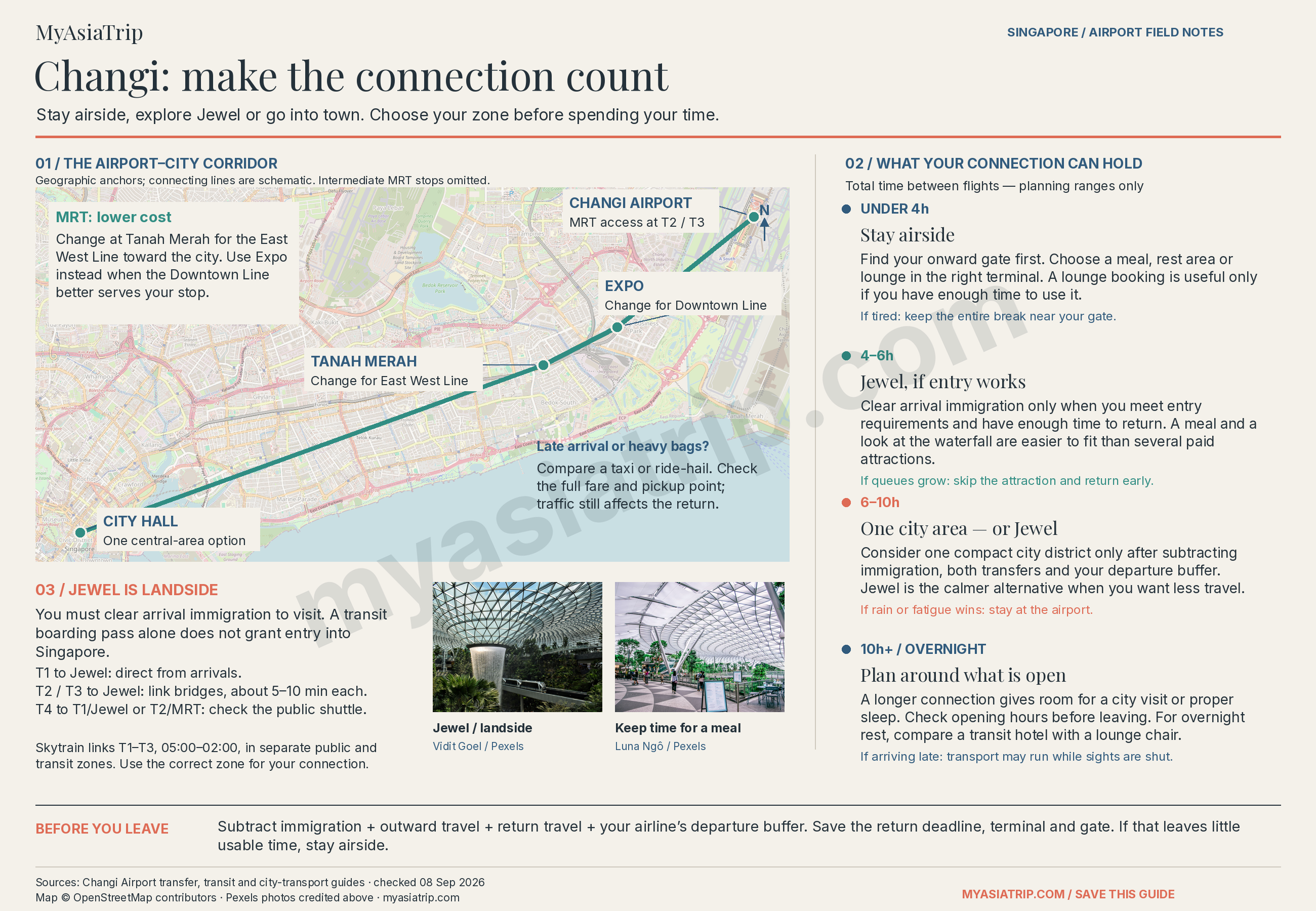
A successful layover plan uses usable time, not simply the gap between scheduled landing and takeoff. Deduct time for disembarking, terminal orientation, immigration if you go landside, the journey back, security and your airline’s boarding deadline. Keep a larger buffer if you have checked bags, separate tickets, children or limited mobility.
Layover Planning Matrix
| Flight Gap | Usable Time | Recommended Zone | Primary Recommended Itinerary | Critical Operational Rules |
|---|---|---|---|---|
| 2–3 Hours | ~45–75 mins | Airside Only (Same terminal or adjacent) | Visit the Butterfly Garden (T3) or Wonderfall (T2), grab a bowl of laksa at Singapore Food Street, and proceed to the gate. | Do not attempt immigration. Stay within your departure terminal or adjacent terminal via Skytrain. |
| 4–6 Hours | ~2–3.5 hours | Jewel Landside (Immigration entry) | Clear immigration, store carry-ons, view the Rain Vortex, stroll the Shiseido Forest Valley, and enjoy a sit-down lunch. | The official Jewel FAQ advises a minimum 5-hour layover to visit safely. Return to immigration 2 hours before departure. |
| 6–10 Hours | ~4–7 hours | Jewel + 1 City Pocket or Deep Jewel Experience | Option A: Full Jewel (Canopy Park, Experience Studio, dining). Option B: MRT/Grab into Marina Bay / Chinatown for 2–3 hours. | For city excursions, pick exactly one compact neighborhood. Verify Singapore entry visas and electronic SG Arrival Card. |
| 10+ Hours | ~7–10 hours | City Exploration + Jewel | Full Singapore city itinerary (Gardens by the Bay, Marina Bay Sands, historic civic district), returning to explore Jewel evening light shows. | Confirm transit schedules. Consider booking a 6-hour transit hotel room to shower and recharge before the flight. |
The Official Free Singapore Tour
If you have a transit layover between 5.5 hours and 24 hours, you may be eligible to join the complimentary Free Singapore Tour organized jointly by Changi Airport Group, Singapore Airlines, and the Singapore Tourism Board.
- Eligibility & Booking: Available exclusively to transit/transfer passengers with valid boarding passes. You can book your slot in advance online (up to 50 days prior to arrival) or register in person at Free Singapore Tour service counters located airside in Terminal 2 (Transit L2 near Gate F50) or Terminal 3 (Transit L2 near Gate A1–A8) at least 90 minutes before tour departure.
- Tour Itineraries (Approx. 2.5 Hours each):
- City Sights Tour: Covers the Civic District, National Gallery, and Marina Bay Sands.
- Heritage Tour: Explores Chinatown, Kampong Gelam, and the Singapore River.
- Jewel Walking Tour: A guided 2-hour landside exploration of Jewel’s architectural and botanical features.
- Changi Precinct Tour: Explores eastern coastal heritage villages, Tampines New Town, and Changi Beach.
- Critical Constraints: Participants must clear immigration with the tour group and meet all entry visa requirements, including submitting the electronic SG Arrival Card. The Free Singapore Tour is not suitable for wheelchair users or travelers with baby strollers due to step-access tour coach boarding.
Ground Logistics: Skytrain, Baggage Storage, and City Connections
Understanding Changi’s internal transport saves unnecessary terminal changes. The key distinction is whether you are using the public or transit network: the two Skytrain systems are separate, and Jewel is not a Skytrain stop.
Inter-Terminal Skytrain & Shuttle Bus Operations
- The Skytrain (Terminals 1, 2, and 3): Operates daily from 05:00 to 02:00. The system runs on twin, completely isolated track networks: Transit Skytrain (for airside passengers who have not cleared customs) and Public Skytrain (for landside travelers). Travel time between adjacent terminals is roughly 1 to 4 minutes.
- Between 02:00 and 05:00: The Skytrain shuts down for nightly maintenance. Airside passengers can use moving travellators across the T1/T2/T3 inter-terminal link bridges, while landside passengers can walk via public mezzanine bridges.
- Accessing Jewel: Jewel is not a Skytrain station. You cannot take a Skytrain directly “to” Jewel.
- From Terminal 1: Jewel is directly contiguous with the T1 Arrival Hall on Level 1.
- From Terminals 2 and 3: Elevated, air-conditioned pedestrian link bridges equipped with moving walkways connect the terminal departure halls to Jewel (a 5-to-10-minute walk).
- Note on Visuals: While the public Skytrain line between T2 and T3 passes directly through the Jewel dome offering an iconic elevated view of the Rain Vortex, you cannot exit the train inside the dome.
- Terminal 4 Transfers: T4 is physically separated from the main hub. Complimentary 24-hour airport shuttle buses run continuously:
- Airside Shuttle: Connects T4 Transit Lounge directly with T1 and T3 Transit Lounges (10–15 min journey).
- Landside Shuttle: Connects T4 Arrival Hall with T2 Arrival Hall (Door 1).
Left Baggage and Luggage Storage
Left luggage facilities operated by Smarte Carte / excess baggage partners are available 24 hours daily in both public and transit halls across all four terminals and inside Jewel (Level 1). Current verified per-24-hour storage rates are:
- Loose Items (jackets, umbrellas, small shopping bags): S$6.00
- Small Baggage (cabin bags, backpacks under 10 kg): S$11.00
- Big / Odd-Sized Items (standard suitcases over 10 kg, strollers): S$16.00
- Extra-Large Items (surfboards, oversized bike boxes): S$19.00
Local SIM Cards, eSIM, and Connectivity
- Physical Tourist SIMs: Available at 24-hour Changi Recommends counters and convenience stores (Cheers / 7-Eleven) located across all arrival halls. Standard prepaid packages from Singtel, StarHub, and M1 offer generous data allowances. By Singapore law, physical passport registration is mandatory.
- eSIM Alternatives: Activating a digital eSIM profile before landing allows immediate connectivity upon touchdown without waiting in counter queues.
- Airport Wi-Fi: High-speed complimentary Wi-Fi (
#WiFi@Changi) is available across all terminals. Connect by selecting the network and verifying via SMS OTP or web browser click-through.
Transport from Changi to Downtown Singapore
For exhaustive fare breakdowns, train station navigation diagrams, and bus routes, refer to our comprehensive Changi Airport to City Transfer Guide. Key options include:
- Mass Rapid Transit (MRT): Changi Airport station (CG2) is between T2 and T3. Most city routes change at Tanah Merah (EW4); Downtown Line destinations can change at Expo (DT35). The last train that connects toward the city leaves at 23:18 daily.
- Ride-hailing and taxis: Official taxi stands operate 24 hours. App cars use designated pickup areas rather than taxi ranks. Typical metered taxi fares to the city are S$25–45 before applicable surcharges.
- Public Bus 36: Serves the east coast and central corridor. It can suit a hotel close to its route, but frequent stops make it less comfortable with luggage.
Practical tips for airside and landside visits
These details matter more than squeezing in one extra attraction:
- Jewel requires entry to Singapore: Check your own passport, visa or transit eligibility and any required arrival declaration on the ICA website before leaving transit. Rules vary by nationality and journey.
- Security may be at the gate: T1, T2 and T3 use gate security for many departures. Keep duty-free liquids in the required sealed packaging and follow the rules for your onward airport.
- Your airline’s gate deadline is final: Work backward from the boarding time on your pass and allow for terminal travel, queues and possible gate changes.
- Returning airside takes time: After visiting Jewel, you must clear departure immigration and security again. Make sure you hold an onward boarding pass and keep a conservative buffer.
Quick answers
Frequently asked questions
Can I visit Jewel during a layover without clearing Singapore immigration?
What are the operating hours and light show times for the Jewel Rain Vortex?
What free attractions can I visit airside without clearing immigration?
How does the Skytrain system connect the terminals and Jewel?
What are the current baggage storage rates at Changi Airport?
Research notes
Official planning references
We use these primary references for the time-sensitive details relevant to this guide. Rules, prices and operating hours can change, so confirm the live information before you travel.
- Jewel Changi Airport Official Attraction & Rain Vortex Status
Details to check: Official details and live planning updates
- Canopy Park Operating Hours and Rules
Details to check: Official details and live planning updates
- Changi Experience Studio Overview
Details to check: Official details and live planning updates
- Changi Airport Terminal Transfer Logistics
Details to check: Official details and live planning updates
- Changi Free Movie Theatre Directory
Details to check: Official details and live planning updates
- Official Free Singapore Tour Booking & Conditions
Details to check: Official details and live planning updates
- Changi Airport Baggage Storage
Details to check: Official details and live planning updates
- Wheelchairs and Accessibility Aids at Changi
Details to check: Official details and live planning updates
- Changi Airport Special Assistance
Details to check: Official details and live planning updates
- Singapore Immigration & Checkpoints Authority (ICA) Entry Rules
Details to check: Official details and live planning updates
Guide reviewed 10 September 2026. Confirm live rules, prices and operating details with the linked authority before travel.