Where to Stay in Singapore: Best Neighborhoods and Areas
Compare Singapore neighborhoods by MRT access, repeated journeys, evening character, luggage friction and price pressure before choosing a hotel.


Choose the MRT station and walk from the station before the neighborhood name. Chinatown and Bugis are strong all-round bases for a first visit; Marina Bay buys the view at a premium; Orchard works when shopping and hotels are the trip; Sentosa makes sense only when the island’s attractions justify repeated mainland transfers. In Singapore’s humidity, a nominal ten-minute walk with luggage or no covered route can matter more than one extra train stop.
The most useful way to decide where to stay in Singapore is to test a hotel against the two or three journeys you will repeat. Check the route to Gardens by the Bay, the number of changes needed for Sentosa, and how you will return after an evening around the Singapore River. A room that costs S$25 less but adds two exposed walks every day is rarely the better value after a humid afternoon or a sudden downpour.
Compare Singapore bases by the same criteria
| Area | Best lodging purpose | Typical nightly range | Typical property | Main caution |
|---|---|---|---|---|
| Chinatown and CBD edge | First visit, transport value and hawker food | S$170–360 | Boutique, aparthotel and mid-range business hotel | Check whether Chinatown, Maxwell or Telok Ayer is actually nearest |
| Bugis and Lavender | Value, first trips and linked cultural districts | S$150–320 | Mid-range hotel and compact room | A hotel using “Bugis” in its name may not be near Bugis MRT |
| Orchard Road | Shopping, families, rain protection and reliable dining | S$220–450 | 4- or 5-star city hotel and family room | Weaker nightlife and high peak-season rates |
| Marina Bay and Colonial District | Views, luxury and a short special trip | S$380–900+ | Five-star, view room and heritage hotel | Highest budget pressure; some MRT walks are still exposed |
| Little India | Budget, Indian food and vivid streets | S$110–260 | Hostel, budget hotel and small boutique | Crowded streets and variable soundproofing |
| Kampong Glam | Design hotels, cafes and street art | S$160–330 | Shophouse and design-led boutique | Busy, noisy weekend evenings |
| Singapore River quays | Nightlife, riverside dining and couples | S$230–520 | River-view hotel and serviced apartment | Inspect room orientation and soundproofing |
| Sentosa | Family resort, theme parks and beach | S$320–900+ | Resort, family hotel and luxury villa | Slower mainland access and more expensive food |
| East Coast and Katong-Joo Chiat | Local seaside, Peranakan streets and slow travel | S$150–320 | Boutique and mid-range hotel | Less MRT convenience than central districts |
Start with neighborhood fit, then compare the full stay price and cancellation terms. The results below are live booking inventory, not a fixed editorial ranking.
Singapore’s extensive Mass Rapid Transit (MRT) system makes it easy to get around from most neighborhoods. You are unlikely to be stranded in a distant suburb, but your choice of base still matters for convenience. It saves time on daily commutes and matches the local vibe you prefer. The where-to-stay collection provides the same decision path for other destinations.
Still, “only an hour” adds up if you are sightseeing for several days. The MRT covers virtually every area discussed in this guide, with stations often within a five- to ten-minute walk from hotels. For travelers on a tight schedule, a centrally located base like Chinatown can shave ten to twenty minutes off each journey compared to staying in Sentosa or the far end of Orchard Road.
Almost any central neighborhood can reach the major sights. The better question is what you want outside the hotel door: hawker food, nightlife, shopping, resort facilities or the shortest possible MRT journeys. That choice matters more than distance from the Merlion.
Note: Hotel prices, rates, and availability change frequently. Always check current booking sites for exact figures. Attraction hours and fees are subject to change. Visit the official Visit Singapore website for up-to-date details.
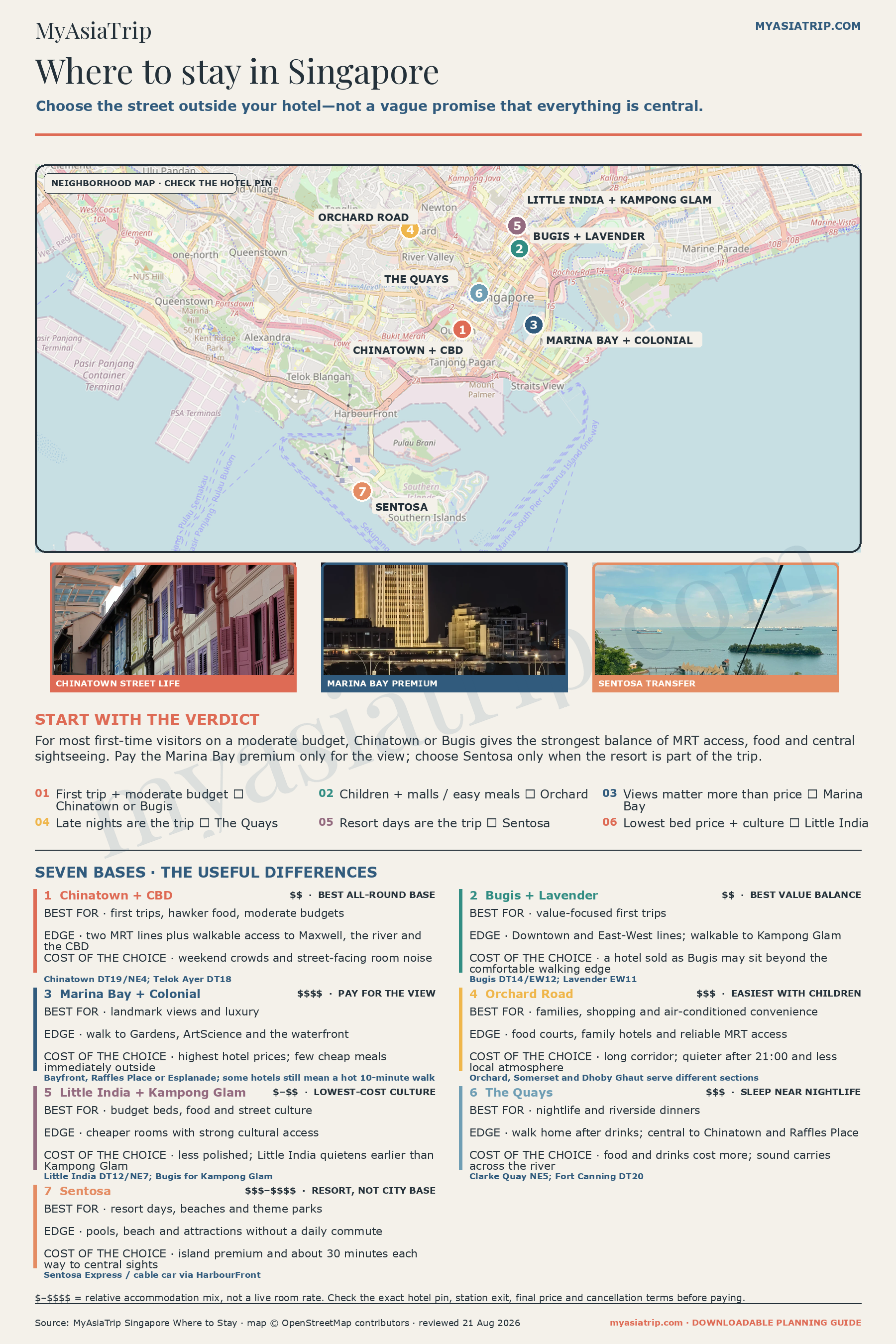
The downloadable map uses OpenStreetMap geometry to place the central neighbourhoods, MRT context and Sentosa relationship on one canvas. It is a planning map, not turn-by-turn navigation; always check the exact hotel pin and station exit before booking.
Singapore neighborhood and hotel price comparison
The ranges below are estimated 2026 planning bands per room per night, not live quotes. F1 week, major concerts, Lunar New Year, the Christmas period and large conferences can push them sharply higher. Taxes, breakfast, cancellation terms, room size and occupancy must be compared at the final checkout screen.
| Area | Best accommodation purpose | Typical room range | Common hotel position | Main trade-off |
|---|---|---|---|---|
| Chinatown / CBD edge | First trip, hawker food, central access and moderate budgets | S$170–360 | Boutique, aparthotel and mid-range business hotels | Street-facing rooms can be noisy; check whether Chinatown, Maxwell or Telok Ayer MRT is closest |
| Bugis / Lavender | Value, first visits and linking heritage districts | S$150–320 | Compact 3- and 4-star hotels | A property marketed as Bugis may sit beyond the comfortable walking edge |
| Orchard Road | Shopping, families and rain-proof convenience | S$220–450 | 4- and 5-star city hotels, some larger family rooms | Long corridor, weaker late-night character and event premiums |
| Marina Bay / Colonial District | Skyline views, luxury and short celebration trips | S$380–900+ | Landmark 5-star and heritage hotels | Highest room pressure; some hotels still require an exposed MRT walk |
| Little India | Lowest private-room and hostel choices, Indian food and vivid street life | S$110–260 | Hostels, compact budget and boutique hotels | Crowded pavements and variable soundproofing |
| Kampong Gelam | Shophouse character, cafés, design and street art | S$160–330 | Boutique and restored-shophouse hotels | Weekend evening noise around Haji Lane and Arab Street |
| Clarke / Robertson / Boat Quay | Nightlife, riverside dining and couples | S$230–520 | River hotels and serviced apartments | Room direction and acoustic insulation matter |
| Sentosa | Resort time, theme parks, beaches and family downtime | S$320–900+ | Resorts, family hotels and luxury villas | Mainland transfers and higher food costs |
| Katong / Joo Chiat / East Coast | Peranakan streets, local food, cycling and slower trips | S$150–320 | Boutique and mid-range hotels | Less efficient than the centre for a landmark-heavy first visit |
Choose an area by purpose
| Main purpose | Best areas | Useful alternative | Usually a poor fit |
|---|---|---|---|
| First 3–5 day visit | Chinatown or Bugis | Orchard | Staying on Sentosa for the entire city trip |
| Travelling with children | Orchard or Sentosa | Bugis | A room directly above the Clarke Quay nightlife core |
| Lowest practical budget | Little India, Lavender or Chinatown edge | Bugis | Marina Bay |
| Nightlife | Robertson Quay, Clarke Quay or Chinatown edge | Kampong Gelam | Deep Sentosa if late mainland nights are the priority |
| Shopping and wet-weather convenience | Orchard | City Hall or Bugis | East Coast |
| Beach or resort break | Sentosa | Katong / East Coast | Chinatown with a daily island commute |
| Heritage streets and food | Chinatown, Little India, Kampong Gelam or Joo Chiat | Bugis | A Marina Bay-only stay |
Marina Bay and Colonial District: Luxury and landmarks
Best for: First-time visitors who want iconic views and are comfortable spending top dollar. Not ideal for: Budget travelers or anyone seeking a local, everyday Singapore experience.
Marina Bay is the postcard-perfect heart of Singapore. Here you find Gardens by the Bay, the ArtScience Museum, and the iconic Marina Bay Sands hotel. Accommodation is overwhelmingly upscale rather than budget-focused. Expect five-star chains, concierge service, and skyline panoramas. Examples include The Ritz-Carlton, The Fullerton Bay, and Marina Bay Sands itself.
The Colonial District wraps around the Padang and includes the old Supreme Court, Raffles Hotel, and the Esplanade. This area feels grand and historic, but it is also the most expensive in Singapore for lodging. You will not find hostels or independent guesthouses here.
Pros:
- Walking distance to major landmarks (Gardens by the Bay, Merlion Park, ArtScience Museum)
- Spectacular city skyline, especially at night
- Excellent dining within hotels and nearby malls (for example, the Shoppes at Marina Bay Sands)
Cons:
- No budget accommodation
- Can feel touristy and sterile, few local hawker centers. If you want a hawker meal, you need to walk fifteen minutes to Telok Ayer or take a short MRT ride to Chinatown.
- MRT stations (Bayfront, Raffles Place, Esplanade) are efficient but not as close as in other neighborhoods. Some hotels require a ten-minute walk under the sun or rain.
Decision-making context: If your trip is short and you prioritize sleeping next to the country’s most recognizable landmarks, Marina Bay is a no-brainer. But consider that you can reach Marina Bay from Chinatown in two MRT stops (about five minutes). Staying in Chinatown gives you cheaper accommodation, hawker food next door, and exactly the same access to Marina Bay’s attractions. For a first-time visitor on a moderate budget, Chinatown offers a better trade-off. Only choose Marina Bay if you really want to wake up to skyline views and are prepared to pay a steep premium.
Recommended hotels in Marina Bay and the Colonial District:
- Marina Bay Sands — Best for a first-time Singapore splurge and the full resort experience. Bayfront MRT is roughly 300 metres away, while Gardens by the Bay and the ArtScience Museum are walkable without crossing exposed city blocks. The infinity pool, skyline views and integrated mall are the reasons to book; the trade-off is a very high rate, busy public areas and a less intimate atmosphere. Check the exact tower, bed type and view category before paying, because the experience varies sharply by room.
- The Fullerton Hotel Singapore — Best for heritage character and a quieter waterfront base. The former General Post Office sits beside the Singapore River, about 200 metres from Merlion Park and close to Raffles Place MRT. Rooms tend to feel more substantial than new-build micro-hotels, and the riverfront pool is a genuine midday retreat. Heritage architecture means layouts differ within the same category, so compare the actual room description rather than relying on one gallery image.
- Pan Pacific Singapore — Best for convention visitors and families who want malls, food and transport indoors. The hotel connects into the Marina Square and Suntec network, reducing outdoor walking during tropical rain or the 2 p.m. heat. Rooms and public spaces are full-service rather than boutique, with a pool, gym and several dining options. It is practical rather than secluded, and the large scale can mean a busy breakfast and lobby at event times.
- The Ritz-Carlton, Millenia Singapore — Best for spacious rooms, bay views and a special-occasion stay. Entry rooms are around 51 square metres, unusually generous for central Singapore, and many categories frame Marina Bay through the hotel’s distinctive windows. Marina Square, the Helix Bridge and Promenade MRT are nearby. The premium is justified by space and service more than direct attraction access, so confirm a Marina-facing category if the view is the main reason for booking.
Orchard Road: Shopping and families
Best for: Families, shopping enthusiasts, and travelers who want a central location with plenty of dining options. Not ideal for: Nightlife seekers (quieter after 9 pm) or solo backpackers looking for street food.
Orchard Road is the main shopping district. It has huge malls, food courts, family-friendly hotels, and convenient MRT access. The Orchard, Somerset, and Dhoby Ghaut stations divide a long corridor, so use the Orchard Road guide to choose the section that fits your plans.
Families often choose Orchard because of its central location, wide range of hotel price points (from mid-range to luxury), and many dining options. The malls themselves have excellent food courts with local dishes like chicken rice and laksa. You do not need to venture far for a good meal.
Pros:
- Extensive shopping (luxury brands, electronics, souvenirs)
- Family-friendly hotels with pools and kids’ clubs
- Excellent MRT connections: Orchard MRT (on the North-South Line) and Somerset MRT (on the same line) make transfers easy
- Abundance of food courts and restaurants in malls
Cons:
- Nightlife is limited; bars close early in most malls
- Can feel commercial and lacking in character compared to Chinatown or Little India
- Hotels can be expensive during peak seasons and shopping events (Great Singapore Sale, Christmas)
Comparison with other family areas: If you are traveling with young children and want a resort atmosphere, Sentosa might be a better pick despite its isolation. Orchard Road keeps you closer to non-theme-park attractions like the Singapore Zoo or Gardens by the Bay. For families who value easy access to diverse dining and quick MRT connections, Orchard is ideal. For families who want a beach and waterpark on-site, Sentosa wins.
Practical context: Orchard Road’s malls house some of Singapore’s best air-conditioned play areas for children. But the lack of greenery means you need to plan outdoor time. A short taxi ride to the Botanic Gardens (UNESCO site) can balance the commercial vibe.
Recommended hotels on Orchard Road:
- Royal Plaza on Scotts — Best for shoppers who value a conventional, comfortable room. It sits just off upper Orchard Road near ION Orchard and Orchard MRT, and typical rooms are about 32 square metres, leaving more room for luggage than many newer lifestyle hotels. The location is excellent for malls and medical appointments but less atmospheric after the shops close. Compare breakfast-inclusive and room-only rates because dining nearby is easy.
- YOTEL Singapore Orchard Road — Best for solo travellers and couples prioritising location over floor space. The 366 Orchard Road address puts the hotel near Orchard MRT, ION and Takashimaya, with a pool and gym above the retail corridor. Its cabin-style rooms use adjustable beds and tight storage efficiently, but they can feel cramped with two large suitcases or a child. Peak-time lift queues and the compact bathroom arrangement are worth considering before booking.
- JEN Singapore Orchardgateway by Shangri-La — Best all-round Orchard choice for first-timers and small families. Somerset MRT is roughly 100 metres away and the hotel connects directly to Orchardgateway, so rain rarely disrupts the commute. Standard rooms begin around 27 square metres, while larger family options can reach about 47 square metres; the rooftop pool is a strong bonus. It costs more than the compact hotels nearby, but the direct transport access often saves energy every day.
- Holiday Inn Singapore Orchard City Centre — Best for families needing two proper beds in one room. The hotel is around 400 metres from Somerset MRT and offers selected categories with two double beds, a useful configuration that is not common in Singapore. The building and decor are more traditional than the newest Orchard properties, but the room layout is practical. Verify occupancy rules and whether breakfast covers every child before confirming.
Chinatown and CBD: Central and budget-friendly
Best for: First-time visitors, budget travelers, and anyone who wants to be immersed in Singapore’s Chinese heritage with easy access to the rest of the city. Not ideal for: Those seeking a quiet, resort-like stay.

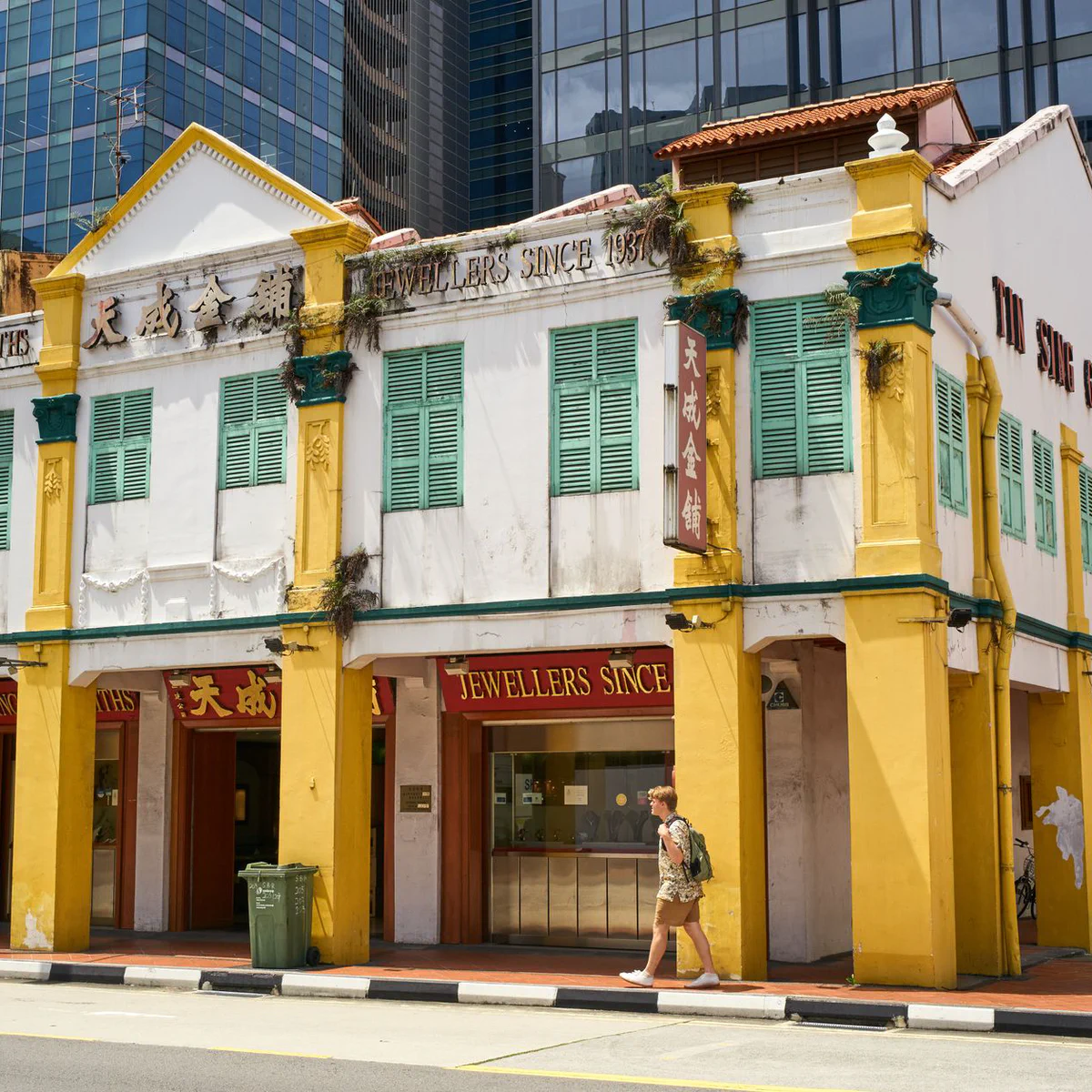
Chinatown is arguably the most well-rounded base for first-time visitors. It has a mix of budget hostels and mid-range hotels near temples and hawker centres. The area sits between the CBD (Central Business District) and the historic shophouses of Tanjong Pagar, giving you a blend of sky-high offices and traditional tea houses.
The main attractions include the Buddha Tooth Relic Temple, the Sri Mariamman Temple, and the Chinatown Street Market. You also find Maxwell Food Centre (famous for Tian Tian Hainanese Chicken Rice) and many cheap eateries along Smith Street.
There are few ultra-luxury options here. The area is predominantly affordable.
Pros:
- Centrally located; MRT stations Chinatown (Downtown and North-East Lines) and Telok Ayer (Downtown Line) put you within two stops of Marina Bay, Raffles Place, and Little India.
- Many hawker centres with lower-cost everyday meals
- Walking distance to the CBD, Marina Bay area, and Clarke Quay
- Budget-friendly hotels and hostels
Cons:
- Can be noisy, especially on weekends with crowds along the main street
- Not much green space or water views
- Some rooms overlook busy streets; check for double-glazed windows
Sequencing advice: For a three- or four-day trip, many travelers spend the first two nights in Chinatown to cover central sights, then move to a different neighborhood for a change of pace. That is not necessary. Chinatown works well for the entire stay if you do not mind a lively environment.
Comparison with other budget areas: Little India offers even cheaper hostels and a very different cultural flavor. But it is slightly farther from the CBD and Marina Bay. Chinatown strikes a better balance between affordability and centrality. If you have a very tight budget and do not mind a longer commute, Little India is a strong alternative.
Recommended hotels in Chinatown and the CBD:
- Capri by Fraser, China Square — Best for longer stays and travellers who want a residential feel. The South Bridge Road location is close to Telok Ayer MRT, Maxwell Food Centre, Chinatown and the CBD. Studio-style rooms and self-service facilities make laundry and simple in-room meals easier than at a conventional hotel. It suits business-leisure trips especially well, though the atmosphere is polished and functional rather than historic-shophouse romantic.
- The Clan Hotel Singapore — Best for couples and business travellers wanting a refined base beside the MRT. Telok Ayer station is about 100 metres away; room categories run from roughly 24 to 36 square metres, with a high-floor pool and city views. Chinatown food, the CBD and Marina Bay are all straightforward from here. The sleek, service-led experience comes at a premium, and entry rooms are not as large as the hotel’s tall exterior suggests.
- Hotel 1900 @ Chinatown — Best for budget-conscious travellers who want to be in the middle of Chinatown. Chinatown MRT is about 100 metres away, and Mosque Street places hawker food and heritage sights at the door. The low rate is achieved through very compact rooms: some categories are only 8 to 12 square metres and some have no window. It works well for a short, sightseeing-heavy stay, but carefully select room size and window status.
- Mondrian Singapore Duxton — Best for design, rooftop atmosphere and evenings around Keong Saik Road. Maxwell MRT is roughly 300 metres away, with the food centre, Chinatown and Duxton’s restaurants within an easy walk. The rooftop infinity pool and bar make the hotel feel more social than the CBD business properties. Base rooms can be compact, and weekend nightlife nearby may not suit light sleepers seeking an early night.
Bugis and Lavender: Best for value and easy first trips
Best for: First-time visitors who want MRT access, food and moderate hotel prices without staying in the CBD. Not ideal for: Resort atmosphere, skyline views or travelers who want nightlife outside the hotel door.
Bugis sits between the Civic District, Kampong Glam and Little India. That location makes it a practical base for a short first trip: you can walk to heritage streets, use the Downtown or East-West MRT lines and reach Marina Bay without depending on taxis. Lavender, one stop east on the East-West Line, often offers larger or better-value rooms while keeping the centre within easy reach.
The name covers several micro-areas. A hotel beside Bugis MRT behaves very differently from one advertised as “Bugis” but located beyond the comfortable walking edge of Jalan Besar or Lavender. Map the actual station entrance, covered route and late-evening food options before booking.
Choose Bugis for the strongest balance of transport, dining and cultural access. Choose Lavender when price or room size matters more than stepping directly into the main sights. If Marina Bay views are the priority, stay in Marina Bay; if the lowest bed price matters, compare Little India. For most moderate-budget first-timers, Bugis is the useful middle ground.
Recommended hotels in Bugis, City Hall and Lavender:
- lyf Funan Singapore — Best for younger travellers, friends and longer stays that benefit from shared facilities. The hotel sits inside Funan mall, around 400 metres from City Hall MRT, with communal kitchens, laundry, workspaces and social areas. The location is excellent for the Civic District and multiple train lines. Private rooms are deliberately compact and service is closer to co-living than a traditional full-service hotel, so it is not the right choice for travellers expecting bell service or a resort breakfast.
- PARKROYAL on Beach Road — Best for families wanting a larger room near Kampong Glam. Standard categories are around 35 square metres, and Nicoll Highway MRT is roughly 300 metres away; Haji Lane, Arab Street and Bugis are walkable. A full pool, gym and spa make it easier to schedule downtime. The hotel is across a broad road from the heritage lanes, and some club facilities have age restrictions, so families should check the selected package carefully.
- V Hotel Lavender — Best for maximum MRT convenience at a moderate rate. Lavender MRT and everyday food outlets are effectively downstairs, making airport connections and early starts simple. Rooms are mostly around 14 to 16 square metres, with triple configurations available in selected categories. The compromise is density: corridors, lifts and breakfast can feel busy, and the room is better for sleeping than spreading out.
- Hotel Mi Rochor — Best for value seekers splitting time between Bugis and Little India. Rochor MRT is about 200 metres away, Little India MRT about 500 metres, and Bugis Street is a short walk. The property is modern and efficient, with more than 500 rooms and compact layouts. Ask for the exact bed and window configuration, and do not book it expecting the neighbourhood intimacy of a small boutique hotel.
Little India and Kampong Glam: Culture and street art
Best for: Budget travelers, culture enthusiasts, and photographers. Not ideal for: Luxury travelers or those who prefer quiet, suburban surroundings.

These adjacent neighborhoods combine budget-oriented hotels, Indian restaurants, sari shops and active temples such as Sri Veeramakaliamman. Little India and Farrer Park MRT stations serve the area, but pavements can feel crowded with luggage and some rooms pick up street noise.
Kampong Glam is one of Singapore’s strongest areas for street art, particularly along Haji Lane and in the Gelam Gallery. The neighborhood centres on Sultan Mosque and lively Arab Street.
Accommodation types:
- Little India: Budget hostels and mid-range hotels like Wanderlust by The Unlimited Collection or the more upscale Wanderlust.
- Kampong Glam: Boutique hotels and hostels, often in restored shophouses (for example, The Sultan Hotel, Village Hotel Bugis). Prices are slightly higher than Little India but still reasonable.
Decision-making guidance: Choose Little India if you want the most affordable beds in town and love Indian food and temples. Choose Kampong Glam if you care about street art, hipster cafés, and a more relaxed vibe. Haji Lane is perfect for an afternoon of photography and boutique shopping. Both areas are within a twenty-minute walk of each other. You can easily visit both regardless of where you sleep.
Caveat: At night, Little India can feel quieter than Kampong Glam, which has more evening dining options near Arab Street. If you want to be close to nightlife, Kampong Glam edges ahead. For a truly budget stay, Little India has the cheapest dorm beds.
Comparison with Chinatown: Chinatown is bigger, busier, and has more hawker options. But Little India and Kampong Glam offer a more intimate cultural experience with less chain-store feel. Street art is unique to Kampong Glam. Chinatown has murals too, but not as concentrated.
Recommended hotels in Little India and Kampong Glam:
- The Sultan — Best for heritage atmosphere and evenings around Arab Street. The 64-room property occupies conserved shophouses on Jalan Sultan, near Kampong Glam and about 500 metres from Nicoll Highway MRT. Rooms vary greatly, from roughly 12-square-metre singles to 44-square-metre lofts, so category choice matters more than usual. Book for character and walkable food, not for uniform layouts or resort facilities.
- Wanderlust by The Unlimited Collection — Best for design-minded couples who also want practical long-stay touches. This conserved Art Deco building is about 200 metres from Jalan Besar MRT and close to Little India dining. Rooms are stylish but compact, generally around 13 to 18 square metres, and self-service laundry is useful. Loft rooms look memorable in photographs but stairs and low sleeping areas may be awkward for limited mobility or bulky luggage.
- ST Signature Jalan Besar — Best for independent adult travellers seeking a low central rate. Jalan Besar MRT is about 100 metres away and the hotel uses app-led check-in with compact cabin-style rooms and shared social space. There is no conventional reception, extra beds are not available, and current property rules do not allow children. Read the check-in window and room-access instructions before payment; this is a functional sleep base, not a family hotel.
- Village Hotel Bugis — Best for families, halal-food access and a straightforward full-service stay. Bugis MRT is around 300 metres away and Arab Street is almost at the doorstep. Standard rooms are about 32 square metres, with family and connecting options up to roughly 64 square metres. The property is larger and less boutique than nearby shophouse hotels, but that scale brings a pool, practical room configurations and easier multigenerational logistics.
Sentosa and East Coast: Beach and relaxation
Best for: Families wanting a resort stay, beach lovers, and those who want to combine attractions with downtime. Not ideal for: Day-trippers (unless staying on the island), budget travelers, or those who plan to explore the mainland frequently.
Sentosa Island
Sentosa is Singapore’s dedicated resort island. It is home to Universal Studios Singapore, Singapore Oceanarium, Adventure Cove Waterpark, and several beaches. It works well for relaxation and family attractions. However, it is less convenient for exploring the rest of Singapore because every mainland trip adds transit time.
Hotels on Sentosa are mostly resorts: Shangri-La Rasa Sentosa, The Barracks Hotel, and the more budget-friendly Oasia Resort Sentosa. Prices are mid-range to luxury, but you also pay for the island premium. Dining is largely within resorts or at the Sentosa Boardwalk area, with few cheap local options.
Pros:
- Beach access and family-friendly attractions
- Quiet, resort atmosphere
- Good for a few days of relaxation within Singapore
Cons:
- Isolation from the mainland; not convenient for sightseeing
- Fewer everyday neighborhood food options
- Can be expensive, especially for a family of four
Practical context: If you have young children and want a vacation where you rarely leave the resort, Sentosa is ideal. But if you plan to visit Chinatown, Little India, or the Gardens by the Bay for more than a half-day, you will spend about thirty minutes each way on the monorail and MRT. That quickly adds up. Many families combine a two-night stay on Sentosa with a few nights in the city.

Recommended hotels on Sentosa:
- Shangri-La Rasa Sentosa, Singapore — Best overall Sentosa choice for families with younger children. It is directly on Siloso Beach and combines water-play areas, pools, a kids’ club, family activities and a shuttle to VivoCity. Sea-view balconies and the resort breakfast create a real holiday feeling without leaving Singapore. Rates are high, the public areas can be lively during school holidays, and travellers focused on Universal Studios should allow for transport across the island.
- Village Hotel Sentosa — Best for attraction-heavy family trips and connecting-room flexibility. Imbiah Station is about 200 metres away and Universal Studios Singapore is roughly a 500-metre walk. Rooms range from compact 18-square-metre options to 36- and 44-square-metre family configurations, while several pools include child-friendly areas. It offers strong convenience rather than beach seclusion; verify whether a quoted family rate is one room or two connecting rooms.
- Oasia Resort Sentosa — Best for couples and families wanting a calmer, wellness-led base. The hotel is beside the Imbiah transport zone, one Sentosa Express stop from both Resorts World and the beach area. Rooms are generally more restful than the large family resorts, with a spa, pool and scheduled wellness activities. Some guests report corridor noise, so light sleepers should request a room away from lifts and connecting doors.
- The Barracks Hotel Sentosa — Best for a quiet anniversary or adults-first luxury stay. The restored military building has only about 40 rooms, generous categories around 39 square metres and a low-rise atmosphere near Imbiah Station. Service and privacy are the selling points, not children’s entertainment. Families are accepted, but the neighbouring Village Hotel delivers better pools and room combinations for most child-focused trips.
- Capella Singapore — Best for privacy, grounds and a true destination-hotel stay. The 112-room resort sits amid greenery near Palawan Beach, with buggy and shuttle services, pools, spa facilities and large public spaces. It is the strongest couples’ splurge on Sentosa and also works for families who will use the resort itself. The price is exceptional, and Imbiah Station is about 800 metres away, so this is poor value if every day will be spent off-island.
East Coast
For a quieter, more local beach experience, East Coast Park is the mainland answer. It is a long stretch of parkland with beaches, cycling paths, and seafood restaurants (like the famous East Coast Lagoon Food Village). Accommodation here is limited to a few hotels near the park, such as Hotel Indigo Singapore Katong or Village Hotel Katong. Most visitors choose to stay in nearby areas like Katong or Joo Chiat for their Peranakan heritage shophouses and great food.
Pros:
- Local atmosphere, good for joggers and cyclists
- Seafood and hawker food near the beach
- More affordable than Sentosa
Cons:
- Less convenient MRT access; you need a bus or taxi
- Not as many hotels directly on the beach
- East Coast Park itself is fine for a day trip, but staying there can feel disconnected
Comparison: Sentosa is a full-blown resort island with theme parks. East Coast is a public park with a beach. If you want a dedicated resort experience with swimming pools and waterslides, choose Sentosa. If you want to spend an afternoon at the beach and then have great seafood without staying overnight, East Coast works as a day trip from any central neighborhood.
Recommended hotels in Katong and the East Coast:
- Hotel Indigo Singapore Katong — Best for couples who want local design without giving up hotel facilities. The Peranakan-inspired rooms are around 30 square metres, Marine Parade MRT is roughly 200 metres away, and Joo Chiat food streets are within an easy walk. A rooftop pool and gym add downtime options. The neighbourhood is the attraction, so travellers with a tightly packed Marina Bay itinerary may prefer a central base despite the direct MRT connection.
- Village Hotel Katong — Best for families and travellers who value room size. Marine Parade MRT is about 300 metres away, a supermarket is linked to the building, and East Coast Park and Katong dining are nearby. Rooms range from roughly 26 to 41 square metres, including family categories, plus a pool and gym. The interiors are less design-forward than Hotel Indigo, but the extra space is usually more useful with children or several suitcases.
- Holiday Inn Express Singapore Katong — Best for a reliable mid-range stay with breakfast included in many rates. The hotel is near Marine Parade MRT and shares the same food-rich East Coast setting as the more expensive boutique options. Rooms are compact and streamlined, with self-service facilities suited to short trips and business travellers. Confirm whether breakfast and sofa-bed occupancy are included for every guest, and expect limited leisure facilities compared with the two hotels above.
The Quays: Nightlife and dining
Best for: Nightlife lovers, expats, and couples wanting a lively dining scene. Not ideal for: Families with young children (noise levels can be high) or budget travelers.
The Quays area is split into three main sections: Clarke Quay, Robertson Quay, and Boat Quay. Together they form one of Singapore’s main nightlife areas, with nightclubs, craft beer bars, and riverside restaurants.
- Clarke Quay: The busiest, lots of flashy clubs like Zouk and salsa bars. Can be loud late into the night.
- Robertson Quay: More upscale, quieter, with trendy brunch spots and craft beer pubs (for example, Brewerkz).
- Boat Quay: Stretches along the Singapore River near Raffles Place, with tourist-friendly restaurants and some nightlife.
Accommodation here leans mid-range to luxury: hotels like the InterContinental Robertson Quay, Paradox Singapore Merchant Court at Clarke Quay, and the boutique Hotel 1900 @ Chinatown. There are also some serviced apartments for longer stays.
Pros:
- Wide choice of restaurants and bars open late
- Scenic riverwalk and skyline views
- Central location: walking distance to Chinatown, Raffles Place, and Marina Bay
Cons:
- Noise from nightlife can carry into hotel rooms; check for soundproofing
- Can be pricey for drinks and food
- Less family-friendly atmosphere
Decision-making: If you plan to hit the clubs every night, staying at Clarke Quay saves you taxi fares. If you want a more relaxed evening with a good meal and a few beers by the river, Robertson Quay is a better fit. For a budget-conscious traveler, consider staying in Chinatown (five minutes’ walk) and walking over for nightlife. You get the same access at cheaper accommodation.
Caveat: Noise is a real issue. Many hotels along the river have soundproofed windows, but not all. Request a room facing away from the water or on a higher floor if you are a light sleeper.
Recommended hotels around the Singapore River:
- InterContinental Singapore Robertson Quay — Best for couples and business travellers wanting polished riverfront evenings. The 225-room hotel sits among Robertson Quay restaurants, about 600 metres from Havelock MRT, with several in-house dining venues and a compact pool. The area is calmer than Clarke Quay but still lively at dinner. Rooms prioritise design over huge floor plans, and the MRT walk can feel longer in heavy rain.
- M Social Singapore — Best for a design-led short stay at a lower Robertson Quay price. Havelock MRT is roughly 500 metres away and riverfront restaurants begin almost outside. Alcove and loft rooms are around 19 to 22 square metres; the dramatic split-level layout is fun for couples but awkward with young children, mobility limits or large bags. Book a conventional alcove room if stairs are a concern.
- Paradox Singapore Merchant Court at Clarke Quay — Best for first-timers who want nightlife and sightseeing on the doorstep. The hotel is beside Clarke Quay Central and close to the MRT, with Chinatown, Fort Canning and Boat Quay all walkable. A resort-style pool gives families useful recovery time. The immediate area is busier and louder than Robertson Quay, so request a quieter-facing room if late-night music will be a problem.
- Park Regis by Prince Singapore — Best for practical access to both Clarke Quay and Chinatown. The approximately 203-room property has refurbished contemporary rooms, a pool and an urban location near Merchant Road. It lacks the riverside romance of the InterContinental and the nightlife-at-the-door convenience of Paradox, but it can price more reasonably. Compare the final tax-inclusive rate and room size, not just the headline discount.
Turn a neighborhood into a hotel shortlist
| Main purpose | First choice | Backup | Usually avoid |
|---|---|---|---|
| First 3–5 day visit | Chinatown or Bugis | Orchard | Staying only on Sentosa |
| Traveling with children | Orchard or Sentosa | Bugis | Core Clarke Quay nightlife blocks |
| Limited budget | Little India, Lavender or Chinatown edge | Bugis | Marina Bay |
| Nightlife | Robertson Quay, Clarke Quay or Chinatown edge | Kampong Glam | Sentosa if you expect late returns |
| Shopping and rainy days | Orchard | City Hall or Bugis | East Coast |
| Beach resort | Sentosa | East Coast or Katong | Chinatown with a daily island commute |
| Historic streets and food | Chinatown, Little India, Kampong Glam or Katong | Bugis | Spending the entire stay in Marina Bay |
After choosing the area, compare the room and the final walk. “Near MRT” can mean a sheltered connection through a mall or an exposed route across several traffic lights. Check the exact station exit, lift access and hotel entrance; this matters with luggage, a stroller or an afternoon downpour.
- Total room price: Compare the same occupancy, tax treatment, breakfast, cancellation terms and extra-bed policy.
- Room size and layout: A low headline rate may buy a room with little luggage space; families should verify actual bed configuration rather than relying on “family-friendly” copy.
- Arrival time: Confirm reception hours, early luggage storage and the route from Changi if the flight lands after rail service.
- Sleep conditions: Ask for a room away from nightlife, lifts, connecting doors or major roads when noise matters.
- Repeated journeys: Test the hotel against the two or three places you will visit most, not only its distance from Marina Bay on a marketing map.
A permanent list of “best hotels in Singapore” dates quickly because ownership, renovation, room categories and total prices change. Choose the base first, then judge whether the exact property removes or adds friction to your trip.
Final recommendations at a glance
| Traveler Type | Recommended Neighborhood(s) |
|---|---|
| First-time visitor | Chinatown (best balance of cost and access) |
| Luxury seeker | Marina Bay and Colonial District |
| Family with children | Orchard Road (convenience) or Sentosa (resort) |
| Budget traveler | Little India or Chinatown |
| Value-focused first trip | Bugis or Lavender |
| Nightlife enthusiast | The Quays (Clarke Quay or Robertson Quay) |
| Culture and street art | Kampong Glam (plus Little India for food) |
| Beach and relaxation | Sentosa (resort stay) or East Coast (day trip) |
These recommendations are meant to narrow down your options. Test the hotel against the Singapore MRT map and transport guide and the daily geography in the three-day itinerary before paying. Moving hotels is worthwhile only when the second stay changes the experience, such as ending on Sentosa; changing between two central MRT areas usually adds more packing than value.
Quick answers
Frequently asked questions
What is the best area for first-time visitors?
Where should I stay if I want nightlife?
Which area is best for budget travelers?
Research notes
Official planning references
We use these primary references for the time-sensitive details relevant to this guide. Rules, prices and operating hours can change, so confirm the live information before you travel.
- Land Transport Authority — Plan Your Journey
Details to check: MRT stations, payment methods and journey-planning checks behind the neighborhood transit comparisons (checked 2026-08-30).
- Singapore Tourism Board — Essential Travel Information
Details to check: Official destination and visitor-information context used for the first-trip base recommendations (checked 2026-08-30).
Guide reviewed 14 September 2026. Confirm live rules, prices and operating details with the linked authority before travel.