Ayutthaya Day Trip from Bangkok: Train, Tour or Taxi?
Plan an Ayutthaya day trip from Bangkok with transport trade-offs, a realistic temple route, heat and meal breaks, site etiquette and return timing.


Ayutthaya is the most rewarding history-focused escape from Bangkok, but don’t let the 86-kilometer distance fool you into thinking it’s a simple stroll. The former Siamese capital is a sprawling collection of red-brick ruins scattered across an island and its riverbanks. It’s close enough for a day trip, yet large enough to leave you exhausted and frustrated if you try to “wing it” without a transport strategy.
Is an Ayutthaya day trip right for you?
Head to Ayutthaya if you’ve had your fill of Bangkok’s modern malls and want to see the scale of old Siam. It’s a slower, more provincial pace, but be honest about your group’s stamina. If you’re on a tight three-day break or traveling with anyone who wilts after twenty minutes in the sun, you might be better off sticking to the riverside temples in Bangkok where air-conditioned retreats are never far away.
This is not a single, walkable park. The ruins are clustered in pockets, and the gaps between them are just long enough to be punishing under the midday sun. Your choice of transport—whether a breeze-free tuk-tuk or a slow-burning bicycle—will define exactly how much of the city you actually see before the heat forces a retreat. A good day here is about understanding three or four major sites, not checking off every crumbling tower on the map.
The practical choice is to get on the earliest train or tour possible and keep your evening plans in Bangkok loose. Even a “perfect” day involves uneven brick, dust, and a return journey that often takes longer than the morning run. Don’t book a fancy dinner for 7 PM; you’ll likely just want a shower and a quiet meal near your hotel.
Train, tour or private car?
| Option | Best for | Trade-off |
|---|---|---|
| Train | Independent travelers and railway atmosphere | Fixed schedule; local transport still needed |
| Group tour | First-time visitors who want logistics handled | Less control over pace and stops |
| Private car | Families, small groups and heat-sensitive travelers | Highest cost |
| Minivan/bus | Budget travelers comfortable with terminals | Drop-off and return points can change |
Compare Ayutthaya products by guide access, pace and time on the river
| Ayutthaya tours | Tour format | Suits | Main trade-off |
|---|---|---|---|
| Eight-hour small-group temples and river-cruise day · guided first visit | Shared guide, hotel pickup, lunch and admissions advertised | Solo travelers and couples wanting interpretation with logistics handled | Early pickup, real group cap, temple time and how much of the cruise is actually on the water |
| Eight-to-thirteen-hour private charter · selectable routes for a family | Private vehicle, hotel pickup and several route packages | Families, older travelers and groups splitting a per-party cost | Exact guide, admissions, meal, temples and return time change by package |
| Ten-hour private temple day with short longtail ride · balanced land-and-river route | Private transport plus a 30-to-40-minute boat component | Small groups wanting pace control while keeping temples central | Vehicle capacity, guide language, entrance fees, lunch and airport surcharge |
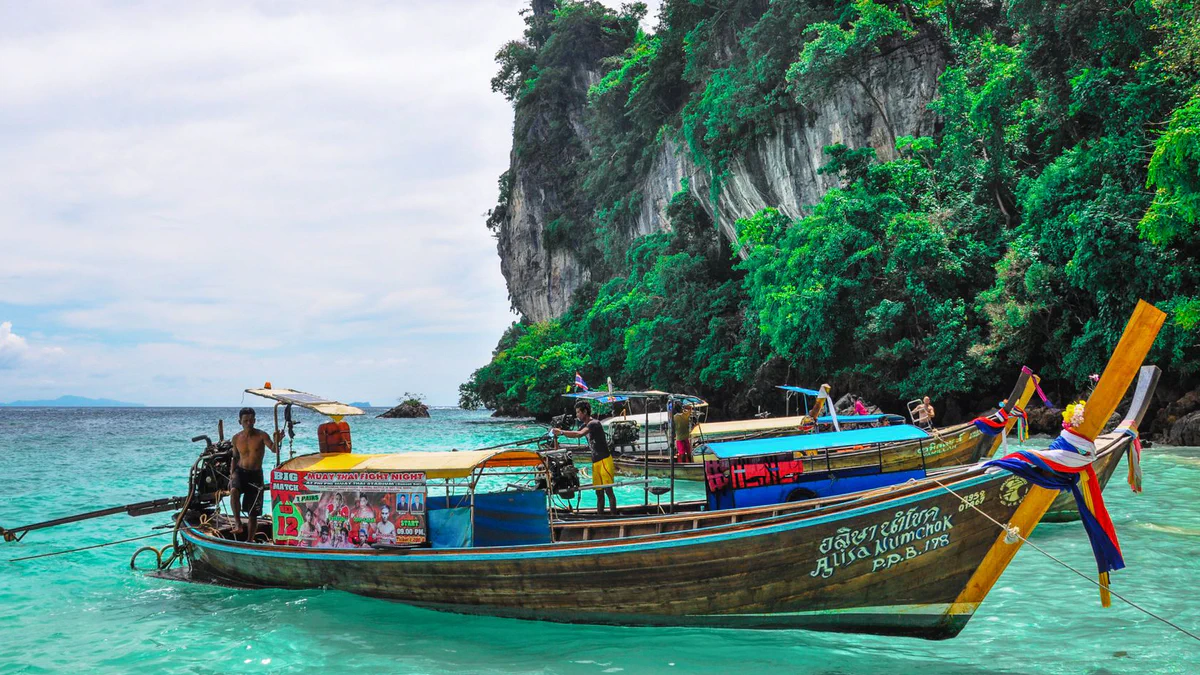
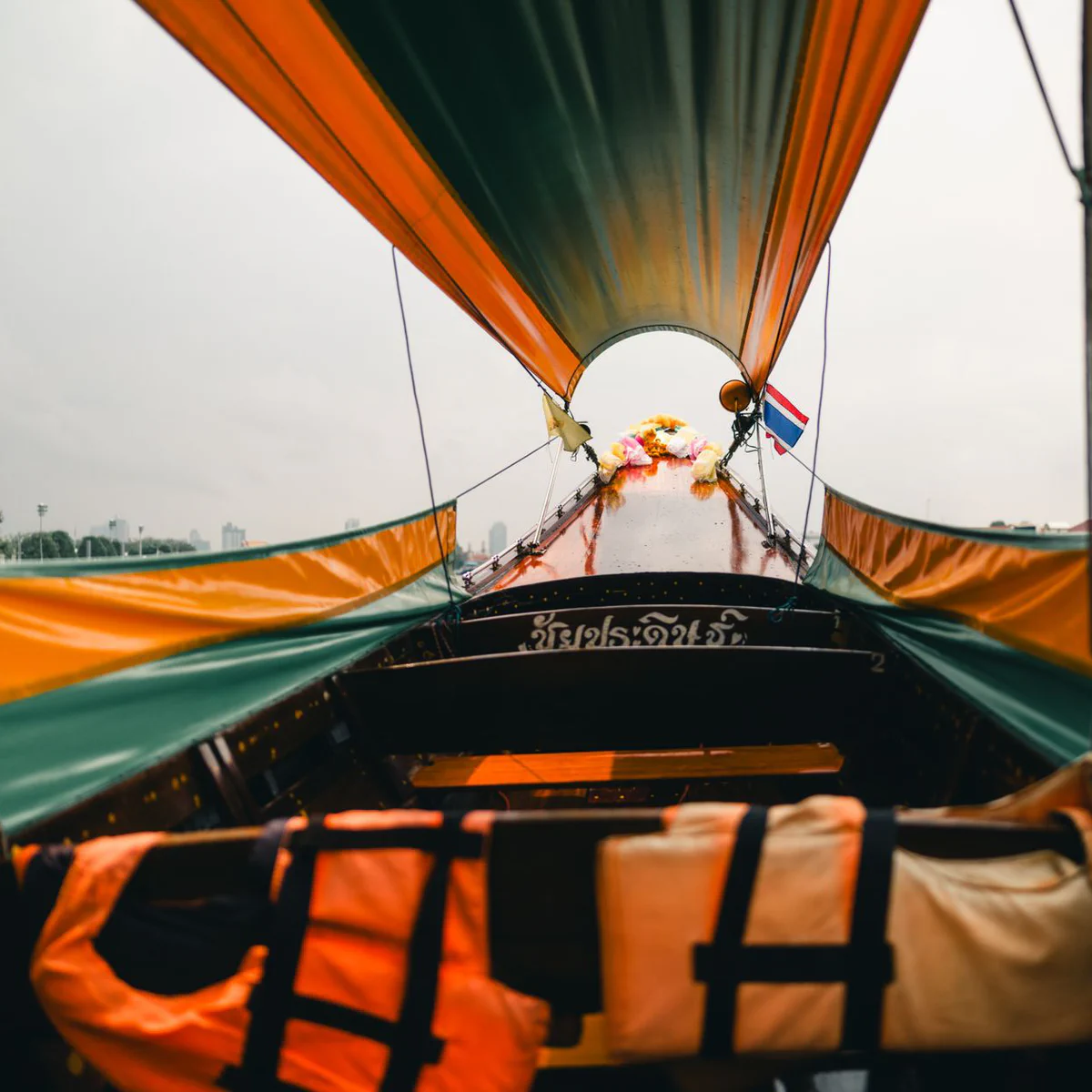
| 9.5-hour private day with four-hour longtail circuit · river-first itinerary | Driver and private captain; many riverside temples | Travelers for whom the boat is the day’s main experience | Driver and captain are not necessarily historical guides; temple fees and rain risk remain separate |
| 45-minute shared or one-to-three-hour private local cruise · add-on after train arrival | Boat only from an Ayutthaya pier | Independent train or driver trips that want a contained river segment | Does not solve Bangkok transport, temple transfers or a historical guide |
| If this is your priority | Start here |
|---|---|
| Lowest-cost independence | Train plus a pre-agreed local tuk-tuk; add the short local cruise only if time remains |
| Guide and a coherent first visit | Small-group temple-and-cruise day |
| Family pace, shade breaks and toilet stops | Private charter or balanced private longtail day |
| The river matters more than detailed interpretation | Four-hour private boat circuit |
| You want a sunset boat without surrendering the whole day | Independent transport plus the one-hour local cruise |
Train
The train is the most atmospheric way to arrive, and it’s incredibly cheap, but it requires the most effort. Make sure you check whether your service leaves from the modern Krung Thep Aphiwat Central Terminal or the old Hua Lamphong station—showing up at the wrong one is a stressful way to start the day. Once you pull into Ayutthaya, the station is still across the river from the main ruins, meaning your journey isn’t over until you’ve navigated the ferry or a tuk-tuk.
Always have a backup return time in mind. Thai trains are charming, but they aren’t always punctual, and scheduling a flight or a non-refundable dinner right after your return is asking for trouble.
Don’t just head to “the station.” Confirm your train number and give yourself at least 30 minutes to navigate the terminal, find the right window, and stock up on water. Once you’re on the tracks, the third-class carriages are open-window and breezy, but the dust and noise are part of the price you pay for the view.
The moment you step off the train, you’ll be met by drivers. Decide your transport mode before you cross the river. If you start negotiating while you’re still disoriented by the heat and the map, you’ll likely end up on a driver’s “standard” route rather than seeing what you actually came for. If you aren’t a regular cyclist, don’t let the low rental price tempt you into a bike—the roads are busier and the distances further than they look on a flyer.
Group tour
A group tour is the path of least resistance. It solves the “how do I get there” problem and usually bundles several distant ruins into one air-conditioned loop. However, you trade away your freedom. Before you pay, look closely at the “shopping stops”—some tours will kill an hour at a gem gallery or silk shop that you never asked to visit.
Pay attention to the actual time spent at each temple. A tour that promises six sites in one afternoon usually means you’ll have just enough time for three photos before being ushered back onto the bus. If you want to actually sit and absorb the atmosphere of a 14th-century temple, look for a “small group” option that prioritizes depth over a long checklist.
Private car
If you’re traveling as a family or a group of four, hiring a private car is the most sensible way to survive the heat. You get a climate-controlled sanctuary between every ruin, which can be the difference between a great day and a meltdown. Just remember that your driver is there to drive, not to guide; if you want the history explained, you’ll need to hire a licensed guide separately.
Be clear about the route and included hours. Send the priority sites to the operator in advance and ask whether fuel surcharges or tolls are included. Having a car makes it tempting to pack the day with ten stops, but resist that urge—spending the whole day getting in and out of a van is just a different kind of exhausting.
A realistic one-day route
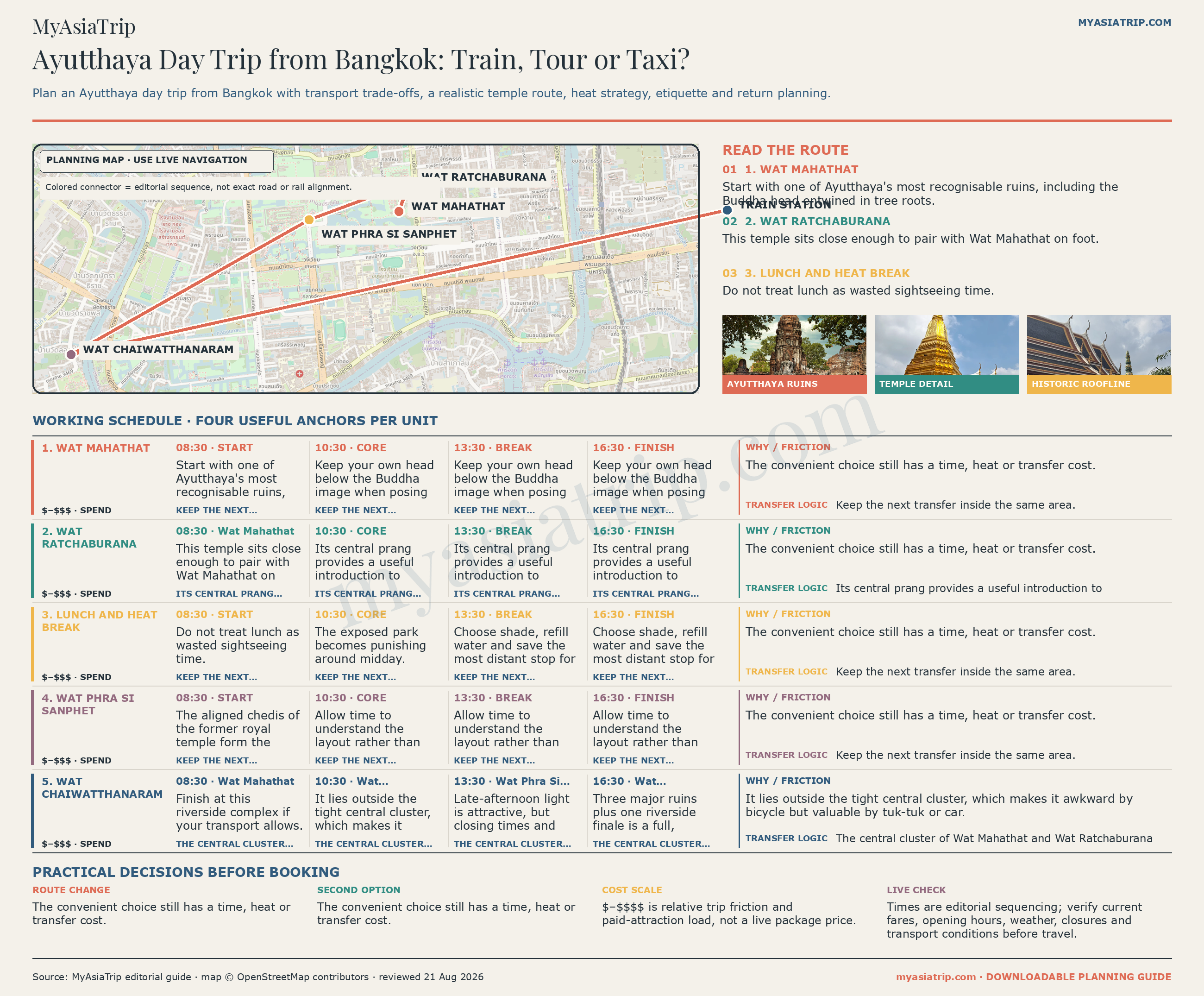
1. Wat Mahathat

Start with one of Ayutthaya’s most recognisable ruins, including the Buddha head entwined in tree roots. Keep your own head below the Buddha image when posing nearby and never climb restricted masonry.
2. Wat Ratchaburana
This temple sits close enough to pair with Wat Mahathat on foot. Its central prang provides a useful introduction to Ayutthaya’s architectural vocabulary without adding another transfer.
3. Lunch and heat break
Do not treat lunch as wasted sightseeing time. The exposed park becomes punishing around midday. Choose shade, refill water and save the most distant stop for after the break.
4. Wat Phra Si Sanphet
The aligned chedis of the former royal temple form the historical core of the old palace area. Allow time to understand the layout rather than photographing the same angle and moving on.
5. Wat Chaiwatthanaram
Finish at this riverside complex if your transport allows. It lies outside the tight central cluster, which makes it awkward by bicycle but valuable by tuk-tuk or car. Late-afternoon light is attractive, but closing times and return transport come first.
Three major ruins plus one riverside finale is a full, satisfying day. Any more than that and the temples start to blend into a blur of red brick and heat haze. The real work of the day is physically repetitive: it’s a cycle of taking shoes off, navigating uneven stone, standing in exposed courtyards, and then climbing back into a vehicle.
The central cluster of Wat Mahathat and Wat Ratchaburana is your walkable core. After that, pick the royal scale of Wat Phra Si Sanphet and save one “destination” ruin like Wat Chaiwatthanaram for the end. This gives you variety without making you feel like you’re constantly in transit.
Understand the route before adding stops
Think of your route in blocks. The Mahathat/Ratchaburana pair is the easiest win. Adding Wat Phra Si Sanphet gives you the grand royal perspective. Finally, Wat Chaiwatthanaram provides that iconic riverside silhouette, but only if you have a driver or tuk-tuk waiting. This sequence keeps the logistics simple and the variety high.
If you want to visit the Chao Sam Phraya National Museum, don’t try to squeeze it into a gap—swap out one of the temples instead. The museum is a great air-conditioned refuge, but it deserves an hour of focus, not a rushed walk-through while you’re thinking about lunch. For families, consider cutting the list down to two central temples and one riverside stop, leaving plenty of room for a long, shaded lunch.
Don’t get obsessed with catching the perfect “sunset shot” at the final temple. Between unpredictable clouds and the hard reality of closing times, you’re better off finishing while you still have enough energy to get back to the station or your van. The last thing you want is to be stranded at a riverside temple while your train is pulling out of the station.
Bicycle or tuk-tuk in Ayutthaya?
Cycling sounds romantic, but the reality involves narrow roads, unpredictable traffic, and a sun that feels twice as strong when you’re pedaling. If you choose a bike, do it for the freedom of the central island, but don’t expect to reach the distant riverside temples without a serious sweat. Always check the tires and brakes before you leave the shop—a flat tire three kilometers from the station is a quick way to ruin the afternoon.
A tuk-tuk is the most pragmatic choice for most people. It gives you a roof over your head and moves you between sites faster than a bike ever could. Just make sure you agree on the price and the specific temples before you sit down. Take a photo of the driver’s ID or vehicle number—it’s just good practice, especially if you leave a bag in the back while you explore a ruin.
Use bikes for solo travelers or couples who are used to cycling in traffic and have a high heat tolerance. If you have kids or if it’s already 32°C (90°F) by 10 AM, skip the bike. A tuk-tuk might cost more, but the shade it provides is worth every baht when you’re halfway through the day.
A tuk-tuk driver is a transporter, not necessarily a historian. Keep a map handy to verify each agreed temple stop, and confirm that waiting time is included in the quoted price. A private car provides the most comfort, though it can move more slowly through the old town’s narrow streets.
What to wear and bring
The dress code here is non-negotiable: shoulders and knees must be covered. Choose the lightest, most breathable fabrics you own, because the red brick of the ruins radiates heat like an oven. A pair of sturdy, easy-to-remove shoes is essential, as you’ll be stepping in and out of sacred areas all day. And don’t forget a compact umbrella—it’s your best defense against both the sudden tropical downpours and the relentless sun.
Respect the sites. These aren’t just photo backdrops; they are active religious spaces for many. Never climb on the masonry or sit on a Buddha image for a selfie—it’s not just disrespectful, it’s a quick way to get yourself escorted out.
Cash is king in Ayutthaya. You’ll need it for temple tickets (usually 50 THB each), street food, and your tuk-tuk driver. Make sure your phone is charged and you have an offline map, as signal can be spotty inside the larger complexes. If you’re visiting during the rainy season, a light poncho is a lifesaver, but the heat is the real enemy—bring more water than you think you’ll need.
The contrast between the red brick and the white stone makes for great photos, but it also amplifies the glare. A wide-brimmed hat is great for the narrow paths, but a small umbrella is even better for those vast, open courtyards where there is absolutely no shade to be found.
Food, water and the midday decision
Don’t wait until you’re starving and overheated to look for lunch. Find a shaded spot near the temple you’re currently at, rather than chasing a “famous” restaurant across town. Use this break to honestly assess your energy levels. If the group is flagging, there is no shame in cutting the final temple and heading back to the station early.
A successful day in Ayutthaya isn’t about how many tickets you collected; it’s about whether you actually enjoyed the history. If you’re feeling the effects of the heat, swap the last ruin for an hour in a quiet, air-conditioned museum. Pushing yourself through one more temple when you’re exhausted usually leads to a miserable return journey and a missed train—and that’s a trade-off that’s never worth it.
Should you stay overnight?
If you really want to see Ayutthaya at its best—without the midday crowds and the crushing heat—consider staying overnight. The ruins are hauntingly beautiful at sunrise and sunset, and you’ll have time for a relaxed riverside dinner. A day trip is a great introduction, but it’s essentially a highlight reel; an overnight stay lets you actually see the city beyond the postcards.
Staying the night takes the pressure off your return logistics, but be aware that it means another hotel check-in and out. If your Thailand trip is already packed, a day trip is perfectly fine. Only book a room if you genuinely want to explore the history at a deeper level, not because you feel “guilty” about only spending a day here.
Ayutthaya day-trip checklist
- Verify the outbound terminal and current return options.
- Choose train, tour or car before building the temple list.
- Save an offline map and mark the central cluster.
- Wear temple-appropriate, heat-friendly clothing.
- Protect a long lunch and water break.
- Keep the Bangkok evening unbooked.
- Recheck opening notices and weather shortly before departure.
Compare this outing with other options in best day trips from Bangkok. Keep the evening simple by choosing a base from the Bangkok neighborhood guide, and check the city-side connection in getting around Bangkok before committing to a return train.
Sources and live checks
Quick answers
Frequently asked questions
Can Ayutthaya be visited as a day trip from Bangkok?
Is the train or a tour better?
Research notes
Official planning references
We use these primary references for the time-sensitive details relevant to this guide. Rules, prices and operating hours can change, so confirm the live information before you travel.
- Tourism Authority of Thailand
Details to check: Official destination information and trip-planning context
- BTS Skytrain
Details to check: Official Bangkok rail routes, stations and fares
Guide reviewed 30 August 2026. Confirm live rules, prices and operating details with the linked authority before travel.