Getting Around Bangkok: BTS/MRT Map, Boats & Taxis
Get around Bangkok with a downloadable BTS/MRT map, key interchanges, boats, taxis, airport links, payment advice and realistic safety tips.


The best way to get around Bangkok
For a first Bangkok trip, use the BTS and MRT whenever they cover the route, boats for river or canal corridors, and a taxi or ride-hail for the final gap. The hard part is not the number of transport options; it is knowing when a short distance on the map hides a hot walk, a separate ticket or an hour of road traffic.
The key decision points are simple:
- Time of day. During the morning and evening commuter peaks, rail is normally more predictable than a car for a rail-connected journey. Outside those periods, a taxi may be competitive for a group, but Bangkok traffic can still change quickly.
- Distance. If you need to go from the Old City to Sukhumvit, you are crossing the city’s heart. The rail network is the only way to do this without losing half your afternoon to a gridlocked intersection.
- Budget. If you’re counting every baht, the public buses and canal boats are the winners. Rail fares add up quickly if you’re making multiple transfers, and road trips often come with “hidden” costs like expressway tolls or airport surcharges that can double your initial estimate.
- Luggage. The Airport Rail Link is a lifesaver for solo travelers with a backpack, as it bypasses the highway mess entirely. However, if you have three suitcases and a family in tow, a taxi is a necessary luxury, provided you leave yourself an extra hour for traffic.
- Novelty versus practicality. A tuk-tuk can be an experience, but it is not a dependable network strategy. Agree the fare and destination before boarding, and use rail or a metered/app-booked car when arrival time matters.
There is no single mode that works everywhere. You may use rail, a river boat and a taxi in the same day, so plan around the part of each journey that is hardest to replace.
Choose transport by the shape of the trip
| Trip shape | Best starting point | Why it usually works | Check before committing |
|---|---|---|---|
| Hotel and attraction both near rail | BTS or MRT | Predictable in road traffic and easy to price | The final walk, station exits and whether a system change is required |
| Old City and river sights | MRT plus boat or short taxi | Avoids a long road crossing of central Bangkok | Pier location, boat flag and final service |
| One awkward last kilometre | Rail plus short taxi or motorcycle taxi | Keeps the road leg short | Pickup point, helmet and luggage suitability |
| Door-to-door with children or bags | Metered taxi or ride-hail | Fewer stairs and transfers | Traffic time, tolls and pickup restrictions |
| Very short novelty ride | Tuk-tuk | Memorable and direct for a negotiated hop | Total price and destination before boarding |
A BTS map answers only part of the question. BTS, MRT and Airport Rail Link are separate systems with different ticketing, and the station that looks closest on a schematic map may still involve a hot final walk. Use the map to find the line; use a street map to judge the exit and last 500 metres.
Bangkok BTS and MRT map
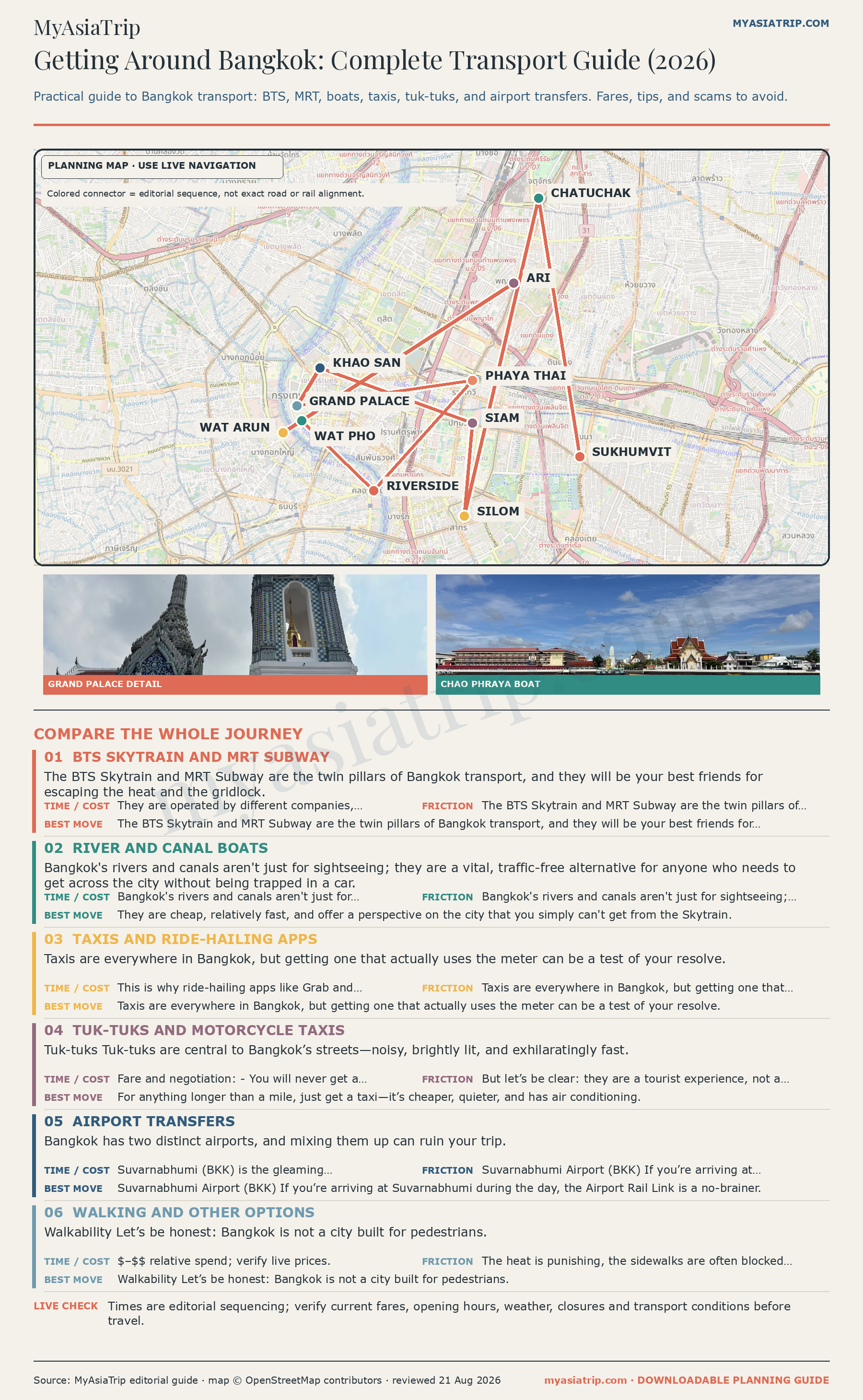
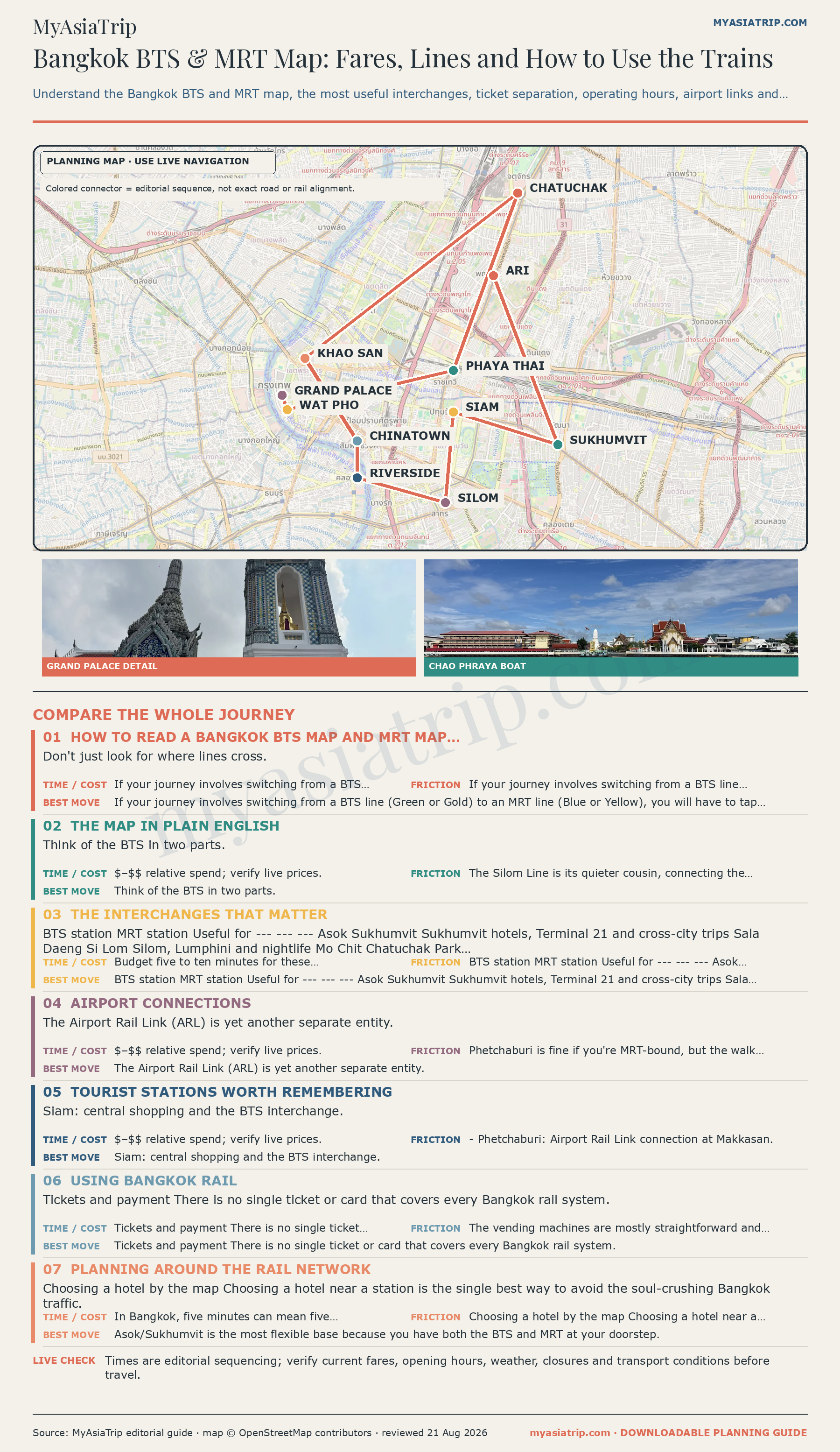
The BTS Skytrain and MRT are separate systems that meet at several interchanges but do not share a single ticket. Use this visitor map to identify the rail corridor closest to your hotel, then check the walking connection at any BTS–MRT transfer. A station pair that appears joined on a diagram may still involve stairs, a corridor and a few minutes outdoors.
The rail map in plain English
The BTS Sukhumvit Line serves Siam, Asok and many hotel districts along Sukhumvit Road. The BTS Silom Line connects the shopping core with Silom and the river at Saphan Taksin. The MRT Blue Line is particularly useful for Chinatown at Wat Mangkon, the Old City edge at Sanam Chai and the Sukhumvit interchange. Other lines can matter for a specific hotel or suburban destination, but most first-time itineraries revolve around these three corridors.
BTS–MRT interchanges visitors use
| BTS station | MRT station | Useful for |
|---|---|---|
| Asok | Sukhumvit | Sukhumvit hotels, Terminal 21 and a central cross-system transfer |
| Sala Daeng | Si Lom | Silom, Lumphini and evening areas |
| Mo Chit | Chatuchak Park | Chatuchak Weekend Market and northern connections |
| Ha Yaek Lat Phrao | Phahon Yothin | Northern shopping and onward rail connections |
| Bang Wa | Bang Wa | Western Bangkok and the MRT Blue Line |
Siam is the main interchange between the two BTS lines and does not require leaving the paid area. At a BTS–MRT interchange, expect to exit one system, walk to the other station and pay again.
Airport rail connections
From Suvarnabhumi Airport, the Airport Rail Link connects with the BTS at Phaya Thai and with the MRT via the Makkasan–Phetchaburi connection. Neither transfer is part of the BTS or MRT paid area. Don Mueang uses the SRT Red Line or airport buses rather than BTS; the Suvarnabhumi Airport to city guide covers the full arrival decision.
Tourist stations worth remembering
- Siam: BTS interchange and central shopping.
- Asok/Sukhumvit: major BTS–MRT transfer and Sukhumvit hotels.
- Saphan Taksin: connection to Chao Phraya river services.
- Wat Mangkon: Chinatown.
- Sanam Chai: the Old City edge for Wat Pho and nearby sights.
- Mo Chit/Chatuchak Park: Chatuchak Weekend Market.

BTS and MRT tickets, fares and operating hours
Operating hours and frequency
- BTS publishes an overall service window of 5:00 AM to 1:00 AM, but the last useful train depends on the station, direction and any connection you still need to make.
- BEM lists the MRT Blue Line at 6:00 AM to midnight, while the Purple Line starts at 5:30 AM on weekdays and 6:00 AM on weekends and public holidays, ending at midnight.
Do not build a midnight connection around the advertised end of service. The last train that completes your direction or transfer may leave earlier, so check the operator timetable on the day and use a taxi or ride-hail after rail service ends.
Fare structure
Rail fares are based on how many stations you pass, and the prices have a habit of creeping up every year. Always check the official fare tables for your specific date. Be wary of “Day Passes”—they only provide value if you are staying strictly on one system (like the BTS) all day. They won’t help you if you’re hopping back and forth between the Skytrain and the Subway.
Separate systems
The biggest frustration for newcomers is the lack of a unified payment card. Your BTS Rabbit card is useless at an MRT gate, and while the MRT now accepts contactless bank cards, the BTS is still catching up. When you transfer at major hubs like Asok/Sukhumvit or Mo Chit/Chatuchak Park, be prepared to tap out, walk through a crowded tunnel or overpass, and tap back in at the other station. It’s a minor annoyance, but it adds five minutes to every transfer.
Ticket options
- BTS single-journey tickets come in the form of thin magnetic cards sold at station kiosks. Most newer machines now accept QR payments, which saves you from carrying a pocketful of coins.
- Rabbit card is the smart choice if you’re in town for a few days and plan to use the Skytrain heavily. Just be aware that there is a non-refundable issuing fee, so it won’t save you money if you only plan to take two or three rides.
- MRT Blue and Purple lines are much more modern, allowing you to simply tap your Visa or Mastercard at the gate. Just make sure you use the same card to exit that you used to enter, or the system will flag you for a maximum-fare penalty.
- Day and trip products often sound like a bargain, but they are frequently restricted to specific lines or zones. Read the fine print before you buy, or you might find yourself paying extra for a station that “wasn’t included” in your pass.
Which rail system should you use?
- BTS covers the tourist-heavy areas along Sukhumvit Road (Nana, Asok, Thong Lo, Ekkamai), Silom Road, and Siam Square.
- MRT covers the Old City (Sanam Chai station near the Grand Palace), Huai Khwang, and connects to the Airport Rail Link at Phetchaburi (MRT) and Makkasan.
If your route requires you to use both the BTS and the MRT, accept the fact that you’ll be paying twice and doing a bit of walking at the interchange. Even with that friction, you will still be moving at three times the speed of the cars stuck in the street below you.
Practical rail tips
- Rush hour. Between 7:30 and 9:00 AM and 5:00 and 7:00 PM, the trains aren’t just full—they are packed to the point of discomfort. If you aren’t comfortable with body-to-body crowds, avoid the Sukhumvit line during these windows. If you must travel, try to stand near the doors to make your exit easier.
- Route planning. Don’t guess. Use Google Maps or the official apps to see the current train frequency and transfer times. A route that looks short on a map might involve a long, hot walk between stations.
- Payment convenience. Using a Rabbit card on the BTS saves you from the inevitable queue at the ticket machines. For the MRT, your contactless bank card is the easiest path, but be aware that some international banks might flag the small, repeated transit charges as fraud. Always have a backup card or some cash ready just in case.
- Elevators and escalators. Most stations are equipped with them, but they aren’t always where you need them to be. Some older BTS stations still rely on steep stairs for certain exits. If you’re traveling with heavy luggage or a stroller, the MRT is generally a much friendlier experience than the older parts of the BTS network.
River and canal boats
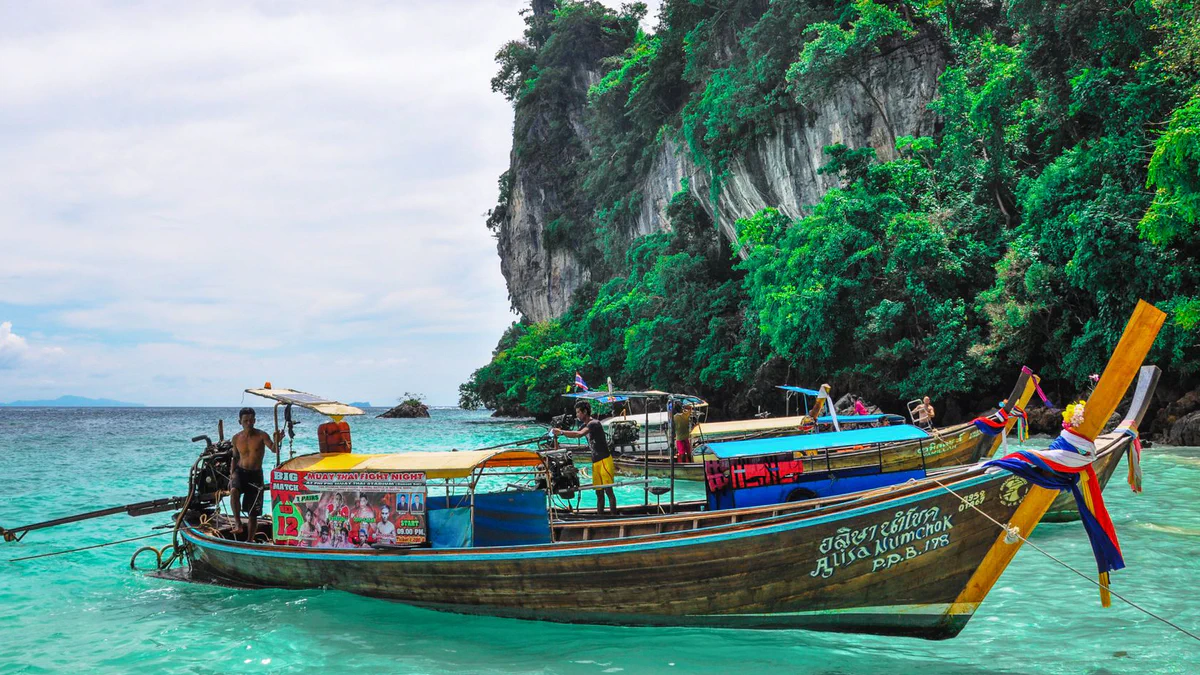
Bangkok’s rivers and canals aren’t just for sightseeing; they are a vital, traffic-free alternative for anyone who needs to get across the city without being trapped in a car. They are cheap, relatively fast, and offer a perspective on the city that you simply can’t get from the Skytrain.

Chao Phraya express boats
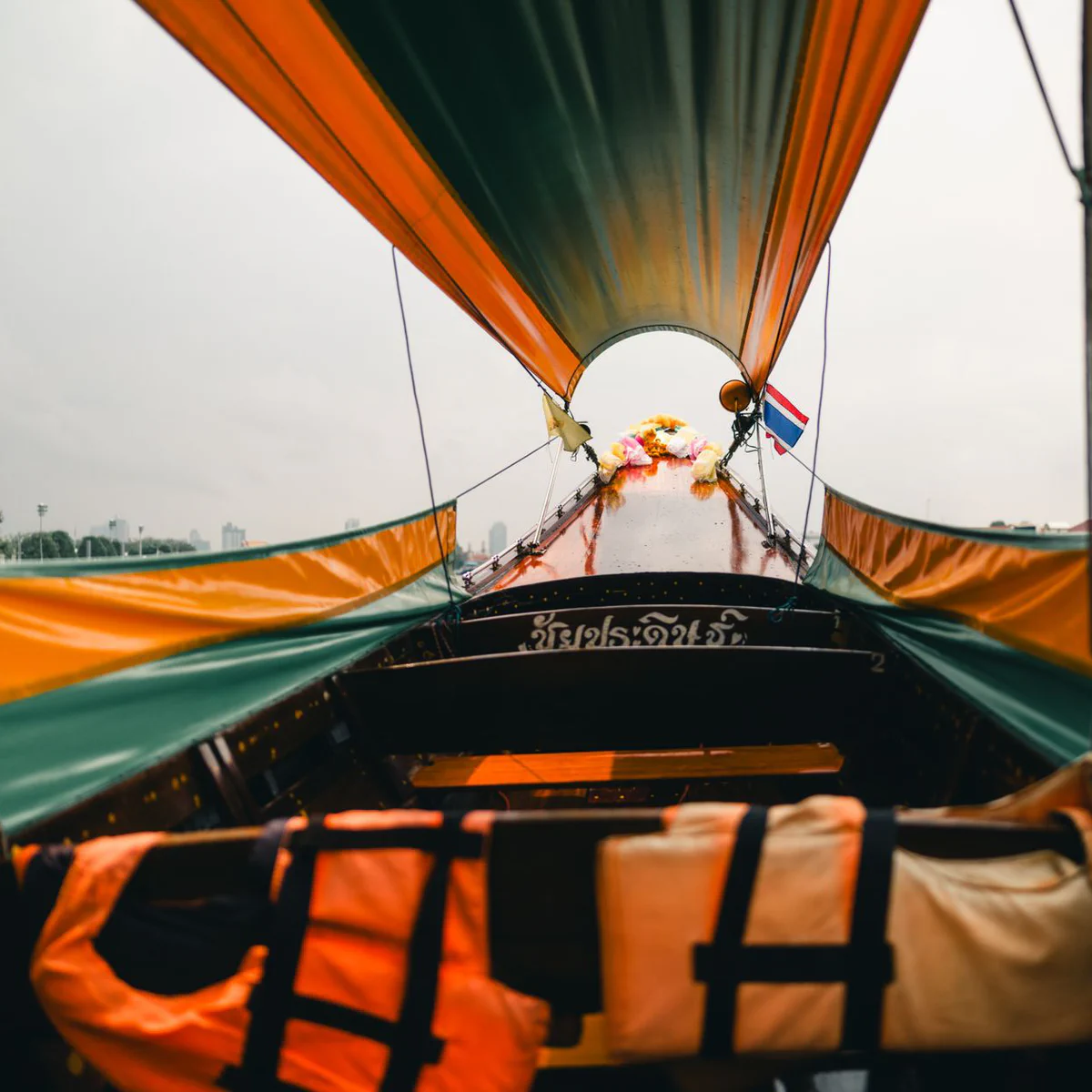
The river boat services use colored flags to distinguish routes. Use the Chao Phraya river boats guide for current piers, service days and a single-ticket versus day-pass comparison:
- Express boats. The current Orange Flag timetable covers weekday peak periods. For daytime or weekend travel, compare the Yellow Midday timetable and check the exact pier before boarding. These commuter services can be busy.
- Blue flag. The separate Chao Phraya Tourist Boat offers single tickets and a same-day hop-on/hop-off pass between sightseeing piers. A pass is useful for several journeys; it does not reserve a seat or cover other operators.
If you just need to get across the river—for example, from Wat Pho to Wat Arun—there are dedicated cross-river ferries that run every few minutes for a tiny fare. Don’t waste money on a longer boat ride just to cross the water. Keep some small coins handy, as these ferries don’t take cards or large notes.
Boarding tips: You can usually buy your ticket at the pier, but on some boats, a conductor with a metal cylinder will come around to collect your fare. The boats dock for only a few seconds, so don’t wait until the last moment to move toward the exit. River services finish earlier than the trains, and final departures vary by operator, direction and pier. If you’re planning to return by boat, take a photo of the last-departure notice at the pier so you don’t end up stranded.
Saen Saep canal boats
If you need to go from the Old City to the shopping malls of Siam Square, the Saen Saep canal boats are a secret weapon. These long-tail boats fly through the narrow canals, bypassing every single red light and traffic jam on the road above.
- Route. Golden Mount (near Wat Saket and the Khao San area) to Minburi (eastern suburbs).
- Key stops for tourists. Hua Chang is useful for Siam Square and the MBK Center; Pratunaam serves the shopping area and Baiyoke Tower.
- Fare. 8 to 20 THB, collected on board by a conductor who passes along the side of the boat. Lower fares are for shorter trips.
- Operating hours. Typically 5:00 or 6:00 to 19:00 or 20:00 on weekdays. Weekend schedules are less consistently reported. Check at the pier or use as a weekday option.
Caveats:
- The canal water is not something you want on your clothes. It’s murky and occasionally splashes over the side, so keep your electronics tucked away and maybe don’t wear your best white shirt.
- Boarding is not for the faint of heart. The boats dock quickly and often don’t come to a complete standstill. You’ll need to be nimble as you step from the deck to the pier.
- There are no ticket machines here. Just find a spot, hold onto the handrail, and wait for the conductor—who will be balancing on the edge of the boat—to come to you for payment.
When to choose boats
- The Chao Phraya orange flag is your best bet for a day of temple hopping. It connects the Grand Palace and Wat Pho directly to the BTS network at Sathorn, saving you from a long, expensive taxi ride.
- The Saen Saep canal boats are the undisputed champions for getting from Khao San Road to the malls of Siam or Pratunaam in under twenty minutes. It’s a gritty, noisy ride, but it beats sitting in a taxi for an hour.
- Remember the curfew: almost all boat services shut down between 6 and 8 PM. They are a daytime solution, not a way to get home after dinner.
Taxis and ride-hailing apps
Taxis are everywhere in Bangkok, but getting one that actually uses the meter can be a test of your resolve. This is why ride-hailing apps like Grab and Bolt have become so popular—they offer a fixed price and a guaranteed ride, even if it costs a bit more than a metered cab.
Metered taxis
A metered taxi is technically the cheapest way to travel by car. The fare starts at just 35 THB, and most short trips around the city will only cost you 60 to 90 THB. However, you are responsible for any expressway tolls, which the driver will ask for as you approach the toll booth. These can add another 50 to 120 THB to your bill, turning a “cheap” ride into a 200 THB journey in the blink of an eye.
How to get a taxi that uses the meter:
- The best way to get a metered ride is to avoid the taxis parked directly in front of major tourist attractions. Instead, walk a block away and hail a cab that is already moving. Drivers who are cruising are much more likely to play by the rules.
- If a driver greets you with a flat price—say, “200 baht to Siam”—simply smile, say no, and close the door. There is no point in arguing. Just wait for the next cab; there are thousands of them.
- If you find yourself in a “meter-refusal zone” (like outside a major nightclub at 2 AM), this is when you pull out your phone and use a ride-hailing app. It saves you the frustration of haggling.
Additional costs:
- When leaving the airport, don’t be surprised when the driver adds a 50 THB surcharge to the final meter price—this is the official airport fee.
- Keep in mind that the meter also ticks up based on time, not just distance. If you’re sitting in deadlocked traffic, the price will slowly rise even if you aren’t moving. For short trips, this is negligible, but it can add up on a long cross-city crawl.
Ride-hailing apps (Grab, Bolt, inDrive)
- How they differ. The biggest advantage is the fixed price. You know exactly what you’re paying before you even open the car door, and you can pay automatically through the app without worrying about change.
- The trade-off. You are paying for peace of mind. A Grab ride will almost always be 20% to 50% more expensive than a metered taxi for the same distance. For many, that premium is worth it to avoid the meter argument.
- Availability. Grab is the undisputed king in Thailand, but Bolt and inDrive are catching up with often lower prices. It’s worth having two or three of these apps installed so you can compare prices when the demand is high.
- When to use them. Apps are a lifesaver when it’s raining (when taxis suddenly become impossible to find), late at night, or when you’re heading to the airport and don’t want to gamble on a driver showing up.
General taxi advice: The golden rule is this: a metered taxi is your first choice for value, and a ride-hailing app is your “Plan B” for reliability. Don’t be afraid to switch between them depending on how much patience you have left at the end of the day.
Tuk-tuks and motorcycle taxis
Tuk-tuks
Tuk-tuks are central to Bangkok’s streets—noisy, brightly lit, and exhilaratingly fast. But let’s be clear: they are a tourist experience, not a practical transport solution. They offer zero protection from the heat, the noise, or the pollution.
Fare and negotiation:
- You will never get a “local” price in a tuk-tuk. Fares start at 100 THB even for a two-minute ride. You must negotiate the price before you get in, or you will be in for a shock when you arrive.
- Be on guard for the “attraction is closed” routine. If a driver tells you the Grand Palace is shut for a ceremony and offers to take you to a “lucky Buddha” instead, he is likely leading you into a commission-based scam at a tailor or gem shop. Decline politely but firmly.
- Use a tuk-tuk for a quick five-minute ride through an area such as the Old City. For anything longer than a mile, just get a taxi—it’s cheaper, quieter, and has air conditioning.
Safety: Safety-wise, a tuk-tuk is essentially a motorized carriage with no seatbelts or crumple zones. They are fine for a slow crawl through a market, but avoid them on high-speed roads and during tropical downpours.
Motorcycle taxis (motorsai)
The orange-vested riders you see at every street corner are Bangkok’s “motorsai.” They are the city’s red blood cells, moving people through the narrowest gaps in traffic that no other vehicle can reach.
- Fare. At the main stands near rail exits, you’ll see a board with fixed prices for common destinations. For anywhere else, you’ll need to agree on a price first—usually between 20 and 50 THB for a short hop.
- When to use. They are the undisputed champions of the “last mile.” When you step off the BTS and realize your hotel is a twenty-minute walk down a hot, sidewalk-free street, a motorcycle taxi will get you there in three minutes for the price of a coffee.
- Safety. Be aware that this is the most dangerous way to travel. You will be weaving between buses and cars with inches to spare. If you decide to take the risk, insist on a helmet and keep your knees tucked in. If you aren’t comfortable with high-stakes traffic, stick to walking or a taxi.
Airport transfers
Bangkok has two distinct airports, and mixing them up can ruin your trip. Suvarnabhumi (BKK) is the gleaming international hub, while Don Mueang (DMK) is the older, smaller home for budget carriers.
Suvarnabhumi Airport (BKK)
If you’re arriving at Suvarnabhumi during the day, the Airport Rail Link is a no-brainer. For just 45 THB, you can bypass the highway traffic and be at a BTS or MRT connection in thirty minutes. It’s clean, efficient, and incredibly cheap.
Taxis from Suvarnabhumi:
- If you choose a taxi, follow the signs to the official public queue. You’ll take a ticket from a machine and go to a numbered lane. The driver is required to use the meter. Between the fare, the 50 THB airport fee, and the highway tolls, expect to pay between 300 and 500 THB to reach central Bangkok.
- Ignore the people in the arrivals hall who approach you offering a “limousine” or a fixed-price ride. They are almost always charging double the official rate. Stick to the queue.
When to choose which:
- Take the train if you’re a solo traveler or a couple with light bags and your hotel is near a rail station.
- Take a taxi if you’re arriving after midnight (when the trains stop), if you have more bags than you can comfortably carry, or if you’re staying in the Old City where the rail network doesn’t reach.
Don Mueang Airport (DMK)
Don Mueang Airport is connected to the city by the SRT Red Line train. It avoids northern Bangkok traffic, but it is not a direct ride to most tourist centers. You will usually transfer at Krung Thep Aphiwat for the MRT or take a taxi for the final stretch.
Airport buses A1 through A4 remain useful when their destination matches the hotel: A1 serves Mo Chit 2, A2 Victory Monument, A3 Lumphini Park and A4 Sanam Luang. The airport currently lists flat fares of 30 baht for A1–A2 and 50 baht for A3–A4, with different service windows by route. The airport buses (A1 to A4) are a surprisingly good value if their route happens to end near your hotel. They are cheap—30 to 50 THB—and use the elevated toll roads to skip the worst of the traffic. Just double-check the current bus stop location when you land, as they have a habit of moving them during airport renovations.
Taxis and ride-hailing from Don Mueang:
- Just like at Suvarnabhumi, use the official taxi stand or the designated ride-hailing pickup point. Don’t be tempted by the “private drivers” waiting in the arrivals hall. And remember: tolls are always extra, so have some cash ready for the driver.
Walking and other options
Walkability
Bangkok is not a city built for easy pedestrian travel. The heat is punishing, the sidewalks are often blocked by street food stalls or construction, and motorbikes sometimes use the pavement as a shortcut. Walking is still the best way to see certain compact pockets of the city, but choose those sections deliberately.
- Chinatown (Yaowarat). Narrow alleys with street food stalls. Walking is the primary mode.
- Old Town (Rattanakosin). Temples (Grand Palace, Wat Pho, Wat Arun) are close together. The stretch along the river and the Bangkok Linear Park provides a pleasant riverside walking path.
- Sukhumvit between Soi 11 and 24. Sidewalks are present but crowded. You can walk between BTS stations, but the heat and traffic fumes can be taxing.
If you do decide to explore on foot, keep your eyes on the ground. Uneven pavement and the occasional missing manhole cover are real hazards. And always listen for the sound of a scooter behind you—on a busy afternoon, the sidewalk is just another lane for the locals.
Renting a car or motorbike
Before considering a rental car or scooter, check the licensing and insurance requirements and whether you are comfortable with dense traffic and frequent lane changes. Driving also adds navigation and parking to each outing, which may be more work than you want on a short visit.
If you are unfamiliar with Bangkok traffic, choose public transport or a car with a driver instead of renting a scooter. For trips beyond the city, a driver or arranged transfer lets you avoid navigating unfamiliar roads yourself.
Other options (briefly)
- Public buses. The bus network is vast and dirt-cheap, but it’s a puzzle for most visitors. Unless you have a reliable mapping app that tells you exactly which bus number to wait for, you’re likely to end up on a very long, very hot tour of the suburbs.
- Bike-sharing (e.g., Moov, some Lime scooters). You might see a few shared bikes or scooters around, but the infrastructure just isn’t there yet. They aren’t integrated with the rail system, and the registration process often requires a Thai phone number, making them more trouble than they are worth for a short stay.
Official checks
Quick answers
Frequently asked questions
What is the cheapest way to get around Bangkok?
Is it safe to take a tuk-tuk in Bangkok?
Do taxis in Bangkok use the meter?
How do I get from Suvarnabhumi Airport to the city?
Research notes
Official planning references
We use these primary references for the time-sensitive details relevant to this guide. Rules, prices and operating hours can change, so confirm the live information before you travel.
- Tourism Authority of Thailand
Details to check: Official destination information and trip-planning context
- BTS Skytrain
Details to check: Official Bangkok rail routes, stations and fares
Guide reviewed 7 September 2026. Confirm live rules, prices and operating details with the linked authority before travel.