


Best Time to Visit Thailand: Seasons, Coasts and Crowds
Compare Thailand's seasons, regional weather, crowds, prices, smoke and sea conditions to choose travel dates, the right coast and a workable route.


Use this guide when you have the luxury of choosing your dates and need to balance the promise of sunshine against the reality of crowd levels and peak pricing. If your flights are already booked and you just need to know what to expect, you should go straight to the Thailand weather by month breakdown. For those looking beyond Thailand, our Southeast Asia timing hub or regional trip ideas for December–February, March–May, June–August and September–November will give you the broader picture.
Choose your travel window by priority
| Your priority | Strong starting window | Main trade-off | Next guide |
|---|---|---|---|
| Most reliable multi-region weather | Mid-November to February | Peak prices and crowds | 10-day Thailand route |
| Andaman beaches such as Phuket or Krabi | November to April | Busiest around year-end | Thailand islands and beaches |
| Gulf islands such as Samui or Tao | February to August | Heat or showers vary by month | Check the monthly weather breakdown |
| Lower prices and fewer visitors | May to September | Rain and disrupted sea plans | Thailand travel costs |
| Northern trekking and comfortable city days | November to February | Smoke risk rises later in the dry season | Two-week Thailand route |
| Songkran | Mid-April | Extreme heat and holiday demand | Packing list |
Overview: Thailand’s three seasons
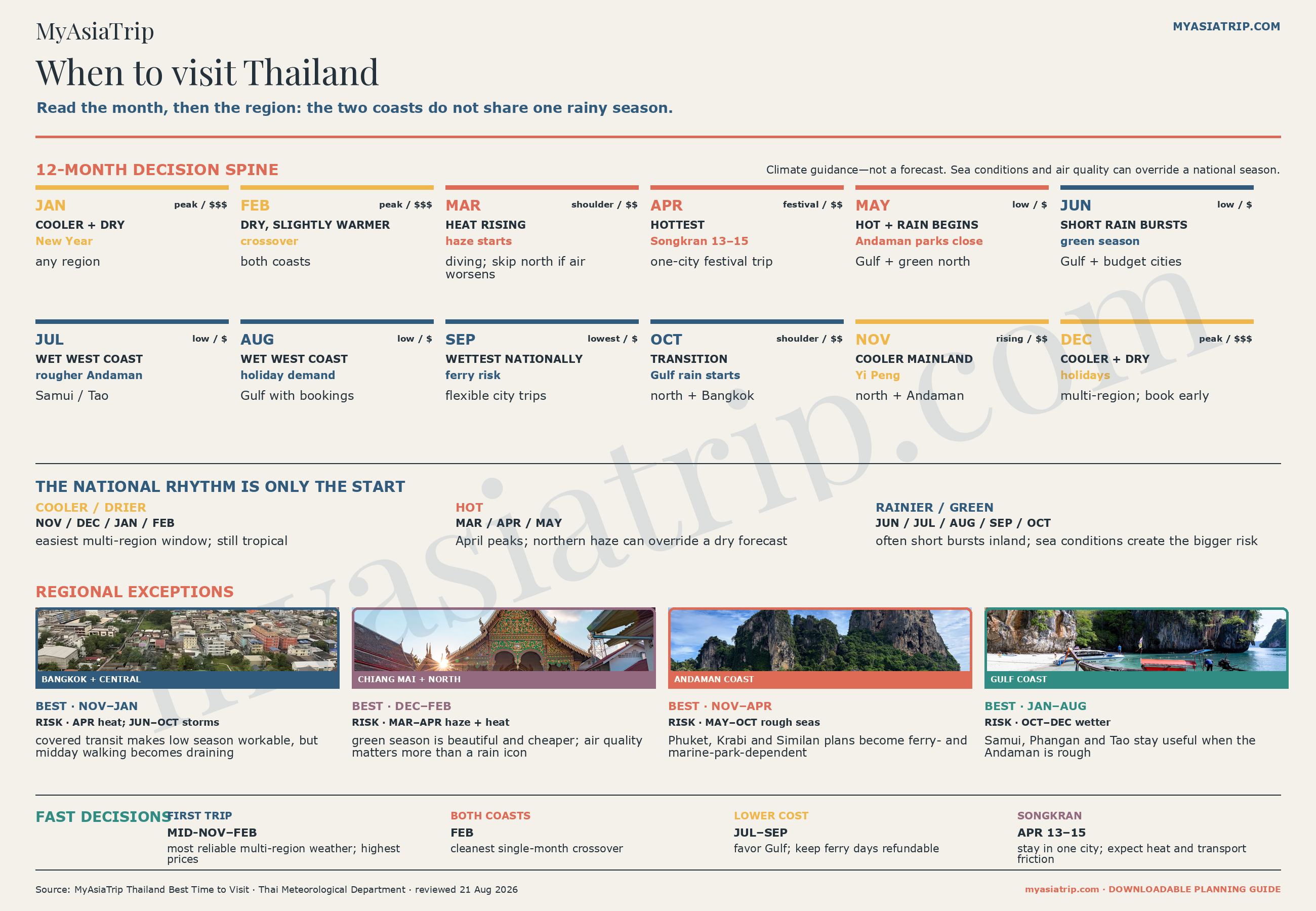
Thailand’s tropical climate is often simplified into three seasons, but the reality on the ground is far more nuanced. While most of the country experiences a hot season (March to May), a rainy season (June to October), and a “cool” dry season (November to February), these labels can be misleading. The “cool” season is still hot by most standards, and the “rainy” season rarely means it rains all day every day. However, the timing varies dramatically between the two coasts, and some destinations have their own microclimates that can make or break your plans.
November through February offers the most reliable weather across the country: lower humidity, cooler nights that actually let you sleep, and minimal rainfall. This is, of course, the peak tourist season, when you will be sharing that “perfect” sunset with thousands of others, and paying a premium for the privilege. The rest of the year involves a series of calculated trade-offs between heat, cloud cover, and your travel budget.
Choose your travel window by region, weather tolerance, festival timing and crowd pressure rather than by one national “best month.” Use the monthly breakdown linked above once you have shortlisted a season.
The most important thing to understand is the divergence between the Andaman coast (Phuket, Krabi, Phi Phi, and the Similan Islands) and the Gulf coast (Koh Samui, Koh Phangan, and Koh Tao). Their monsoon timings are offset by roughly six months. The west coast gets its prime weather from November through April, while the east coast is often at its best from January to August. This means that even during the national rainy season, there are pockets of sunshine if you are willing to be flexible with your destination. There is no single “bad” month to visit Thailand, only different sets of compromises you’ll need to make.
Best overall time: November to February
If your primary goal is blue skies and manageable temperatures, you should book your trip between mid-November and late February. During these months, the northeast monsoon brings relatively cool, dry air across most of the mainland. In northern Chiang Mai, the evenings can actually get chilly enough to require a light jacket—a welcome relief from the tropical heat. Down on the beaches of Phuket and Krabi, the Andaman Sea is calm, clear, and perfect for island-hopping.
Peak season brings higher prices for flights and hotels, and you should expect long queues at major temples, crowded viewpoints, and chaotic ferry terminals. Book accommodation well in advance, especially if you plan to be here for Christmas or New Year. The convenience of perfect weather comes at a cost, both to your wallet and your patience for crowds.
For a first trip or a rare visit, November through February is the most dependable window. It is the most reliable time for a smooth, multi-region itinerary. The combination of lower humidity and minimal rainfall makes sightseeing in Bangkok, temple-hopping in Chiang Mai, and lounging on either coast equally pleasant. For first-timers who want a hassle-free introduction to the country without worrying about ferry cancellations or flooded streets, November through February is the clear winner.
However, “peak” doesn’t have to mean “bankrupt.” If you are organized and book your flights three to four months ahead and your hotels two to three months out, you can still find reasonable rates. The payoff is an almost guaranteed good-weather experience. For those with a bit more flexibility, the shoulder months of March and October offer a similar climate with noticeably fewer tourists, though you’ll have to contend with rising heat in March and the last of the monsoon rain in October.
Shoulder and low seasons: Trade-offs for fewer crowds
March to June: The heat sets in
March is a transition month where the “cool” season fades and the temperatures begin their steady climb toward the punishing highs of April. Humidity starts to build, and you might see the occasional brief afternoon shower in the north. The trade-off is that the crowds begin to thin out at the major resorts, and you’ll have the chance to experience Songkran (April 13-15), Thailand’s massive, country-wide water fight.
April is the hottest month nationwide and overlaps with the northern “burning season.” Agricultural fires in the surrounding hills can create a thick, acrid haze that makes the air quality in Chiang Mai genuinely unhealthy. If you have respiratory sensitivities or just want to see the mountains without a veil of smoke, March and April are not the months for the north. However, the coastlines remain a great option, particularly the east coast, which enjoys drier conditions and refreshing sea breezes.
May and June see the arrival of the rains, particularly in the north and on the west coast. But don’t let the term “rainy season” scare you off—the showers often come in short, intense bursts in the late afternoon, leaving the mornings clear for exploration. The “green season” transforms the landscape into a lush, lively paradise, and you will benefit from significantly lower hotel rates and empty beaches. This is the sweet spot for budget travelers who can tolerate the heat and don’t mind the occasional downpour. For divers, just keep in mind that the Andaman marine parks (like the Similans) close around mid-May, so you’ll need to shift your focus to the Gulf coast.
July to September: Low season rewards
The low season (July to September) is when you’ll find the absolute best deals on flights and luxury hotels. Yes, the rain is real—September is statistically the wettest month nationwide—but the character of the rain matters. Most of the time, it’s a sharp downpour that clears the air and is gone within an hour. The Gulf of Thailand islands (Koh Samui, Koh Phangan, and Koh Tao) enjoy their own microclimate during this period and often remain relatively dry and sunny while the west coast is getting soaked.
The real risk during these months isn’t just getting wet; it’s the sea conditions. Boat schedules to the more remote islands can be disrupted, and ferries are frequently cancelled at short notice if the swells get too high. The Andaman coast is largely off-limits for island-hopping as the major marine parks are closed for conservation and safety. If your heart is set on diving the Similan Islands, you simply have to come between November and April; there is no way around it.
For inland cities like Bangkok and Chiang Mai, the low season is actually quite rewarding. The rain usually falls in the evening, the dust is washed away, and the city feels much fresher. The lush greenery, lack of crowds at major sights, and the ability to book top-tier hotels for a fraction of their peak price make this a great time for travelers who can be flexible and don’t mind carrying a sturdy umbrella.
October: The final rainy month
October is a gamble. It is the tail end of the rainy season, and while the west coast starts to dry out, the east coast can still be quite wet. It is a true shoulder month: you’ll find moderate crowds, low prices, and beaches that you might actually have to yourself. The occasional heavy downpour is still a certainty, but the landscape is at its most lively and green.
October is also the big transition month for the entire country. The air in northern Thailand starts to clear as the humidity drops, and the burning season is still months away. In Bangkok, the temperatures become much more bearable. However, the Gulf islands are just beginning their own specific rainy period, which lasts through December. If you are planning a beach-heavy itinerary in October, you can stay flexible and keep an eye on the local forecasts before committing to one coast.
By region: Bangkok, Chiang Mai and the beaches
Thailand’s geography splits its weather into three distinct zones: the central plains (Bangkok), the mountainous north (Chiang Mai), and the two long coastlines. Each has its own ideal travel window.
Bangkok
Bangkok is at its most bearable from November to January. The humidity drops just enough that you can explore the Grand Palace or wander through the massive Chatuchak Market without feeling like you’re in a sauna. From February onwards, the heat builds relentlessly, peaking in the sweltering humidity of April. The rainy season (June to October) brings localized flooding and short, sharp storms, but the city’s extensive network of covered skywalks and air-conditioned malls makes it easy to find refuge. If you can handle the heat, the low season offers incredible hotel deals and much shorter lines at the big tourist sights.
For many, Bangkok is just a transit hub. If that’s you, the cool season makes those layovers far more pleasant. If you’re on a tight budget and don’t mind the sweat, you can visit any time—just make sure your transport has working air-conditioning, or you’ll regret it within minutes.
Chiang Mai and northern Thailand
The north follows a three-season cycle: cool (November-February), hot (March-May), and rainy (June-October). Avoid the north in March and April if you can. The “burning season” haze is not just a photographic nuisance; it’s a genuine health concern. By May, the first rains wash the air clean and the mountains turn a brilliant green. The rainy season is actually a beautiful, underrated time to visit the north—the waterfalls are thunderous, the rice terraces are spectacular, and the prices are low.
The absolute best months for Chiang Mai are December to February. The days are warm and sunny, and the evenings are cool enough to actually enjoy a hot bowl of Khao Soi at a night market. This is also when the region hosts the stunning Yi Peng lantern festival in November. If you want to see those thousands of lanterns in the sky, you need to book your room at least six months in advance.
The hot season (March to May) can be punishing in the north, with temperatures often exceeding 40°C in April. Combine that with the haze, and it is generally not recommended unless you are specifically coming for Songkran. The rainy season, however, is underrated: the cooler air, green landscapes, and lower prices make June through October a viable option for travelers who do not mind occasional rain.
West coast (Andaman Sea): Phuket, Krabi, Phi Phi, Similan Islands
The west coast is a winter destination. From November to April, the Andaman Sea is like glass, the diving visibility is at its peak, and you can hop between islands without worrying about storm warnings. The Similan and Surin Islands are only open from mid-October to mid-May; if you arrive outside this window, you will not be able to visit them.
From May to October, the southwest monsoon brings rough seas and heavy rain. Ferry cancellations are common, and some of the smaller islands effectively shut down. If you’re a flexible traveler, you can find amazing luxury resort deals during this “green season,” but you must be prepared for the fact that you might spend half your trip indoors.
For beach lovers, the ideal timeline is November through April. May through October is possible but requires flexibility: book refundable accommodation, allow extra days in case of ferry cancellations, and focus on activities that do not depend on perfect weather (e.g., cooking classes, spa treatments, indoor markets).
East coast (Gulf of Thailand): Koh Samui, Koh Phangan, Koh Tao
The Gulf islands have a completely different rhythm. They are driest from January to March, but remain relatively sunny and pleasant all the way through August. Unlike the west coast, they experience their rainy season later, typically October through December, with November being the wettest. This means you can visit Koh Samui, Koh Phangan, or Koh Tao comfortably during the months when the west coast is getting soaked. That is why many travelers plan multi-island itineraries that track the good weather across the two coasts.
The microclimate of the Gulf islands makes them a year-round option with some caveats. January through March is prime time: blue skies, calm seas, and great diving visibility at Koh Tao. April through August sees increasing humidity and occasional showers, but still plenty of sun. September through December is the wettest period, though even then the rain often comes in short bursts. The Full Moon Party on Koh Phangan runs all year, but the best conditions are January to March.
If you are island-hopping between both coasts, February is the crossover month when both sides are dry. Alternatively, you can visit the west coast from November to April and the east coast from January to August without overlapping bad weather.
By activity: Festivals, diving and island-hopping
Festivals
Thailand’s two biggest festivals are anchored to specific months and are major attractions.
- Songkran (Thai New Year), held nationwide April 13-15. It is essentially a three-day, country-wide water fight. It is chaotic, exhilarating, and exhausting. Chiang Mai hosts the biggest celebrations, which can last a full week. If you’re here for Songkran, pick one city and stay there; traveling between regions is a nightmare as roads are often blocked by people throwing water. The heat is intense, but you’ll be too wet to care.
- Loy Krathong and Yi Peng occur in November. This is the “Festival of Lights,” where thousands of lanterns are released into the sky and floating baskets are placed on the rivers. Chiang Mai is the heart of the celebration, and it is truly one of the most beautiful sights in the world. The weather is perfect—cool and dry—but the crowds are massive. Book your accommodation months, not weeks, in advance.
Beyond these two, there are smaller festivals like the Vegetarian Festival in Phuket (usually September/October) and the Rocket Festival in Isaan (May). For most travelers, Songkran and Loy Krathong/Yi Peng are the standout events that can define a trip’s timing.
Scuba diving
The best time for diving depends on the coast and the specific marine parks. For the Andaman Sea (Similan Islands, Richelieu Rock, Koh Lanta), the prime window is November to April. The Similan and Surin Islands marine parks are closed from mid-May to mid-October for environmental recovery and to avoid the monsoon. Plan accordingly; diving these sites is impossible during the closure.
For the Gulf of Thailand (Koh Tao, Koh Phangan), diving is possible year-round, but visibility is best from January to March. The rainy season (October to December) brings rougher seas, but short charter boats still operate. Liveaboard trips on the Gulf are less common than on the Andaman side.
If diving is your primary motivation, your choice of coast dictates your travel window. Andaman divers have a narrow season (November to April), while Gulf divers have more flexibility (January to August is best, but year-round is possible). For the best of both, plan a trip that hits the Andaman in peak season and then moves to the Gulf before the west coast’s monsoon sets in.
Island-hopping
If you want to jump between islands on both coasts, February is the best single month, dry on both the Andaman and Gulf coasts. In the shoulder months, you can follow the weather: visit the west coast in the first half of the year, then switch to the Gulf after September. Some travelers do a circuit: start in Phuket or Krabi in December to January, head to Koh Samui in February to March, and finish in Chiang Mai in April for Songkran.
For island-hopping exclusively within one coast, the optimal months align with that coast’s dry season. West coast: November to April. East coast: January to August. If you are flexible with the weather, the green season (May to October) offers thinner crowds and lower prices, but you may need to adjust your itinerary if a storm disrupts ferry schedules.
Practical tips: When to book and what to pack
Booking windows
Timing your booking is just as important as timing your travel. For the peak season (Nov-Feb), you need to be proactive. Book your international flights at least four months out and your hotels three months ahead—especially if your dates overlap with Christmas, New Year, or the November lantern festivals. The best boutique spots fill up fast, and you don’t want to be left with the overpriced leftovers.
In the shoulder and low seasons, you can be much more spontaneous. You’ll often find great “last minute” deals just a few weeks before you arrive. However, if you’re planning to visit popular islands in August (when European holidaymakers arrive), you should still book a few weeks ahead.
Flexibility is key in the low season. You should consider booking refundable or changeable options, especially for ferry travel, as schedules can shift unexpectedly due to weather conditions.
Packing essentials
Thailand is all about lightweight, breathable fabrics. In the cool season (Nov-Feb), you’ll want light layers—a light jacket is actually necessary for those cool Chiang Mai evenings. In the hot season (Mar-May), stick to linen and cotton, and don’t forget a high-quality reusable water bottle; the heat will dehydrate you faster than you realize.
For the rainy season, don’t bother with a heavy raincoat; you’ll just sweat inside it. A sturdy, compact umbrella and a few waterproof dry bags for your electronics are much more practical. And regardless of the season, always pack a high-DEET insect repellent—dengue is a real risk, and the mosquitoes are most active at the exact time you’ll want to be out enjoying a sunset drink. Respect the local culture by packing a lightweight scarf or sarong for temple visits; it’s easier than relying on the sweaty, ill-fitting rentals at the gate.
Month-by-month decision summary
| Month | General Weather | Crowds & Prices | Key Events | Best For |
|---|---|---|---|---|
| January | Cool and dry nationwide; comfortable temperatures | Peak season; high prices | New Year celebrations | Beach holidays, Chiang Mai, scuba diving (Andaman) |
| February | Cool and dry; similar to January but slightly warmer | Still peak; high prices | Chinese New Year (varies) | Any region, island-hopping (best crossover month) |
| March | Hot; transition month; beginning of burning season in north | Shoulder; moderate prices | Budget travelers who don’t mind heat; diving still good on both coasts | |
| April | Hottest month; possible rain beginnings in north; haze in Chiang Mai | Shoulder; moderate prices | Songkran (13-15) | Festival-goers and nightlife lovers; avoid Chiang Mai if sensitive to smoke |
| May | Hot and increasingly rainy; north greens up | Low season begins; lower prices | Diving on east coast; west coast marine parks close mid-month | |
| June | Rainy season starts in earnest; short bursts | Low; good deals | East coast islands (Koh Samui) are dry; budget travel | |
| July | Rain nationwide; west coast gets heavy; east coast remains drier | Low; cheap flights | East coast: Koh Samui, Koh Phangan, Koh Tao; avoid Andaman diving | |
| August | Similar to July; still wet on west coast | Low; bargains available | Same as July; Similan Islands closed | |
| September | Wettest month nationally; highest rainfall in Phuket and Krabi | Low; lowest prices | Very budget travel; east coast still viable; expect heavy but short rain | |
| October | Transition month; west coast dries, east coast rain begins | Shoulder; moderate prices | North (Chiang Mai) begins to dry; decent for Bangkok; avoid east coast after mid-month | |
| November | Cool and dry across most of country; east coast may still be wet early | Rising toward peak; moderate | Loy Krathong and Yi Peng | Best month for Chiang Mai (lantern festival); good for west coast; east coast improving |
| December | Cool, dry, comfortable nationwide | Peak; high prices | Christmas, New Year | Any region, but book early; ideal for island-hopping |
This summary helps you weigh weather, crowds and activities; it is not a forecast. Once you have shortlisted a month, use the detailed guides linked earlier to match the coast and keep sea-dependent days flexible.
Quick answers
Frequently asked questions
When is the cheapest time to visit Thailand?
When are the best times for Thailand's beaches?
What is the weather like in Thailand in September?
Is it worth visiting Thailand during rainy season?
What are the major festivals in Thailand?
Research notes
Official planning references
We use these primary references for the time-sensitive details relevant to this guide. Rules, prices and operating hours can change, so confirm the live information before you travel.
- Thai Meteorological Department — Seasons of Thailand
Details to check: National season definitions and north/south monsoon timing used in the seasonal verdict (checked 2026-08-30).
- Thai Meteorological Department — Climate Charts
Details to check: Official historical climate reference behind month and region comparisons; not used as a trip forecast (checked 2026-08-30).
- Thai Meteorological Department — Monthly Weather Summary
Details to check: Recent anomaly context and the distinction between long-term patterns and current conditions (checked 2026-08-30).
Guide reviewed 30 August 2026. Confirm live rules, prices and operating details with the linked authority before travel.