
Getting Around Thailand: A Complete Transport Guide
Compare flights, trains, buses, ferries, and local transport in Thailand. Get practical tips on costs, booking, safety, and scams for independent travelers.


Deciding How to Get Around Thailand: A Mode-by-Mode Comparison
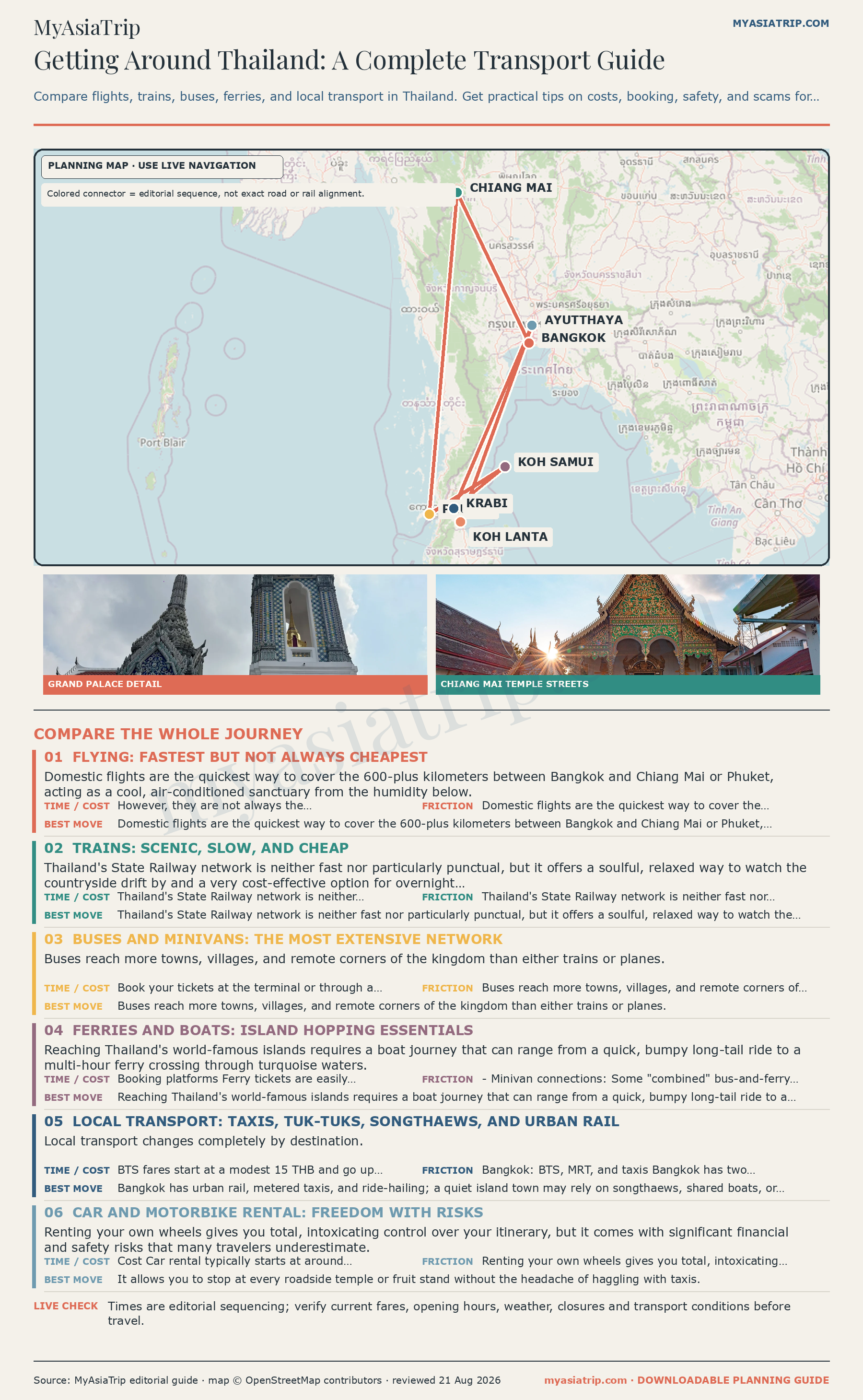
Match each transport leg to its distance, budget, schedule and risk. No single transport mode works for every leg of a Thailand journey. Flights, trains, buses, ferries, taxis and rentals each solve a different problem, but they also bring their own set of frictions—from the bone-chilling air-conditioning of a VIP bus to the slow, rhythmic clatter of a cross-country train. The comparisons below focus on cost, journey time, booking friction and the very real pitfalls you’ll encounter on the ground. Use the Southeast Asia transport hub when Thailand is one leg of a regional route. For an actual sequence of long-distance legs, compare the two-week Thailand itinerary, then pressure-test the fares and transfer days against the Thailand travel-cost guide.
Flights save time but can be expensive; trains are scenic and cheap but slow; buses reach the most places but vary in quality; ferries are essential for islands but weather-dependent; renting a vehicle offers flexibility at the cost of significant safety and legal risks. For short trips within cities, you choose between metered taxis, ride-hailing apps, songthaews, tuk-tuks, motorcycle taxis, and urban rail. The comparison below shows where each works and where it is likely to create extra waiting in the midday heat.
Flying: Fastest but Not Always Cheapest
Domestic flights are the quickest way to cover the 600-plus kilometers between Bangkok and Chiang Mai or Phuket, acting as a cool, air-conditioned sanctuary from the humidity below. However, they are not always the budget-friendly win they appear to be. The main factor is which Bangkok airport you use and which carrier you choose, as the hidden costs can quickly stack up.
Bangkok has two airports: Don Mueang, a bustling hub for budget airlines that feels a bit more like the “old” Thailand, and Suvarnabhumi, the gleaming, massive main international gateway. Most domestic flights on low-cost carriers depart from Don Mueang, so you must factor in the transfer time—often an hour or more in Bangkok’s notorious traffic—between your accommodation and the terminal. Suvarnabhumi also handles some domestic flights, but it is primarily used for international connections.
Low-cost carriers include AirAsia, Nok Air, Thai Lion Air, and VietJet Air. These airlines compete aggressively on price on popular routes such as Bangkok to Chiang Mai and Bangkok to Phuket, where promotional fares are common. But be warned: the base fare is just the beginning. Additional costs add up quickly: baggage fees for checked luggage, seat selection, and airport transfers. Always calculate the total price including a small carry-on bag—and remember that they are very strict about that 7kg limit—when comparing with bus or train fares.
Domestic flight tickets typically cost between 700 and 3,500 THB for a one-way journey. The high end of that range applies to destinations like Koh Samui, where Bangkok Airways holds a near-monopoly and keeps fares elevated for the privilege of landing on their private, boutique airstrip. Flights to other islands (e.g., Krabi, Surat Thani) are usually cheaper because multiple carriers compete for your seat.
When to fly Flying makes sense when you are short on time and value your sanity: a 1h15 flight is a world away from a 10.5h bus ride to Chiang Mai. It’s particularly vital for island destinations like Koh Samui where a combined ground-plus-ferry journey can easily eat a full, exhausting day of travel. For backpackers on a tight budget, the cost of flying plus airport transfers often exceeds a VIP bus or night train, so consider the trade-off between time and money. Booking two to four weeks ahead generally yields the best prices, though last-minute deals are rare on monopoly routes.
Baggage policies All low-cost carriers operate strict carry-on limits (usually 7 kg) and will not hesitate to charge you extra at the gate for checked bags. If you are traveling with a full backpack, factor in 200-500 THB per flight for luggage to avoid a stressful confrontation at check-in. Some airlines, like Nok Air, occasionally include a checked bag in the fare; read the fine print carefully before you hit ‘pay’.
Airport transfer From central Bangkok to Don Mueang, a taxi costs around 200-300 THB (metered) or you can take the A1/A2 bus from Mo Chit BTS station if you don’t mind the wait. To Suvarnabhumi, the Airport Rail Link from Phaya Thai BTS is the fastest public option, soaring above the gridlocked streets below.
Trains: Scenic, Slow, and Cheap
Thailand’s State Railway network is neither fast nor particularly punctual, but it offers a soulful, relaxed way to watch the countryside drift by and a very cost-effective option for overnight travel. The system operates on a four-line network—Northern, Northeastern, Eastern, and Southern—that connects the kingdom with a rhythmic, old-world charm.

Key terminal change In 2023, the massive Krung Thep Aphiwat Central Terminal (also known as Bang Sue Central) officially replaced the beloved but aging Hua Lamphong as the main terminus for long-distance trains. Most trains now depart from and arrive at this modern station, which is connected to the MRT Blue Line. Hua Lamphong still serves some commuter routes, but if you are booking a sleeper from Bangkok to Chiang Mai, Ayutthaya, or down to the southern islands, your departure point is almost certainly Krung Thep Aphiwat. The station is vast and well-signposted, but allow extra time to navigate the cavernous halls before your departure.
Classes and comfort
- 1st class: Private, air-conditioned sleeper compartments with two berths, curtains, a washbasin, and fresh bedding. It’s the closest thing to a hotel room on wheels and is very comfortable for overnight trips. Tickets sell out incredibly quickly—sometimes weeks ahead on popular routes. For travelers who value privacy and a decent night’s sleep, this is worth every extra baht.
- 2nd class: Available as either air-conditioned or fan-cooled carriages, with seats that the train stewards magically convert into sleepers at night. The lower berth is wider and slightly more expensive than the upper; choose it when the extra space justifies the fare. It’s an adequate way to travel, but do expect a bumpy ride and the constant hum of the tracks. Booking a lower berth in an air-conditioned carriage is the sweet spot for most budget travelers.
- 3rd class: Think hard wooden or padded bench seats, no air-con, and windows thrown wide open. This is only for the truly budget-minded or those taking very short, scenic hops between towns. Avoid this for overnight journeys; between the heat, the noise, and the cramped seating, a restful sleep is nearly impossible.
Booking tips Night train tickets should be booked at least 3 to 5 days in advance, and 1st-class sleepers can sell out weeks ahead, especially during peak season on the Bangkok to Chiang Mai route. You can purchase tickets online through the State Railway of Thailand’s official website or at the station counter. Some third-party sites like 12go.Asia also sell tickets and offer a more user-friendly interface, though they add a small commission. For day trains, especially on less popular routes, you can usually walk up and buy tickets at the station on the day you travel.
Scenic routes The Northern Line (Bangkok to Chiang Mai) is a highlight, passing through lush rice paddies, rolling hills, and sleepy rural villages—it’s a pleasant daytime ride if you have the patience to match the train’s pace. The Southern Line down to Surat Thani is the gateway for ferries to Koh Samui or Koh Phangan and is generally reliable. The Eastern Line to Aranyaprathet and the Northeastern Line to Nong Khai are also solid choices for overland adventures into Cambodia or Laos. The route from Bangkok to Kanchanaburi passes the historic Bridge on the River Kwai and remains a deeply popular day trip for its poignant history and river views.
Bottom line Trains are the cheapest long-distance option after third-class buses, and the sleeping compartments offer a genuine, shared cultural experience you won’t get at 30,000 feet. However, if you value time over the “experience,” remember that trains are seldom faster than buses and never faster than flights. They are best for travelers who enjoy the philosophy of slow travel and want to avoid the inherent stress of Thailand’s road traffic.
Buses and Minivans: The Most Extensive Network
Buses reach more towns, villages, and remote corners of the kingdom than either trains or planes. The network mixes government-supported routes with private operators, and quality and reliability vary substantially.
Government vs. Private The most reliable long-distance buses are run by Transport Co (BKS), the government-subsidized operator. Their buses are generally well-maintained, depart from properly managed terminals rather than tourist-heavy side streets, and follow published schedules. Private companies vary wildly: some are excellent (e.g., Sombat Tour, Nakhonchai Air), while others are notorious for aging vehicles, questionable safety records, and inconvenient commission stops at roadside restaurants.
Khao San Road warning Avoid private buses that operate directly from Khao San Road in Bangkok. There have been repeated, credible reports of baggage theft from the holds and unnecessary commission stops where drivers force passengers to spend money at overpriced shops. If you are in Bangkok, take the extra time to get a taxi or public transport to the correct, official bus terminal: Mo Chit (for northern routes), Ekkamai (for eastern routes), or Sai Tai Mai (for southern routes). Book your tickets at the terminal or through a trusted online platform—don’t just buy from a tout on the street.
Classes of service
- VIP bus: This is the most comfortable bus category in Thailand. You’ll get wide, reclining seats, air-conditioning (often set to ‘Arctic’ levels—bring a hoodie!), a toilet, and sometimes a snack and water. A VIP bus from Bangkok to Chiang Mai typically costs 600-800 THB. If you’re doing an overnight journey, this is the only way to go.
- 1st class (ordinary): These are air-conditioned but have less legroom and fewer frills. They’re a decent, budget-friendly option for daytime trips where you don’t need to sleep.
- 2nd class: No air-con, hard seats, and frequent stops to pick up passengers along the way. Only consider this for very short distances where you want to feel the breeze.
- Minivans: These small vans run on routes such as Bangkok to Hua Hin or Chiang Mai to Pai. They may be faster than large buses but can feel cramped, especially with luggage, and driving quality varies. Choose a larger coach or train when seat comfort, space and a calmer journey matter more than the shortest advertised time.
Booking platforms You can book bus tickets online through the official Transport Co website or via the sites of private operators like Nakhonchai Air. Some agencies in tourist areas also sell tickets, but be wary of inflated prices or “VIP” promises that don’t deliver. For minivans, the local ticket offices or the van terminal itself are the most straightforward places to buy. Booking a day ahead is usually enough, unless it’s a major Thai holiday.
Safety concerns Road safety is a real issue in Thailand, and bus accidents are far too common. Government BKS buses generally have a much better record than the private minibuses you’ll see weaving through traffic. Avoid traveling during major holiday periods like Songkran in April or New Year, when the roads are at their most dangerous. Always keep your valuables—passport, wallet, phone—with you in your daypack, never in the luggage hold. If you’re on an overnight bus, keep your wits about you and lock your main bag.
When to choose a bus Buses are your best bet when you need to reach a destination that isn’t on the rail line, or when you want the flexibility of arriving at a specific hour without the high cost of a last-minute flight. A good VIP bus can offer a surprisingly decent night’s sleep for the price of a cheap hostel bed. For daytime travel, the air-conditioned 1st-class buses are comfortable enough to lose yourself in a book while the Thai landscape rolls past the window.
Ferries and Boats: Island Hopping Essentials
Reaching Thailand’s world-famous islands requires a boat journey that can range from a quick, bumpy long-tail ride to a multi-hour ferry crossing through turquoise waters.

Booking platforms Ferry tickets are easily booked online via platforms like FerryHopper, or you can simply arrange them through your hostel reception or local travel agencies. Booking a day ahead is usually more than enough, except during the peak high season (December to March) or the frantic week of the Full Moon Party on Koh Phangan, when ferries can and do sell out weeks in advance.
Important notes
- Check the weather: This is non-negotiable. During the monsoon season (May to October on the Andaman coast, November to February on the Gulf coast), ferry services can be abruptly suspended or canceled. The waves can get rough, and speedboats are often the first to be grounded for safety reasons.
- Minivan connections: Some “combined” bus-and-ferry tickets sold in Bangkok include a long minibus leg; refer back to the minivan safety warning above. If you have the patience, booking your bus and ferry legs separately often allows you to avoid the more unreliable minibuses.
- Seasickness: If you don’t have sea legs, always opt for a large, stable ferry rather than a bouncing speedboat, and try to sit on the lower deck where the motion is less intense. Ginger tablets or acupressure wristbands are small investments that can save your entire day.
- Waterproofing: Keep your electronics and passport in a dry bag, as salt spray can easily find its way onto the open decks. On long-tail boats, try to sit toward the front to avoid the deafening noise and fumes of the exposed engine at the back.
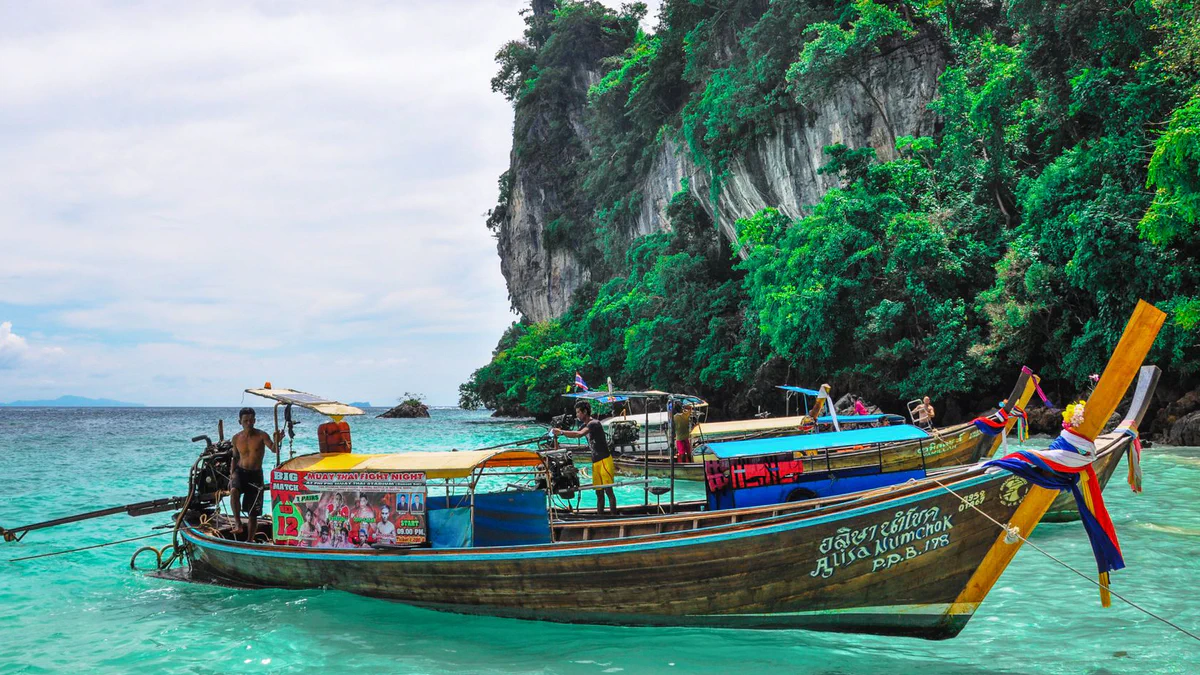
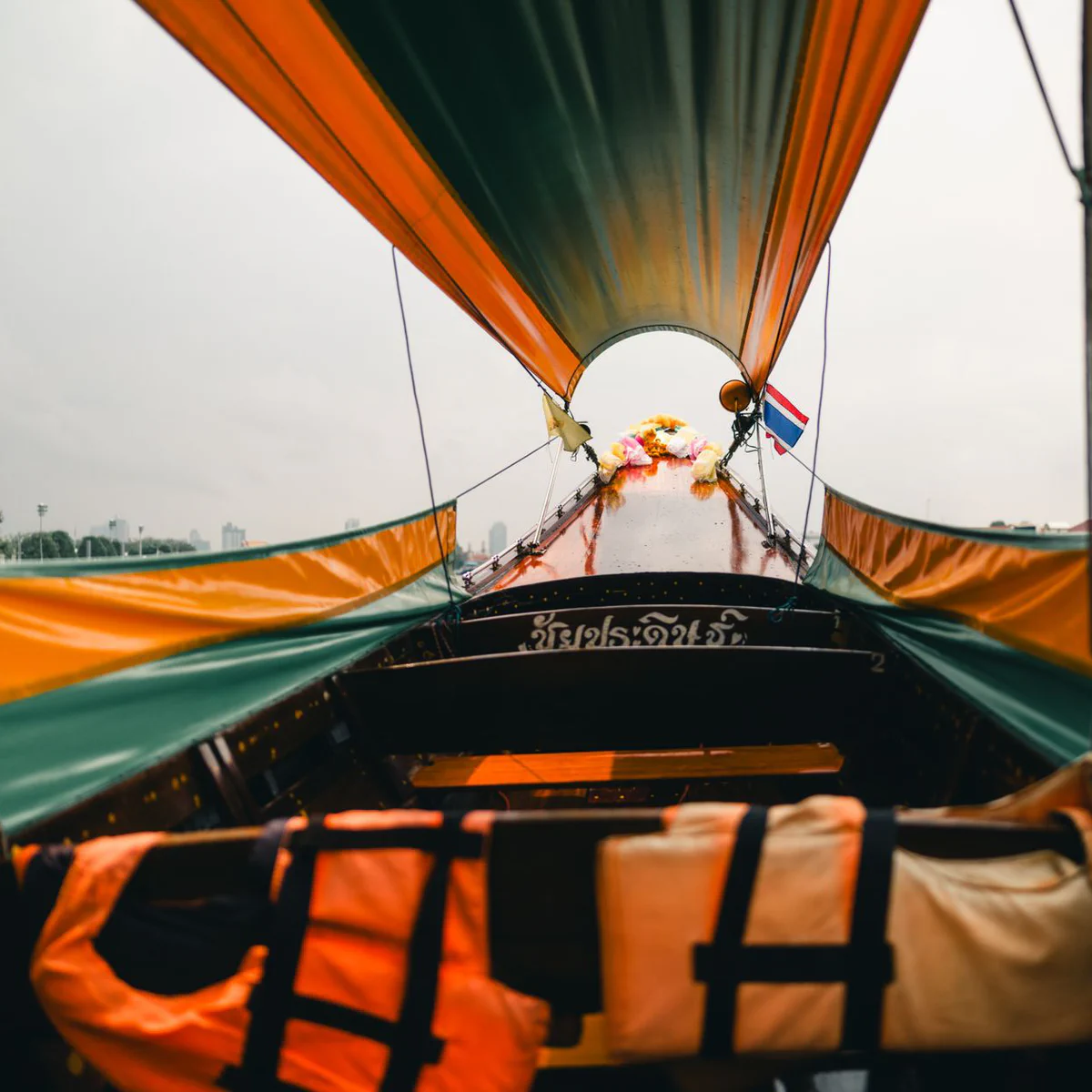
- Long-tail boats: These iconic wooden boats are used for short hops between beaches; always haggle and agree on the price before you step on board to avoid an awkward confrontation later.
When to book For most island travel during the dry season, booking a day or two in advance is perfectly fine. However, if your trip coincides with the Full Moon Party (Koh Phangan), you need to book at least a week ahead. Most operators now offer online check-in; make sure to save your e-ticket to your phone or have a printed copy ready for the pier.
Local Transport: Taxis, Tuk-Tuks, Songthaews, and Urban Rail
Local transport changes completely by destination. Bangkok has urban rail, metered taxis, and ride-hailing; a quiet island town may rely on songthaews, shared boats, or expensive private transfers.
Bangkok: BTS, MRT, and taxis Bangkok has two excellent urban rail systems: the BTS Skytrain (elevated) and the MRT subway (underground). Both operate from around 6am to midnight and are your best friends for avoiding the city’s legendary gridlock. BTS fares start at a modest 15 THB and go up to around 60 THB depending on how far you’re going. The MRT costs slightly more. For areas not served by rail—and there are many—you have three main choices:
- Taxi: Always, always insist the driver turns on the meter. If they refuse or try to offer a “fixed price,” just get out and find another—there are plenty. Metered trips within central Bangkok typically cost between 50 and 200 THB. Be aware that taxis can become frustratingly scarce during heavy rain or the afternoon shift changes (around 3-5pm). Taxis from the airport include a mandatory 50 THB surcharge plus any highway tolls you incur.
- Grab: This is the dominant ride-hailing app in Thailand (Uber no longer operates here). Grab offers fixed pricing, which is usually a bit higher than a metered taxi but saves you the stress of negotiation. You can choose between GrabTaxi (metered) or GrabCar (private car, fixed price). Using Grab is particularly useful late at night or when you’re in a neighborhood where taxis are playing hard to get.
- Tuk-tuk: These iconic three-wheeled open-air vehicles are a quintessential Thai experience, but they are rarely the most practical choice. Fares typically start at 200-300 THB after some firm negotiation for even a short ride within central Bangkok. Always agree on the price before you get in. Tuk-tuks are notorious for detour scams: if a driver offers a suspiciously low fare, he likely plans to take you to a gem shop or a tailor where he gets a kickback. Be firm, say no, and enjoy the wind in your hair for a short novelty ride.
Songthaews In Chiang Mai, the ubiquitous songthaews (red trucks with two benches in the back) operate on flexible routes within the old city for a flat 40 THB. They are a cheap, social, and very common way to get around. In other cities, songthaews may charge variable fares based on distance; always confirm the price with the driver before you hop in.
Ride-hailing alternatives In addition to Grab, local apps like InDrive or Bolt are gaining popularity in certain cities and can sometimes be cheaper, though Grab still has the most extensive coverage. On the islands, Grab availability can be spotty at best; here, motorbike taxis often fill the gap, offering a quick (if slightly harrowing) way to get from A to B.
Car and Motorbike Rental: Freedom with Risks
Renting your own wheels gives you total, intoxicating control over your itinerary, but it comes with significant financial and safety risks that many travelers underestimate.
Cost Car rental typically starts at around 700-800 THB per day for a reliable small hatchback like a Toyota Vios. Motorbike rental is cheaper, ranging from 150-400 THB per day—you’ll pay the lower end for a basic 110cc scooter and the higher end for a more powerful 150cc-200cc bike. Many local rental shops will ask for your passport as a deposit; do not leave an original passport as a rental deposit. It leaves you vulnerable. Instead, offer a cash deposit (usually 3,000-5,000 THB) and a photocopy of your passport.
Legal requirements In theory, you absolutely need an International Driving Permit (IDP) to legally drive or ride in Thailand. While enforcement can be lax for short-term visitors, here is the reality: if you are involved in an accident and you don’t have an IDP, your insurance (both travel and rental) will almost certainly be voided, leaving you with a massive bill. Police checkpoints in tourist hubs like Chiang Mai or Phuket often fine foreigners without a license on the spot (200-500 THB). For your own peace of mind and legal protection, get an IDP from your home country before you leave.
Safety Thailand consistently has one of the highest road fatality rates in the world, and motorbike accidents are the leading cause of serious injury among travelers. The risks are amplified by slick roads during the monsoon, poor lighting at night, and the steep, winding mountain passes (like the infamous road to Pai). Even if you are a skilled rider at home, you must be hyper-vigilant of the local driving culture and the left-hand traffic. Wearing a helmet isn’t just a legal requirement—it’s the one thing that could save your life.
Insurance Read your travel insurance policy very, very carefully. Many policies explicitly exclude coverage for motorbike accidents, especially if you lack a valid motorcycle license in your home country or if the bike is over a certain displacement (often 125cc). If you rent a car, double-check that the price includes basic third-party insurance; consider purchasing the additional collision damage waiver for the vehicle to avoid any nasty surprises upon return.
When renting makes sense
- Car: Renting a car is a practical option for exploring rural provinces with limited public transport, such as Kanchanaburi or the Isaan region. It allows you to stop at every roadside temple or fruit stand without the headache of haggling with taxis. For a family or a group of three or four, a car can actually be more economical than multiple bus tickets.
- Motorbike: A scooter is ideal for getting around islands like Koh Lanta, Koh Phangan, or Koh Samui, where the distances are short but taxi fares are predatory. However, do not ride with a heavy backpack or in flip-flops—Even a low-speed slide can cause painful road rash. If you aren’t confident, practice on a quiet, flat road before tackling traffic.
Pre-ride checklist
- Document everything: Take clear photos of the bike or car from all angles before you drive away, noting every scratch and dent to avoid being blamed for pre-existing damage.
- Safety first: Always wear a helmet and sturdy shoes—never ride in sandals.
- Avoid night riding: Thai roads can be unpredictable after dark, especially with poorly lit sections and roaming livestock.
- Stay legal: Carry your passport (or a clear copy) and your IDP at all times to show at checkpoints.
Sample Travel Times and Costs
To help you plan your budget and your sanity, here are the common long-distance routes with their approximate durations:
- Bangkok to Chiang Mai: A quick 1h15 flight, a long 10.5h bus ride, or a slow, scenic 13.5h train journey.
- Bangkok to Phuket: A 1h25 flight or a grueling 11.5h bus ride; there is no direct train connection.
- Bangkok to Koh Samui: A 1h15 flight or a combined bus-plus-ferry odyssey that takes 13-16 hours.
Costs vary by mode and season. Refer back to the specific sections above for typical fare ranges. Note that prices are per person for a one-way journey; while buses and trains generally include luggage, low-cost flights often only cover a 7kg carry-on. These durations are estimates and don’t account for the inevitable Thai traffic or tropical rain delays.
Practical Booking Tips and Scam Awareness
- Plan ahead for trains: Book your night sleepers early—at least 3 to 5 days ahead for 2nd-class and weeks ahead for 1st-class. The official State Railway website is your best bet.
- Use official bus terminals: Avoid the touts and unreliable buses on Khao San Road. Stick to Mo Chit, Ekkamai, and Sai Tai Mai for the safest and most reliable government BKS buses.
- Ferry wisdom: FerryHopper is a solid platform for booking, but you can also trust your hostel reception for a small fee. Be wary of agents promising “VIP” buses that turn out to be cramped minivans.
- Taxis and Tuk-tuks: Always use Grab for a fixed price or insist on the meter in a taxi. If a driver refuses to use the meter, simply walk away. For tuk-tuks, agree on a price first and stay firm if the driver tries to take you to a shop.
- Rent with care: Only rent motorbikes from shops with excellent reviews. Take photos before you leave and never ride without a helmet.
- Insurance is key: Before you hop on a bike or board a boat, ensure your travel insurance actually covers the mode of transport you’ve chosen. It’s better to be safe than sorry in the Land of Smiles.
Quick answers
Frequently asked questions
What is the cheapest way to get around Thailand?
Is it safe to take a tuk-tuk in Thailand?
Do I need to book train tickets in advance?
Which ride-hailing app works in Thailand?
Research notes
Official planning references
We use these primary references for the time-sensitive details relevant to this guide. Rules, prices and operating hours can change, so confirm the live information before you travel.
- State Railway of Thailand — D-Ticket
Details to check: Official long-distance train search, booking window and passenger-ticket process; checked 2026-08-28.
- State Railway of Thailand — Timetable Matrix
Details to check: Official current timetable reference with change warning; checked 2026-08-28.
- Airports of Thailand — Suvarnabhumi transport overview
Details to check: Official airport transport modes used as a Bangkok arrival example; checked 2026-08-28.
Guide reviewed 31 August 2026. Confirm live rules, prices and operating details with the linked authority before travel.