




Thailand Weather by Month: A Practical Guide for Travelers
Plan your trip with our month-by-month breakdown of Thailand's weather. Find the best time for beaches, trekking, and festivals across regions.


Use this month-by-month reference when your travel dates are fixed and you need to choose the right region for the expected conditions. If your schedule is still flexible and you’re trying to balance the perfect weather against your budget and the inevitable crowds, start with the best time to visit Thailand guide instead.
Monthly weather pattern at a glance
| Travel period | North and central Thailand | Andaman coast | Gulf coast | Planning implication |
|---|---|---|---|---|
| November to February | Cooler and generally drier | Strong beach window | Wet early, then improving | Best multi-region period, but book earlier |
| March to April | Very hot; northern haze can be significant | Mostly viable, with changeable late-April conditions | Generally strong beach window | Build in midday breaks and check air quality |
| May to August | Hot, humid and showery | Rougher and wetter | Usually the better coast | Keep ferries and sea days flexible |
| September to October | Broadly wet, then transitional | Starts improving late October | Wet season strengthens | Prefer refundable plans and current forecasts |
Overview of Thailand’s seasons
Thailand’s weather is often summarized as a relatively cool season, a hot season and a rainy season, but that framework fits upper Thailand better than the whole country. The Andaman and Gulf coasts have different monsoon peaks, and conditions vary within each region. Match your month to a specific destination and keep sea journeys flexible; there is no coast with guaranteed sunshine in every month.
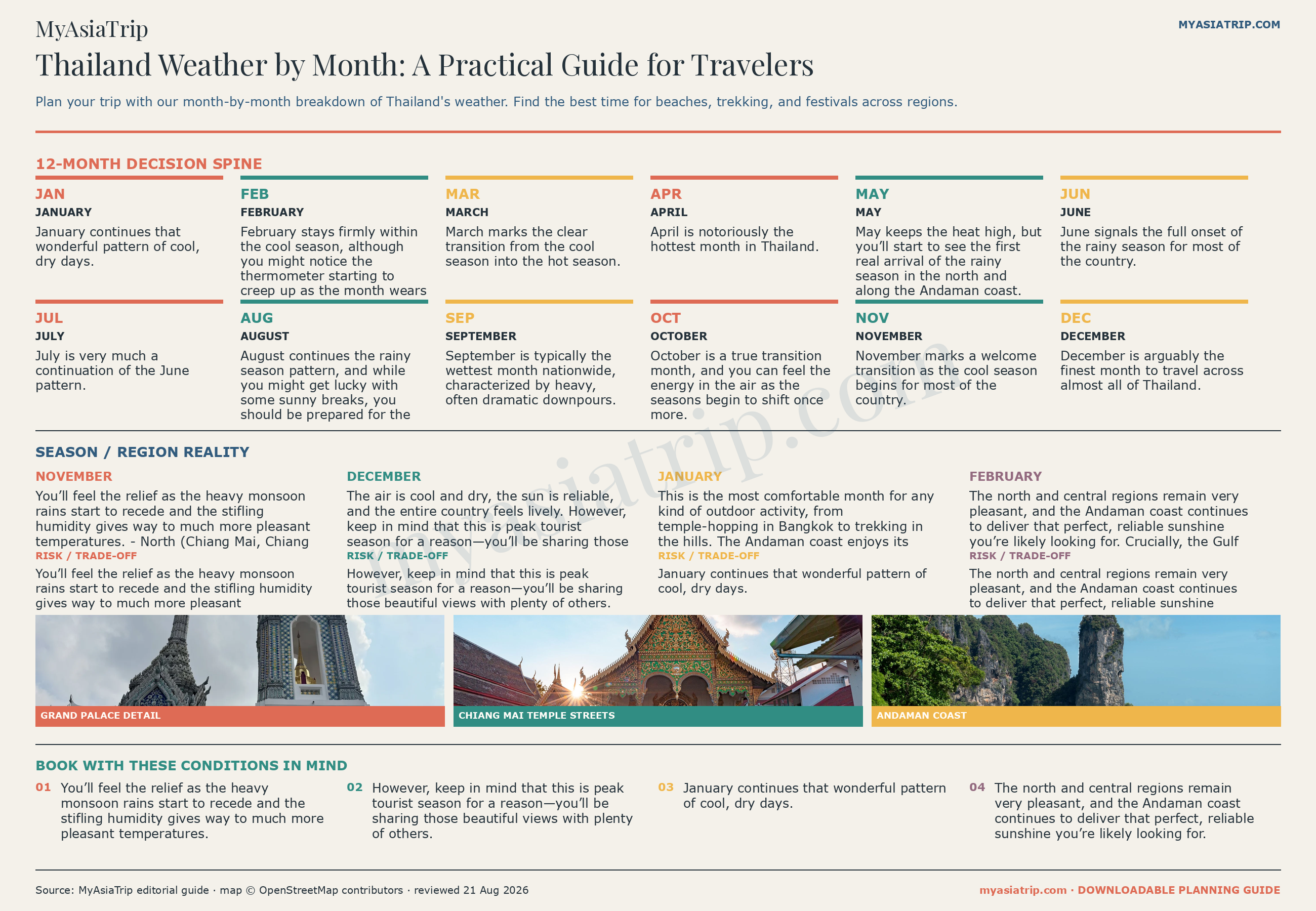
Month-by-month weather guide
November
November marks a welcome transition as the cool season begins for most of the country. You’ll feel the relief as the heavy monsoon rains start to recede and the stifling humidity gives way to much more pleasant temperatures.
- North (Chiang Mai, Chiang Rai): The rainy season ends. Skies clear, daytime highs become comfortable. Average lows in Chiang Mai during December and January drop to around 59°F (15°C); November is slightly warmer but still cool in the evenings.
- Central (Bangkok): Humidity drops. Average high in Bangkok hovers near 88°F (31°C) in December; November is a transition month with highs still warmer but trending downward. Rain becomes infrequent.
- Andaman Coast (Phuket, Krabi, Koh Lanta): This region is emerging from its wettest period (April-October). November sees declining rainfall, though early in the month can still be unsettled. By late November, conditions are often sunny and calm.
- Gulf Coast (Koh Samui, Koh Phangan, Koh Tao): The east coast has a different rhythm. The Gulf sees heaviest rain from September to December. November is typically wet, especially in the first half. If you’re heading to Koh Samui, be prepared for rain.
November is a brilliant time to explore northern and central Thailand as the landscape is still lush from the rains but the skies are clearing. Avoid the Gulf coast beaches in the early part of the month, but keep in mind that the Andaman coast starts to become a viable option toward the end of November.
December
December is one of the easiest months for northern, central and Andaman-coast travel, but the Gulf coast can still be unsettled. It is a popular travel period, and calm seas or clear skies are never guaranteed. Bangkok remains hot during the day even when nights feel more comfortable.
December is an ideal time for the north, central regions, and the Andaman coast. While the Gulf coast remains somewhat unpredictable, conditions improve significantly as the month progresses.
January
January is often comfortable for outdoor activity in upper Thailand and falls within the Andaman coast’s stronger beach window. Northern evenings can feel cool, especially at elevation, so carry a light layer. The Gulf may improve after its late-year rain peak, but check island-specific conditions.
January is a safe bet for just about any region. The Gulf coast might not be at its absolute peak, but you’ll still find plenty of good conditions for a holiday.
February
February remains relatively dry across much of upper Thailand, although heat begins to build later in the month. It is commonly a strong planning month for both coasts, but sunshine and sea conditions still vary from week to week. Northern air quality can also deteriorate as the dry season progresses, so check current readings.
February is a fantastic month for travel nationwide. It’s particularly good for the Gulf coast beaches if you want to beat the intense heat that arrives in March.
March
March marks the clear transition from the cool season into the hot season. You’ll definitely feel the temperatures climbing and the humidity starting to settle in. While rain is still rare in most places, the heat begins to dictate the pace of your day.
- North: Highs in Chiang Mai can reach around 97°F (36°C) in April; March is nearly as hot. The air becomes hazy.
- Central: Bangkok’s average high in April is 95°F (35°C); March approaches that. Expect hot, humid days with little rain.
- Andaman Coast: Still mostly dry, but the first signs of the approaching rainy season appear. Late March may see occasional showers.
- Gulf Coast: Often drier than its late-year period, with local variation among islands.
If you’re heading to the Gulf coast, March is a great choice. However, the north can become uncomfortably hot and hazy, and central areas like Bangkok are already starting to feel like a furnace.
April
April is notoriously the hottest month in Thailand. Temperatures can exceed 40°C (104°F) in several regions, creating a heat that can be genuinely exhausting. However, this is also the month of Songkran, the Thai New Year water festival—a nationwide celebration that offers a much-needed splash of relief. If you’re here in mid-April, you’ll be in the middle of the world’s largest water fight, which is an incredible cultural experience if you can handle the heat.
- North: Chiang Mai highs can reach 97°F (36°C) or more.
- Central: Bangkok’s hottest month. Songkran (mid-April) involves nationwide water fights, making it a unique cultural experience despite the heat.
- Andaman Coast: The rainy season begins. April typically sees increasing rain, especially later in the month. Some good days early on.
- Gulf Coast: Very hot but still dry. The Gulf remains a better bet than the Andaman coast in April.
Consider April only if you’re specifically here for the Songkran festivities or if you have a high tolerance for extreme heat. If you’re looking for a beach, the Gulf coast is still your best bet for avoiding the early rains.
May
May keeps the heat high, but you’ll start to see the first real arrival of the rainy season in the north and along the Andaman coast. It’s a month of change, where the dry heat begins to collide with the approaching monsoon.
- North: The dry season runs until May or June. Early May can still be dry, but by late May heavy rain arrives. Heat remains high.
- Central: Hot and humid. Rain becomes more frequent, often in short afternoon thunderstorms. Average rainfall in Bangkok begins to climb.
- Andaman Coast: Rain increases significantly. This is the start of the monsoon season for the west coast.
- Gulf Coast: Often a better beach choice than the Andaman coast in May, though showers and rough days remain possible.
The Gulf coast remains the smartest choice for beach lovers in May. Avoid the Andaman beaches now, and while trekking in the north is still feasible in early May, be prepared for things to get quite wet toward the end of the month.
June
June is within the southwest-monsoon period for much of Thailand. The Gulf islands can be a better beach bet than the Andaman coast, but they are not a rain-free exception.
- North: The heavy rain period runs June to October. Expect frequent downpours, often in the afternoon.
- Central: Rainy season. Bangkok sees regular showers; humidity is very high.
- Andaman Coast: Peak of the wet season. Rain is heavy and frequent.
- Gulf Coast: Often has a more favorable pattern than the Andaman side, with mixed sun and showers.
The practical choice is to head straight for the Gulf. Avoid the Andaman coast and the north for any kind of serious outdoor activities, as the frequent downpours can be quite disruptive.
July
July continues the broad June pattern. The Gulf coast may offer a better chance of workable beach days than the Andaman side, but it is not a reliable refuge from all rain.
- North: Heavy rain continues.
- Central: Wet and humid. Afternoon thunderstorms are common.
- Andaman Coast: Monsoon strength. Avoid unless you are prepared for persistent rain.
- Gulf Coast: Still within the dry window. Rainfall is low. Good conditions for beach and diving.
Stick to the Gulf islands. The rest of the country can be quite challenging for outdoor plans, with heavy humidity and frequent, unpredictable storms.
August
August continues the rainy season pattern, and while you might get lucky with some sunny breaks, you should be prepared for the wet.
- North: Still rainy.
- Central: High humidity with regular rain; Bangkok’s long-term normals rise toward a September peak.
- Andaman Coast: Monsoon continues. Some rain every day.
- Gulf Coast: Can remain a practical beach choice, although rainfall generally increases toward the later-year monsoon peak.
August remains an optimal time for the Gulf coast. However, keep in mind that as the month draws to a close, there’s an increasing risk of transitional showers as the Gulf’s own rainy season begins to approach.
September
September is very wet in many northern, central and Andaman locations, but calling one month the wettest nationwide hides major regional differences. The Gulf’s stronger rain often comes later. Use province-level forecasts and keep ferry, trekking and road plans flexible.
September is a difficult month for weather-dependent travel in most regions. If your dates are fixed, pack for frequent rain and keep indoor or flexible alternatives ready.
October
October is a true transition month, and you can feel the energy in the air as the seasons begin to shift once more. While the north and the Andaman coast start to dry out, the Gulf coast is unfortunately heading into its wettest period.
- North: Rain decreases toward the end of the month. Late October can have pleasant days. The cool season is just around the corner.
- Central: Rain continues but begins to ease. Still wet early in the month.
- Andaman Coast: The Andaman rainy season winds down. By late October, conditions improve.
- Gulf Coast: The wettest period (September-December) is in full swing. Heavy rain is likely.
Late October can be a wonderful time to visit the north and the Andaman coast as the rains begin to fade. However, avoid the Gulf coast, where the heaviest rain of the year is usually in full swing.
Regional weather patterns in detail
Northern Thailand (Chiang Mai, Chiang Rai, Pai)
- Dry season: November to May or June.
- Rainy season: June to October. The cool season from November to February is the best time for trekking and visiting hill tribes; the trails are dry and the air is fresh. Be warned that March through May can be uncomfortably hot for physical activity. In December and January, temperatures in the north can drop to around 59°F (15°C) at night, so a light jacket or sweater is essential for those early mornings and cool evenings.
Central Thailand (Bangkok, Ayutthaya, Kanchanaburi)
- Follows the three-season pattern closely.
- Bangkok’s average high temperatures range from 88°F (31°C) in December to 95°F (35°C) in April.
- Bangkok’s 1981–2010 normal rainfall peaks in September at about 334 mm; other central locations differ.
- The cool season is by far the most comfortable time for sightseeing in the capital, offering lower humidity and clear, blue skies that make those temple photos really pop.
West Coast / Andaman Sea (Phuket, Krabi, Koh Lanta, Phi Phi)
- Receives most rain between April and October.
- Best time to visit: November to April.
- The monsoon season can bring heavy rain and rough seas that disrupt ferries. November to April is usually the stronger Andaman window, not a guarantee of calm water or uninterrupted sunshine.
East Coast / Gulf of Thailand (Koh Samui, Koh Phangan, Koh Tao, Hua Hin)
- Sees heaviest rain from September to December.
- Often-drier planning window: roughly February to August, with meaningful local and year-to-year variation.
- This region follows a different pattern from the Andaman coast. It can be a useful alternative during the southwest monsoon, but showers, wind and rough seas remain possible.
When to go for specific activities
Beach holidays
- Andaman Coast: November to April is prime. December to March offers the most reliable sun and calm seas.
- Gulf Coast: February to August is often a useful planning window; verify the specific island and month. Avoid both coasts during their respective rainy peaks: the Andaman (May to October) and the Gulf (September to December). If your schedule allows for some flexibility, you can almost always find a decent beach by simply matching your travel month to the coast that’s currently in its dry season.
Trekking and hill-tribe visits
- Northern Thailand: the cool season (November to February) is the only truly ideal time for trekking. The trails are dry and the temperatures won’t leave you exhausted. March to May is simply too hot for comfort, and the rainy season from June to October can turn trails into a muddy challenge. Plan your trek between November and January for the best experience.
Festivals and cultural events
- Songkran (Thai New Year): Celebrated in mid-April, this is a nationwide water fight that brings a welcome reprieve from the most intense heat of the year. While it is sweltering, the festival’s unique energy makes it worthwhile for many. If you do participate, head to the Gulf coast afterward for the best beach weather.
- Loy Krathong: Held in November, this beautiful festival of lanterns and floating baskets usually coincides with some of the most pleasant weather of the year. It is an ideal time for travel, especially in Chiang Mai, where the Yi Peng lantern release is a truly dramatic sight.
Diving and snorkeling
- Andaman Sea (Similan, Surin islands): Best conditions from November to April. During the rainy season, visibility decreases and sea conditions can be rough.
- Gulf (Koh Tao, Koh Samui): Best visibility and conditions from February to September. The Gulf’s dry season aligns with the best diving months, though some rain is possible even then.
If you’re planning to dive, aligning your trip with the dry season for your chosen coast is the best way to ensure flat seas and the kind of clear water that makes the effort worthwhile.
Even within a broad dry season, visibility, wind and boat conditions can change quickly. Use a reputable local operator’s same-week assessment rather than treating a month label as a safety guarantee.
Packing and planning tips
Pack lightweight, breathable clothing for Thailand year-round—fabrics like cotton or linen are your best friends in this heat. If you’re visiting during the cool season, especially in the north, bring a light jacket or a cozy sweater for those evenings when the temperature can dip down to 59°F (15°C). During the rainy season, a compact raincoat or a sturdy umbrella is essential, although you’ll find that most downpours are intense but mercifully short.
November to February is the easiest period for a multi-region trip, with less rain and more manageable daytime conditions across much of the country. Because this is the most popular time, consider looking at shoulder months like March or late October—they can be a great way to avoid the biggest crowds while still finding excellent weather in specific regions, like the Gulf coast in early spring.
You should check a current local forecast shortly before you leave, as weather patterns can be surprisingly variable from one year to the next. The month-by-month breakdown is a planning baseline, but a current local forecast matters more for the days of the trip. Consider consulting the Thailand packing list for seasonal gear and the islands and beaches guide before you finalize your route.
Monthly rainfall totals are historical normals, not a precise forecast. Save the downloadable infographic above for a quick regional comparison, then use a current forecast for ferries, hikes and other weather-dependent plans.
For a city-specific reading, see Bangkok weather by month.
Sources and live checks
- Thai Meteorological Department climate charts
- Thai Meteorological Department monthly climate summaries
- Thai Meteorological Department seven-day forecast
- Thai Meteorological Department: Bangkok 30-year climate normals
Seasonal descriptions summarize long-term patterns across broad regions. They are not promises for a particular island, province or travel week.
Quick answers
Frequently asked questions
What is the best month to visit Thailand?
Does it rain every day in Thailand during the rainy season?
When is the hottest month in Thailand?
Research notes
Official planning references
We use these primary references for the time-sensitive details relevant to this guide. Rules, prices and operating hours can change, so confirm the live information before you travel.
- Tourism Authority of Thailand
Details to check: Official destination information and trip-planning context
- Thai Meteorological Department
Details to check: Official forecasts, warnings and seasonal weather information
Guide reviewed 24 August 2026. Confirm live rules, prices and operating details with the linked authority before travel.